My mother spent her teen years in Kona and was a paddler for the Kai ‘Ōpua Canoe Club, whose practices were held at Kamakahonu, the former home of Kamehameha I.
“This was long before they built the first Kamehameha hotel in 1960,” my mother said.
To reach the bay where her fellow paddlers gathered, my mother would have to walk through the old grounds of Kamehameha’s sacred home. She never had a problem until one day, before leaving the house, her mother handed her a canteen of kalua pig and a canteen of poi, and emphatically instructed her not to share any of her food, no matter who asked or what reason they gave. My mother thought the warning strange, but she obeyed and went on her way.
As she walked across the grounds, a chubby Hawaiian boy in blue shorts appeared beside her. He had wide, beautiful eyes, deep brown skin, and a thick head of hair.
“Make pōloli au,” he said. I’m starving.
My mother’s heart softened immediately. She sat down, opened her canteens, and let him eat. When he finished, he rubbed his belly, grinned, and shouted, “Mahalo!” before running toward the bay and disappearing into a small stand of hao trees.
Practice went as usual, and her walk home felt ordinary. But when she stepped through the kitchen door, her mother was waiting.
“Ua kaʻana like ʻoe i kāu mea ʻai?” she asked. Did you share your food?
My mother lied and said no. The punishment she received for that lie was swift and unforgettable, leaving no doubt about the seriousness of her disobedience. When it was over, her mother asked again, “Ua kaʻana like ʻoe i kāu mea ʻai?”
This time, my mother answered truthfully.
“That was not a boy you shared your food with,” my grandmother said. “That was a kepalō, a hungry spirit. Now that you fed it, you have to keep feeding it, because if you don’t, the next time you go back to that place with nothing to feed that spirit, it will feed on you. I know how soft-hearted you are, lucky thing I prayed that whatever happened to you, would happen to me instead.”
My grandmother rolled up the sleeves of her shirt, revealing little bruised human bite marks, what they call Nahu, from her shoulders down to her wrists. Later, my grandmother offered additional prayers and a ceremony to protect my mother. After that day, she had to walk the long way around to her canoe paddling practice. She was no longer allowed to take the shortcut through the grounds of the original Ahu‘ena heiau.
Long before hotel lights glimmered across Kailua Bay, the area of Kamakahonu was the royal compound of Kamehameha I, where he worshipped at Ahu‘ena heiau and where the most influential figures in Hawaiʻi gathered nightly.
Some historians believe the heiau site was used for human sacrifice as early as the 15th century, during the reign of Ali‘i ‘Aimoku ʻUmialiloa. When Kamehameha restored the temple in the early 1800s, Ahuʻena had become the spiritual heart of his kingdom, and Ahuʻena and Kamakahonu remained sacred until the king’s death in 1819.
Six months later, Kamehameha’s successor, Liholiho, sat down to eat with his mother, Queen Keōpūolani, and Queen Kaʻahumanu, shattering the ‘ai kapu, the rule of law that said women could not eat together with men. By nightfall, the religious system that had governed Hawaiian life for centuries had begun its irreversible collapse.
In the aftermath, Kamakahonu’s purpose shifted. Governor John Adams Kuakini, Kaʻahumanu’s brother, fortified the area, building walls and mounting cannons where the royal compound had stood. When the first missionaries arrived in 1820, Kuakini granted Asa and Lucy Thurston a five-acre parcel overlooking the bay that included the original foundation of Ahu‘ena heiau. They named the place Laniākea, meaning “immense heaven.” Ironically, part of the land that once served as the seat of Kamehameha’s kingdom later came under the ownership of the missionaries’ grandson, Lorrin P. Thurston, who played an active role in the overthrow of the Hawaiian Kingdom 73 years later.
By the early 1900s, Kamakahonu passed from spiritual significance into the hands of the commercial sector. H. Hackfield & Company purchased Kamakahonu, and after World War I, the firm evolved into American Factors and was later known as Amfac. The area became home to boathouses, lumberyards, and various businesses. The shoreline changed shape again and again, each shift pulling it further from its ancient identity.
Then, in the late 1950s, plans for the first King Kamehameha Hotel emerged. But Kona residents pushed back, as locals fought to protect Ahuʻena Heiau from destruction. Only when the state received assurances that the temple would be restored were the hotel plans approved, and the building that curved along the front of the bay opened for guests in 1960.
But promises blurred, and the finger-pointing began. Neither the state nor the hotel wanted to take responsibility for the restoration, and Ahuʻena remained untouched. It was not until 1965 that the hotel, along with some 30 Kona residents, many of whom were employed by the hotel, came together to rebuild the sacred structure themselves. They worked from written descriptions, oral accounts, and an 1816 sketch by Russian artist Louis Choris.
In 1973, when Amfac received permits to demolish and rebuild the King Kamehameha Hotel farther from the shoreline, the heiau again became a central bargaining point. This time, restoration was non-negotiable.
In 1975, with funding from Amfac, labor from Kona residents, and guidance from the Bishop Museum, an accurate, two-thirds scale replica of Ahuʻena Heiau rose from the stones. Renowned artist and historian Herb Kāne played a vital role, shaping the project with cultural knowledge and artistic insight. After nearly a year of building, the new Ahuʻena heiau stood overlooking the bay, once again creating a focal point for the mana of Kamakahonu.
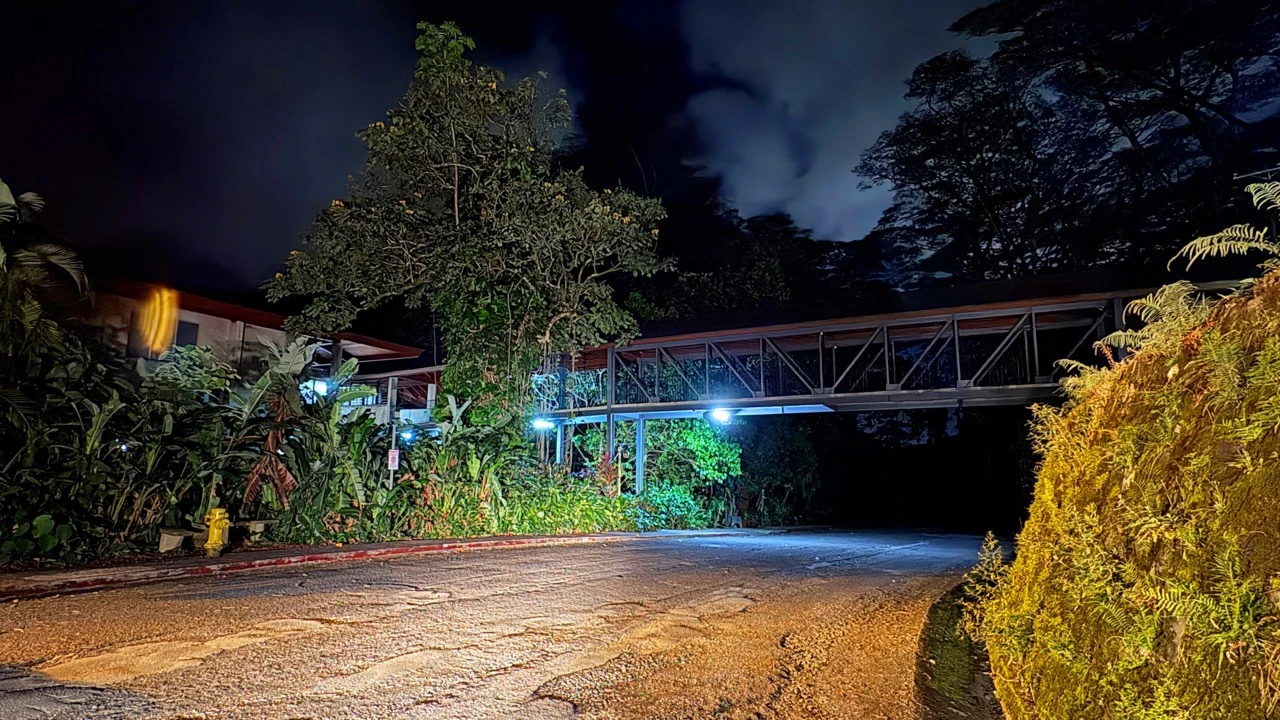
Yet even with the hotel rebuilt and the heiau faithfully restored, Kamakahonu has never entirely shed the weight of its past. Some guests who have stayed at the King Kamehameha Hotel have reported waking in the middle of the night to the steady rhythm of chanting. The sound is soft at first, then grows clearer, as if voices were gathering just beyond the walls. Others speak of marching footsteps passing through the hallway outside their door, though no one is ever there when they look.
Downstairs, Herb Kāne’s paintings of canoes at sea, warriors, priests, and scenes from a kingdom built on discipline and devotion, fill the first-floor gallery. More than a few visitors have claimed that the figures in those paintings do not always remain still. They swear they’ve seen a head turn away, the flicker of an eye, the shift of a shadow that wasn’t cast by any moving person. Some visitors even insist they’ve heard the faint murmur of voices coming from within the artwork itself, as though the painted ancestors were still discussing matters of importance.
Whether these moments are glimpses of old spirits, echoes of history, or simply the mind recognizing the lingering mana of the place, one thing is certain: Kamakahonu has never been ordinary ground. It has carried kings and priests, warriors and missionaries, hotel workers and visitors from around the world. It has held ceremonies, sacrifices, prayers, and whispered warnings.
And beneath the modern rooms and polished floors, the past continues its quiet march, reminding anyone who listens closely that this small stretch of Kona shoreline remembers every footstep that ever crossed it.
For the latest news of Hawai‘i, sign up here for our free Daily Edition newsletter!