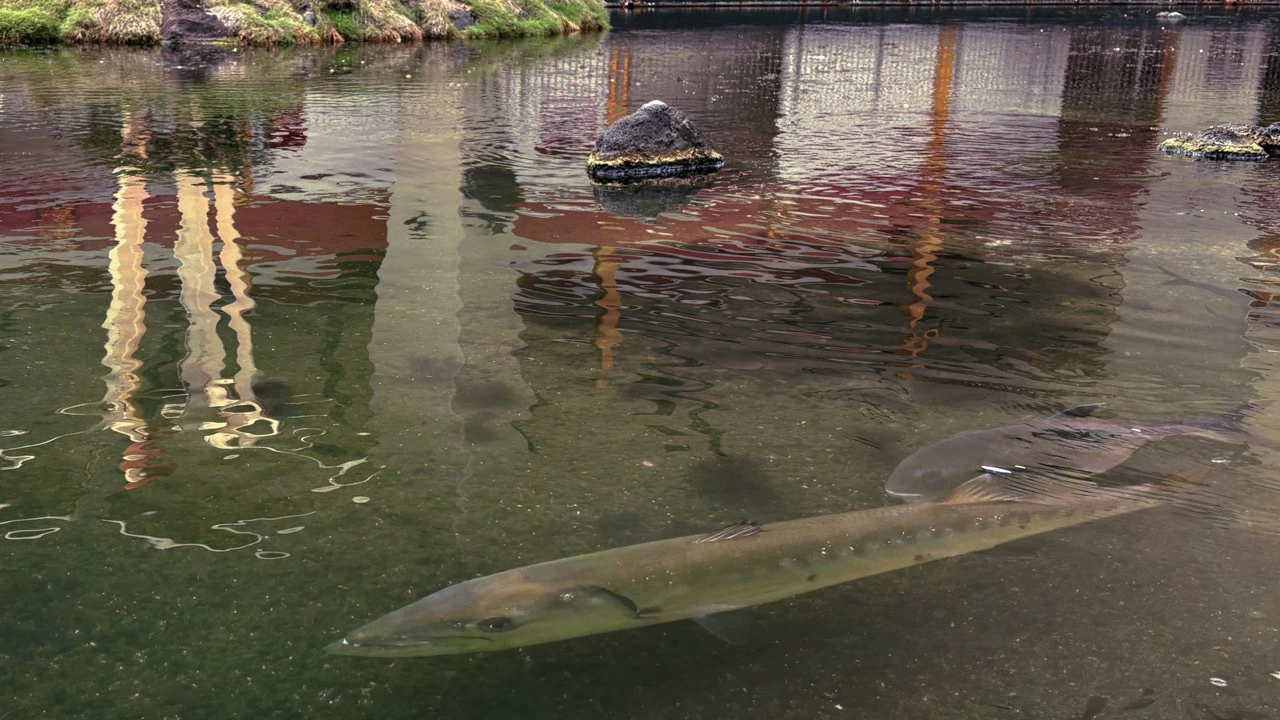
Centrally located between downtown Honolulu and Waikīkī, the Neal S. Blaisdell Center occupies an entire city block at Ward Avenue and King Street. Originally called the Honolulu International Center when it opened in 1964, it was renamed after Honolulu Mayor Neal S. Blaisdell, who oversaw its development as a multi-purpose entertainment and convention venue. Today, the center boasts a 50,000-square-foot arena, a concert hall, exhibition halls, meeting rooms, and landscaped outdoor spaces, including its famous brackish ponds that are home to a wide variety of fish. Concerts, sporting events, expositions, graduations, and community celebrations continue to attract residents and visitors to the entertainment center.
The land beneath the Blaisdell Center lies within the ‘Ili Lele (a subsection of an ahupua‘a) of Kewalo. In pre-contact times, this area was shaped by pūnāwai (freshwater springs), lepo pohō (marshy ground), loko ‘ia (fish ponds), and very little dry land. The waters of Kewalo sustained daily life, but they also carried a dark purpose.
The area was once known to contain a pond called Kawailumalumai, or Drowning Waters. Members of the kauwā, the outcasts who were often used as sacrifice, were drowned there as part of a ritual known as kānāwai kaihehe‘e or kekaihe‘ehe‘e, meaning “sea sliding along,” which suggests the victims were slid under the sea.
If there were any signs of struggle, the kahuna performing the sacrifice would say to his victim, “Moe malie i ke kai o kou haku.” Lie still in the waters of your superiors.
The lifeless body would then be brought to Kānela‘au Heiau on the slopes of Puowaina. Today, the remnants of this heiau lie beneath Robert Louis Stevenson Middle School, and Puowaina is now known as Punchbowl Crater. The school is definitely haunted, but that’s a story for another time.
Following the Māhele, the ‘Ili Lele of Kewalo passed from traditional stewardship into private ownership. In 1870, Curtis Perry Ward and his wife, Victoria Robinson Ward, purchased the property and transformed it into a large estate known as Old Plantation. Curtis Ward died in 1882, but Victoria and their seven daughters continued to maintain their home and the family businesses. After Victoria’s death, the estate remained in the care of the daughters, who lived on the property for decades, preserving both the house and its operations even as Honolulu expanded around them.
In 1958, the City and County of Honolulu purchased the mauka portion of the Old Plantation Estate as part of a plan to create a major civic and cultural venue. The old estate buildings were removed, the wetlands filled, and the property prepared for large-scale construction.
The Honolulu International Center opened in 1964, transforming the entire block. What had once been sacred waters, ritual ground, and later a secluded family estate became a place of public gathering and performance. Yet beneath the concrete and steel, the land retained its earlier identity and its long memory.
When I was half a decade out of high school, I attended Leeward Community College. I usually had lunch with a few people in my English class who worked part-time at the Blaisdell Arena, and they would talk about the exciting events from the weekend. They told me they often saw what appeared to be the spirits of the dead drifting beneath the surface of the fishpond. The figures looked like Hawaiian men of different ages and builds, but they could see right through the bodies, and the men didn’t seem to belong to this era. I took it as just a few fun stories, and didn’t think much more of it at the time.
Life moved on after college, and we all went our separate ways. Some years later, I found myself walking through the Blaisdell Center late one night. Although it had been a while since college, it was still years before I had discovered ghost tours and long before anyone would ever call me “the ghost guy.” The event I was attending at the Honolulu Museum of Art School had just let out, so I was cutting across the grounds from South King Street toward Kapiʻolani Boulevard, where my car was parked. It was after 10:00 p.m., and all was quiet.
I wasn’t on edge. I wasn’t tuned in. I wasn’t looking for anything strange. I was thinking about hitting a drive-thru and getting home.
As I approached the fishpond on the parking lot side, the water glowed with decorative lights placed around the edges. I slowed down to see the ulua and papio, ʻōmilu, a good size barracuda, and hundreds of tilapia moving through the water in circular patterns. At first glance, I thought the fish were clustering together because someone had tossed in food.
Then I saw what they were swimming around.
Just beneath the surface, drifting slowly, were bodies; face up, face down, turned on their sides. They were the same Hawaiian men I had heard described years earlier in college. Different ages. Different builds. All unmistakably dead. Their bodies were motionless, some naked, others wearing malo, and every one of them was transparent, suspended in the water like reflections that didn’t belong.
There was no swelling of fear or the urge to scream. I simply ran.
My keys were already in my hand. I reached my car, opened the door, started the engine, and pulled away as smoothly as if nothing had happened. Only once I was moving and the radio came on, did the sound escape me. The first scream was short and broken. The second was longer, pulled from somewhere deeper. The third came after I pulled over at the Golden Duck restaurant, stepped out of the car, and let my voice tear through the night.
It would be years before I set foot inside the Blaisdell again.
When I finally did, the place felt unchanged on the surface, but the memory of that night lingered just beneath it all. Back then, I had no words for what I had seen, no framework for understanding it. I hadn’t yet learned the old names of the land or the stories behind them. I didn’t know about Kewalo, or the spring called Kawailumalumai. Only later did the pieces begin to align.
The Blaisdell wasn’t simply a venue built on filled land; it stood over land that had witnessed ancient ritual, suffering, and the silence of sacrifice.
Looking back now, I understand that night was just a beginning. Long before I led ghost tours or told stories, the land had already introduced itself. It just waited patiently until I was ready to listen.
For the latest news of Hawai‘i, sign up here for our free Daily Edition newsletter!