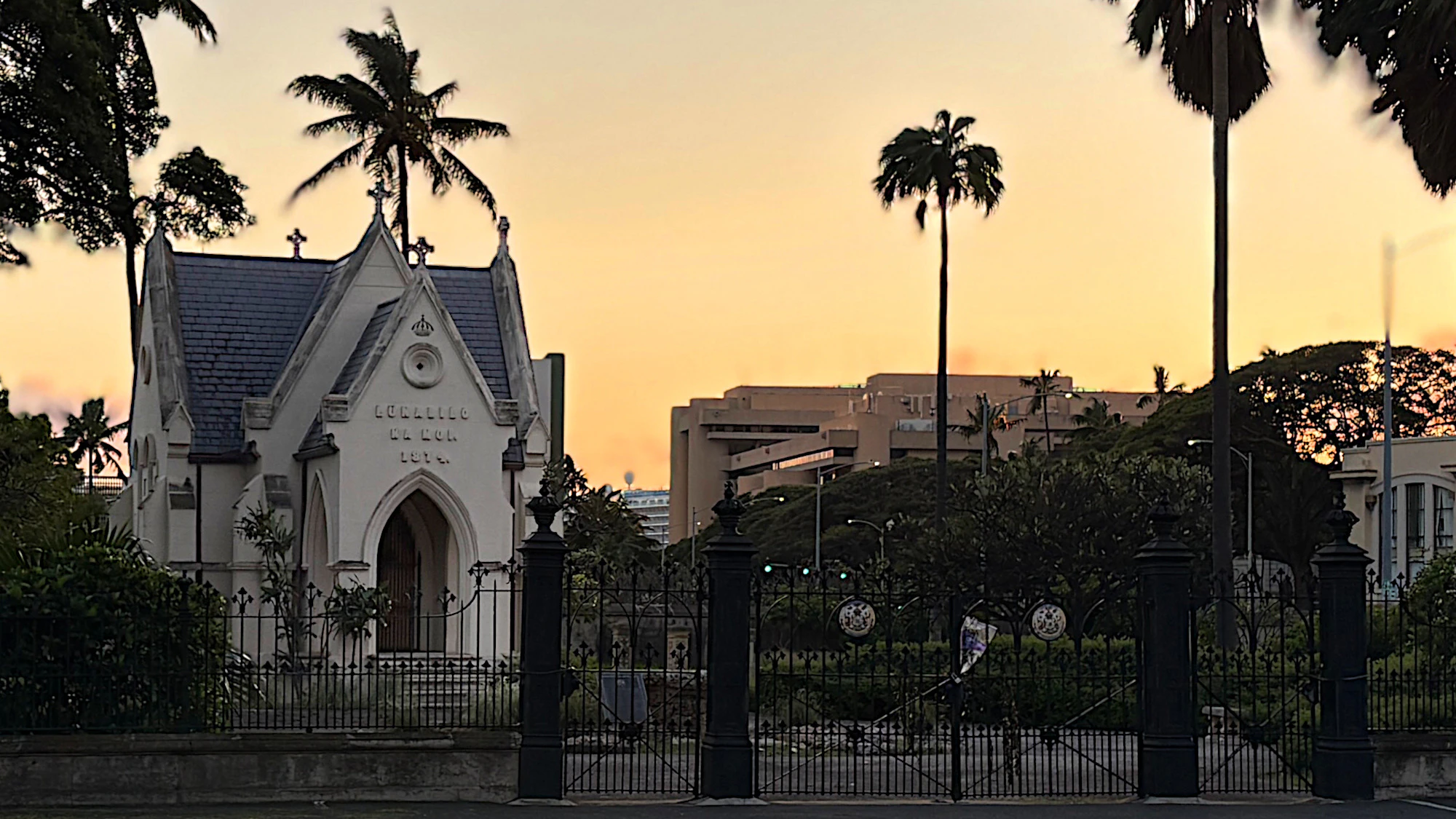
One of the most notable historical facts about this property is that the building on it was burned down on February 27, 1900. On purpose.
As the bubonic plague swept through Honolulu, the Board of Health sought to rid Hawai‘i of the pestilence by fire. On January 20, one “controlled burn” was fueled by strong winds coming down from Nu‘uanu Valley, causing the fire to rage out of control. It burned for 17 days, destroying lives and businesses, and reducing 38 acres of Honolulu’s Chinatown to little more than ash and rubble. Despite the losses in Chinatown, the plague continued to spread.
After the death of a third employee at the Hawaiian Hotel Stables on the corner of Richards and Hotel Streets, the Board of Health once again set fire to the establishment in hopes of eradicating the plague. The outbreak was considered “under control” by March 31.
The stables were rebuilt and remained in use for a few more years until automobiles made them obsolete. Later structures on the Richards, Hotel, and Alakea Street block included physicians’ offices, an art studio, a service station, and an auto dealership, until 1958, when the city opened a new off-street parking garage.
Finally, in 1990, a groundbreaking ceremony marked the start of construction on a new office and retail complex called Ali‘i Place. The 9-story and 23-story structures were approved with plans to house the offices of the Prosecuting Attorney, Police Commission, and other city agencies.
Day after day, the work conducted inside the walls of the Prosecuting Attorney’s office revolves around violence, fear, accountability, and loss. Even when handled professionally and at a distance, those emotions are brought into the office space daily through stories, evidence, testimony, photographs, recordings, and decisions that permanently alter lives.
This creates what many researchers and parapsychologists describe as residual emotional energy. Emotions tend to imprint on the environment, but strong emotions, especially trauma, tend to imprint more deeply than ordinary experiences. In a prosecutor’s office, the emotional residue of grief, moral conflict, anger, and frustration tends to collect in these enclosed spaces.
People who work in these offices may feel uneasy without knowing why. Tension and fatigue are common feelings when entering these spaces. As parapsychologist, Loyd Auerbach explains, this doesn’t require belief in the supernatural. Human beings are highly sensitive to environmental cues such as light, temperature, and sound, as well as to the more subtle effects of memory and residual emotion. When a space is repeatedly used for passionate, contentious, and sensitive work, the body can react before the mind catches up.
The result can be a workplace that feels heavy, draining, or tense even on quiet days.
A former clerk in the building described being shoved in an empty hallway on her way to her boss’s office. When someone suggested she had probably tripped, she emphatically denied it, stating that there was definite pressure against her back, between her shoulders, that pushed her forward and nearly caused her to fall.
“It was absolutely a shove,” she explained. “Maybe it wasn’t a ghost, but it was scary and weird.”
One former deputy prosecutor shared his experiences at Aliʻi Place with me. He said they often happened late at night and in the early morning, when most offices were dark, and the familiar daytime noise had drained away.
On several occasions, he found himself sleeping in his office, as late-night preparations often led to early-morning court appearances. He slept with his office door closed, the hallway outside silent. More than once, he was jolted awake by a loud, deliberate knock on the door. Not a tap or a sound that could be mistaken for settling walls or air pressure. It was a knock that carried intent. Each time, he got up and opened the door immediately, and each time the hallway was empty. There were no footsteps or voices retreating. Nothing to explain who, or what, had been there.
Another incident stayed with him just as clearly. He was alone in the men’s restroom, seated in a stall, when the lights abruptly shut off. The room went completely dark. This was not a motion sensor or timed switch. The lights in that restroom require a manual flip of the switch. The layout made it impossible to see the door or the switch from the stalls, and the walls blocked any direct line of sight. He listened closely. There was no sound of footsteps or of the door opening or closing. No indication that anyone else had entered the room. He sat there in the darkness, aware of how suddenly the space had changed, how absolute the silence felt. When he finally stood and checked, the restroom was empty.
He never claimed these moments were proof of anything supernatural, and he acknowledged that there could be explanations he simply didn’t have. But he does accept that they did happen.
At a place where every decision might hold a person’s life in your hands, he believes that kind of work leaves a mark. And in the quiet hours, when the building is no longer bustling with activity, it sometimes feels as if that accumulated weight finds small ways to make itself known.
For the latest news of Hawai‘i, sign up here for our free Daily Edition newsletter!