Pier 38 Fish Market’s sashimi platters, poke kits and ʻahi fillets are popular during the holidays, but did you know you can get them all year long?
Aloha State Daily was recently invited for a tour of Fresh Island Fish and Pier 38 Fish Market, where we got an inside look at the business’s “boat to table” process.
Our tour began with a walk-through of the Fresh Island Fish, which included its storage and processing rooms. The tour was led by Fresh Island Fish CEO Neil Hirasuna, Ahi & Vegetable restaurant manager/lead Paul Santos and Fresh Island Fish director of operations Marcus Marrotte.
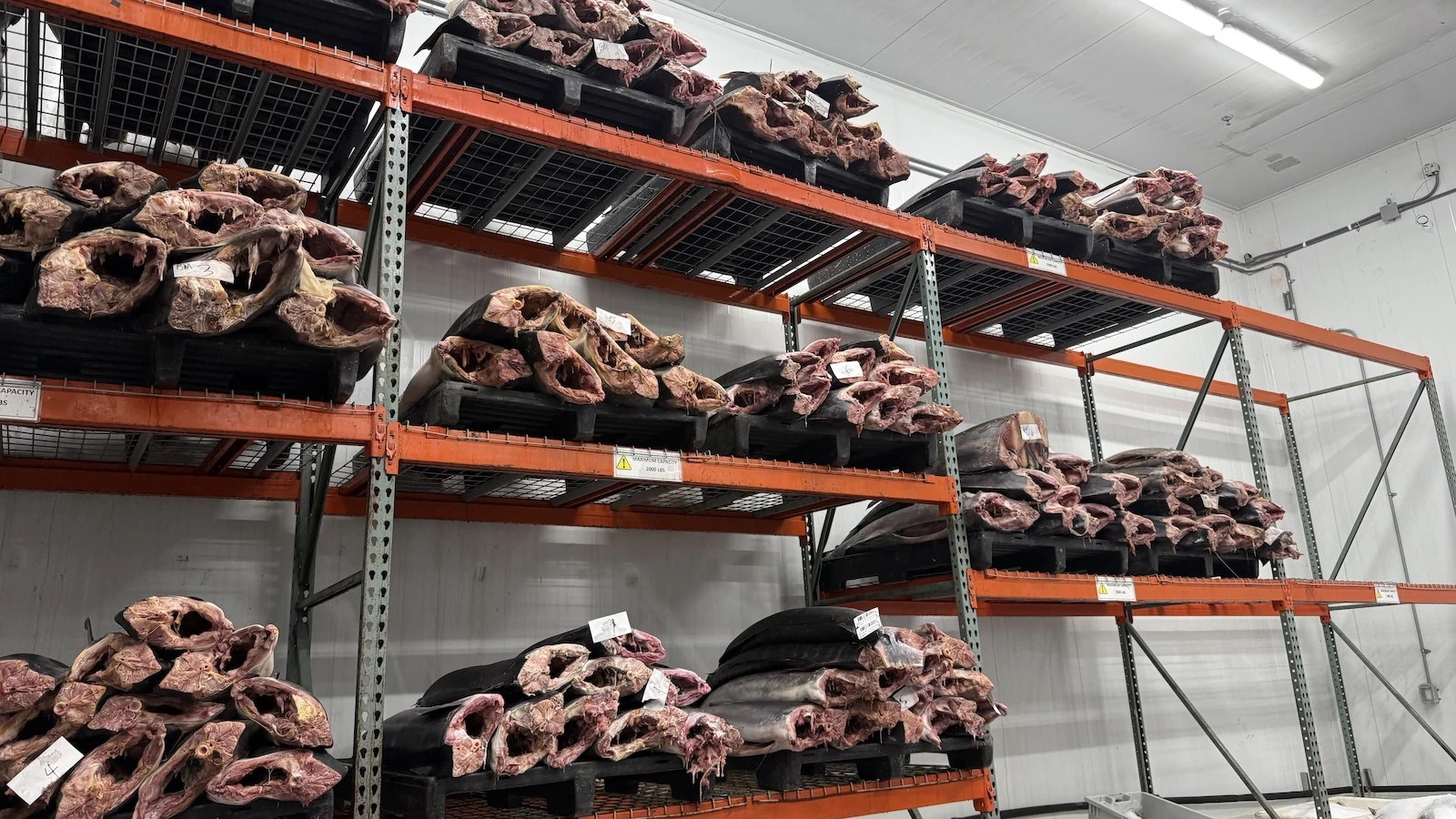
Neil Hirasuna (NH): Envision a bunch of pallets on the ground. Pallets get offloaded directly from the vessels; they get passed to the scale, graded and weights get assigned. This is the first room, where everything is stored temporarily until it needs to get cut and processed.
We like to organize things by species. What you have on the racks is primarily blue marlin and striped marlin.
What makes us a little bit different is that most of the source of our fish comes directly from our vessels. We own and operate 27 commercial long line vessels. We take a lot of pride in being able to directly offload our own vessels. A lot of the challenge that is presented by that is you don’t get to pick and choose the grade (of fish); you have to take it all. You don’t get to pick and choose the species you get; you have to take it all.
What that forces us to do is find alternative markets for a lot of these fish, so nothing goes to waste. For example, we sell a lot of marlin to a fish jerky maker in Kona.
Aloha State Daily (ASD): What are some of the restaurants that buy your fish?
NH: Kona Brewing in Hawaiʻi Kai is a huge supporter of us; Maui Brewing in Waikīkī, as well. A lot of our main support comes from the Neighbor Islands as well — Dukes, Hula Grill, the TS Restaurant Group, the Merriman’s group, they’re big supporters of Fresh Island Fish.


ASD: How long has Pier 38 Fish Market been open?
NH: The market has been open for about 3 1/2 years. The market originated from back in the Covid-19 pandemic. About 70 to 80% of all the fish caught in our longline fishery here is consumed locally — in food service restaurants and retail. A vast majority of the market died off once dine-in died off (in March 2020).
What we did the very next week after the dine-in shut down was announced — we saw our sales and the value of fish plummeting — is we started a drive thru-sale in the parking lot. It expanded from a drive-thru sale that we held in the parking lot into a full-on online ordering process through Shopify.
Right around Mother’s Day of 2020 or 2021, we had our largest sale. Our experience showed us that there was a much larger market for consumers, and maybe our business model should be expanded.

NH: This is the cutting room. Within this room, we cut anywhere from 20,000 to 25,000 pounds of fish a day. We separate it by species, for food safety and cleanliness purposes, and to make sure things are more organized.
We like to say we got the freshest fish because it comes directly from our cutting room — directly from our vessels — onto the shelves. We have all the packaging materials; everything gets packed here, it doesn’t go off site. Everything is directly loaded from the processing facility and cutting room directly to the shelves.

ASD: Tell us more about the grades of ‘ahi.
NH: We have many grades of ‘ahi, like 1, 1+; 2, 2+; and 3. Typically, a lot of restaurants use 2+ for sashimi. Two minus is what we call a poke grade; the reason why we call it a poke grade is because that’s what the majority of people use it for. It’s much more pink and pale. Two is for sashimi, for people a little more value-oriented and a little less picky about the fish they serve.
Our number one-grade ‘ahi is more red and vibrant. This goes to the highest-end sushi bars; it’s used for sashimi.

NH: Once it passes through here (being packed and wrapped), it goes out for distribution. Another thing that makes us unique is that we use oxygen-permeable bags. It’s mostly a food safety thing, but it extends the shelf life (of the fish), which is pretty key for our customers.

Paul Santos (PS): (For sashimi cutting) We section of the backside of the fish to separate the higher-grade of fish we use for nigiri and sashimi. I’m going to section this off into three even blocks; I’m cutting with the grain.
The technique for cutting sashimi is going against the grain.
ASD: Poke can feature several different grades of ‘ahi, right?
PS: Yes, you can use the scraps of ‘ahi that you’re not going to use for nigiri. That way, you utilize the entire fish.

ASD: Tell us more about the poke kits that are available at the market.
Kira Kaneshiro (Fresh Island Fish director of internal audit): Our poke kits are, hands down, the most popular (item). That’s been our staple from day one. The nice thing about the poke kits is that because you mix it yourself, it stays a little bit fresher. If you come in on a Saturday morning and you’re not going to have it until Saturday night, then you can mix it right before you’re going to serve it.

PS: You can custom-make your poke kits to your liking. You can always come (to the market) and add whatever you want — a little bit of limu, a little bit of inamona, fresh Alaea salt. Inamona is very popular; it’s that earthiness you see in most poke.
CONTACT
Fresh Island Fish
1135 N Nimitz Hwy., Honolulu
freshislandfish.com and shop.pier38fishmarket.com
Instagram: @pier38fishmarket
For the latest news of Hawai‘i, sign up here for our free Daily Edition newsletter.
Kelli Shiroma Braiotta can be reached at kelli@alohastatedaily.com.