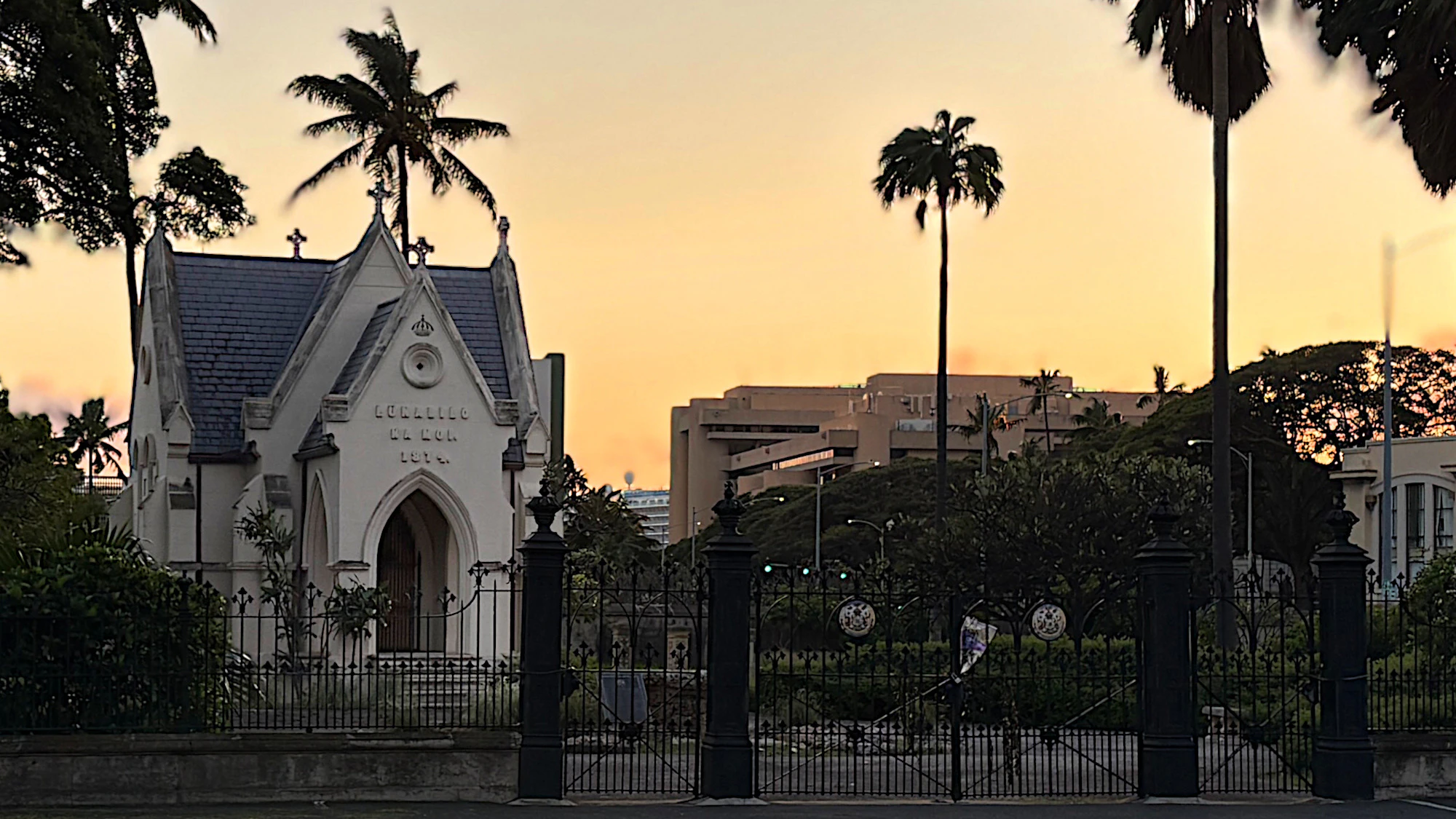
Waikīkī in the old days was a broad wetland. Loko i‘a and lo‘i kalo, fishponds and kalo fields, were fed by numerous streams that came down from the valleys of Pālolo, Mānoa, and Makiki. It was the center of political power for hundreds of years before Western contact.
As foreign populations grew, agriculture changed, and rice replaced kalo as a major food crop. Houses and roads were built where once only ali‘i were allowed to enter. Then, in 1877, crown lands were set aside to create Kapi‘olani Park, King Kalākaua’s gift of greenery to the Hawaiian people. Kapahulu, a small ‘ili (land division) at the edge of Waikīkī, became the doorway to the park.
Decades passed, scenery changed, and Waikīkī soon became an international destination. The Ala Wai Canal drained the wetlands, and hotels crept closer to the shoreline. The neighborhood of Kapahulu grew, too. What was once a quiet road lined with small shops and homes became a lively avenue with cafes, drive-ins, and walk-up apartment buildings.
In 1969, a modern tower arose along the avenue facing Diamond Head. The Queen Kapi‘olani Hotel was named after King David Kalākaua’s gracious wife, one of the most beloved ali‘i of Hawaii’s monarchy era. Its stylized palm tree columns and decorative facade featuring ‘ulu leaves made it stand out from most other hotels in Waikīkī. It was quickly embraced by the community and became a place where weddings, graduations, and birthdays were celebrated.
Yet beneath the polished concrete and bright lights lies something darker. Some say that after the parties are over and the guests have gone or retired for the night, something else stirs gently awake.
A few years ago, my friend worked in marketing at the Queen Kapi‘olani Hotel. He called me one morning, excitedly explaining that guests and housekeepers were reporting spiritual activity on the mezzanine floor.
“I’ll explain everything when you get here,” he said, not even asking if I had anything else on my schedule.
By the tone of his voice, it sounded as if time was of the essence, and I happened to be nearby anyway. Less than 30 minutes later, he met me in the lobby with his foot in a cast and his balance supported by crutches. His foot was crushed when a heavy table fell on it, but it was a simple misjudgment of weight, nothing ghostly, he assured me.
As we stepped out of the elevator onto the mezzanine floor, we were greeted by the contents of every room sitting out in the hallway. My friend then began to explain that the mezzanine, in its present condition, was flooded with disembodied voices traveling up and down the hallway.
“Not whispers or unintelligible voices,” my friend began, “But full conversations.”
The moment he said that, we heard a shower turn on down the hall. Then we heard a male and female voice having a conversation over the running water. They spoke about credit cards, renting a car, and where to have dinner later in the evening. We heard more mundane parts of the conversation, regarding what clothes were appropriate to wear, and then the jangling of keys. We heard the door to the room open and shut. Then the conversation came down the hallway toward us, went past us, and faded once we heard the elevator door open. We heard the conversation. But we didn’t see anyone pass us.
The scenario I just described was impossible. We checked for ourselves, only to find that the room at the end of the hall was empty, just as all the other rooms were. What’s more, every piece of furniture and decoration from every room was out in the hallway. Mattresses, chairs, sofas, tables, pictures in frames, and more were piled in the hall as the rooms were scheduled for renovations. We stood there for a minute wondering what had just happened, when another pair of disembodied voices drifted past us. This time, I turned on my heel, determined to find its source.
My friend called out to me, “Please don’t leave me here with my broken foot!”
Of course, I couldn’t leave him there alone. So, I stopped and waited for him to catch up. He then took me to the kitchen, where a pair of cooks shared their stories.
Every morning, the two men arrived at 3:00 a.m. to prepare breakfast. They said that more often than not, a little Hawaiian boy wearing a white shirt with a wide collar under a Victorian-style waiscoat with knee-high shorts would appear in the kitchen. Whenever they asked the boy his name or why he was there, he’d disappear right in front of them. Although it was strange, he seemed harmless.
But the boy wasn’t the only apparition to show up in the hotel’s kitchen. Now and again, the staff would encounter a large Hawaiian man wearing an all-black mahiole and ahu‘ula (a Hawaiian helmet and long cape covered in black feathers).
“He’s a very threatening presence,” one cook said, “But we have a deadline to get breakfast ready, so we do our best to work around these spirits and try not to let them distract us.”
For the latest news of Hawai‘i, sign up here for our free Daily Edition newsletter!