Like most properties in Honolulu, this plot of land has seen many uses over the past 200 years. In the days of Kamehameha I, when John Papa ‘I‘i was at court, the parcel of land at the ‘Ewa-Mauka corner of Merchant and Bethel Streets contained the hale (houses) of lesser ali‘i.
These low-ranking chiefs often managed local lands, collected food and goods as tribute for the ali‘i nui, served as warriors, maintained community order, and acted as intermediaries between the maka‘āinana (commoners) and the ruling class. But Kamehameha and most of his court only stayed a few years, moving to Hawai‘i Island in 1812.
In 1854, the Privy Council received a petition requesting a lot on which to build a Sailor’s Home. Meant to provide safe, inexpensive lodging and support for merchant seamen, these homes were a purposeful alternative to waterfront taverns. The petition was granted under strict conditions: no intoxicating liquors, no gambling, no disorder, and no women of "lewd" character allowed. The Sailor’s Home welcomed countless seamen until it was damaged in the fires of 1886, after which it relocated to a large, grassy lot between Richards and Alakea Streets.
Originally founded in Japan in 1880, the Yokohama Specie Bank opened its Honolulu branch in 1892 to serve Japanese merchants and plantation workers. The bank first operated from offices inside the Japanese consulate, and quickly became a trusted financial anchor for a growing community.
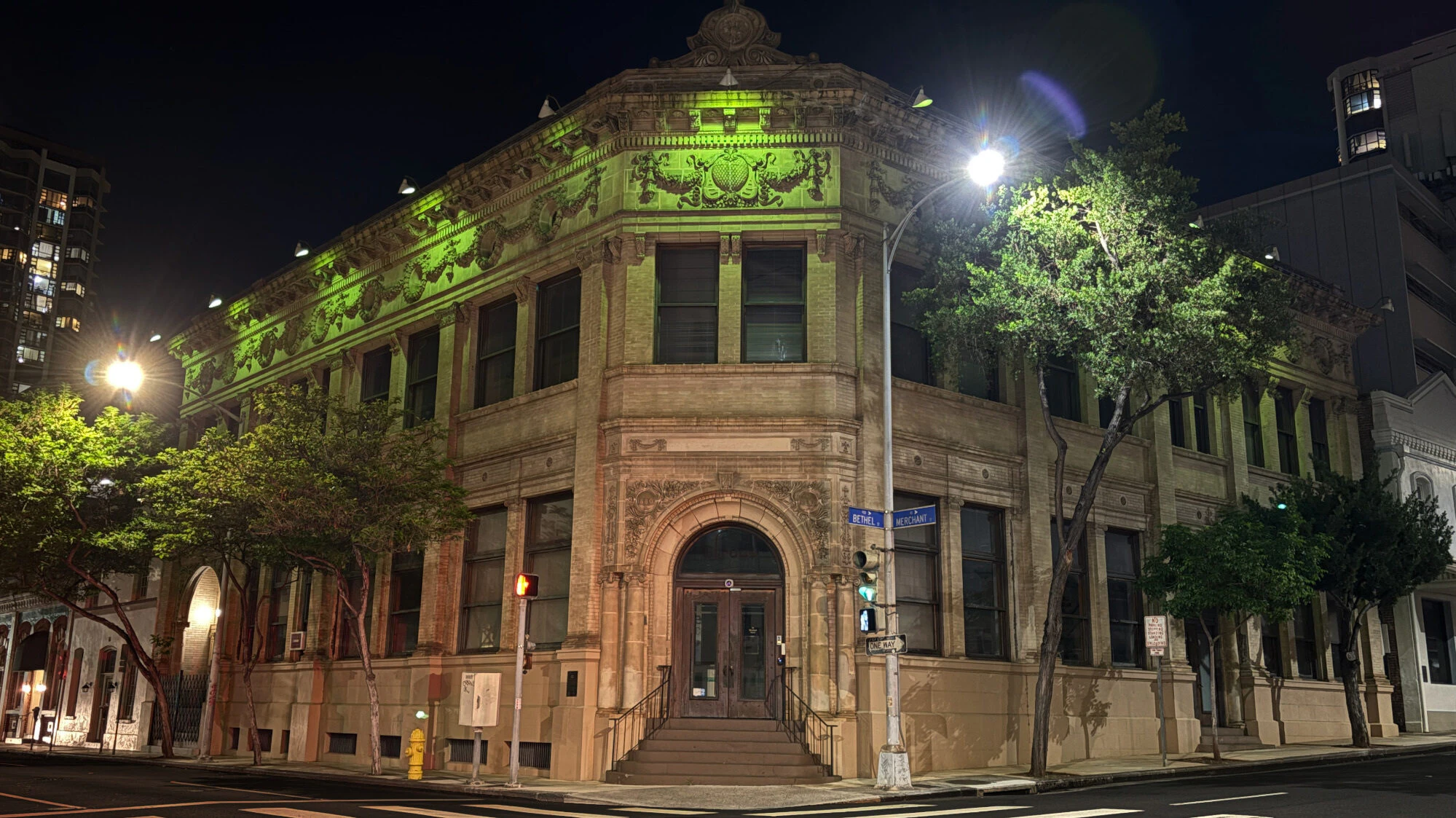
In 1908, in response to Honolulu’s growth, construction began on a permanent bank on the corner of Merchant and Bethel Streets where the Sailor’s Home once stood. The yellow brick building was completed in 1910 with elaborate terracotta ornamentation over its arched entrances and oculi, the circular openings at the top of the building. It was proclaimed completely fireproof when it opened because the brick-and-steel building had no exposed wood. It had copper-clad doors and sashes, and the window casings were copper-clad wood and marble.
While Chinese and Hawaiians held accounts there, most of its depositors were Japanese. The building served as the bank’s Hawaiʻi headquarters for more than three decades, giving the community a sense of permanence. But that all ended on December 7, 1941.
On the day of the attack on Pearl Harbor, Territorial Governor Joseph Poindexter ordered the immediate closure of three Japanese banks in Hawai‘i. The Yokohama Specie Bank was seized and repurposed. During the war years, it functioned as a military police station, allowing MPs to coordinate with the Honolulu Police Department then headquartered across the street. Offices that once held ledgers and account books were used to store confiscated goods, while the basement was renovated to include toilets, showers, and barred cells to serve as a lockup for drunk soldiers.
In 1954, the U.S. Department of Justice, acting through its Alien Property Custodian, sold the building. It was then leased to the City of Honolulu for use as the Traffic Citation Bureau. Since that time, the building has seen many different occupants. Newspaper advertisements show an investment firm housed there in the 1960s, and the building was home to the Honolulu Magazine offices from 1982 to 2001.
In 2004, the historic building became home to The Cole Academy, a daycare and preschool founded by news editor Gina Mangieri and named for her son. Here begins our account of its ghost stories.
When the school was still operating in the old building, a friend of ours who worked at the academy spent long days teaching there. She shared her tales of strange happenings at the former bank with us.
In the basement, she often went down to do laundry. To keep the heavy door from closing, the staff often propped it open with a paint can. More than once, as our friend turned her back to sort clothes, she heard the scrape of metal on concrete. The door would swing closed on its own as if someone had deliberately moved the paint can. There was no wind in the basement, and no explanation she could ever find.
In the infant room, the babies sometimes behaved in ways that unsettled the caregivers. The infants would laugh and smile, reaching upward with open hands as their eyes stared at something above them. Nothing was there that the adults could see, yet the children’s attention moved as though they were following a presence floating above them.
There was a former teacher who had taken her own life one night on a lonely beach. Once in a while, when all was quiet, staff would catch a brief glimpse of her. Someone would notice the sway of long dreadlocks disappearing around a corner, or experience the sense of someone just out of sight in certain hallways. Though they never fully saw her, they believed it was their lost coworker.
Upstairs, older students spoke freely about someone they called “Uncle.” They talked about him as if he were familiar and kind.
“Uncle’s happy you’re here,” they would say, “He’s protecting us.”
Although the teachers never saw anyone, the children spoke as if “Uncle” were an actual person. They didn’t seem to be afraid of him, and they never questioned his presence.
Additionally, cameras often revealed orbs drifting through rooms when no one was there. The teachers from the infant room saw them too, small points of light seeming to move with intention around the children.
A few years ago, I was asked to come and bless the building. My friend and her coworker showed me around and pointed out the staircase leading to the basement. I looked down and watched in confusion as a red rubber ball bounced up the stairs. Up, up, up it traveled until it reached the floor in front of me. Then it rolled past slowly down the hall. Needless to say, something wanted my attention.
The building never felt violent. Just occupied. It almost seemed as if some of its former occupants enjoyed their time there and simply decided to stay.
For the latest news of Hawai‘i, sign up here for our free Daily Edition newsletter!