In an act of bold defiance against U.S. military might, on Jan. 4, 1976, nine aloha ʻāina evaded a U.S. Coast Guard blockade in the ʻAlalākeiki Channel to make landfall on the ravaged island of Kahoʻolawe.
Determined to support an Aboriginal Lands of Hawaiian Ancestry (ALOHA) bill demanding U.S. reparations to Kanaka ʻŌiwi, they wanted to draw national attention to the illegal role that the U.S. played in the overthrow of the Kingdom of Hawaiʻi and protest ongoing U.S. military control and destruction of Hawaiian national lands.
George Helm, Emmett Aluli, Kimo Aluli, Kawaipuna Prejean, Walter Ritte, Ian Lind, Ellen Miles, Steve Morse, and Karla Villalba were later dubbed the “Kahoʻolawe Nine,” becoming contemporary folk heroes.
Their courage in risking not only arrest but death to stand in opposition to the desecration of Hawaiian land was the catalyst for the formation of the Protect Kahoʻolawe ʻOhana (ʻOhana) and the birth of the modern Aloha ʻĀina Movement that celebrates its 50th anniversary this year.
After witnessing firsthand Kahoʻolawe’s ruined landscape, feeling the island’s pain, and sensing a powerful underlying spiritual force on the ʻāina, ʻOhana leaders sought guidance from kūpuna such as Kahuna Sam Lono, Aunty Emma Defries, Aunty Edith Kanakaʻole and others known to them from Molokaʻi and Hāna.
A storied history and sanctification
Through these kūpuna, the ʻOhana learned that, traditionally, Kahoʻolawe was honored as Kohemālamalama Kanaloa.
Named for the god Kanaloa, the island played an important role in the art of wayfinding; a wahi kapu where both navigators and kahuna were trained. The island’s westernmost point is called Kealaikahiki (the path to Tahiti), as is the channel between Kahoʻolawe and Lānaʻi. This channel was known as a “sea road” that connected Hawaiʻi to Kahiki – the ancestral homeland.
In addition to being a navigational center for voyaging, Kahoʻolawe was an agricultural center and a site for religious ceremonies. There are some 600 cultural sites and 3,000 physical features on the island, including heiau, koʻa (fishing shrines), small fishing villages along the coast, inland settlements, and an adze quarry.
The kūpuna advised the ʻOhana to negotiate with the U.S. Navy for special access to the island to conduct a spiritual ceremony.

George Helm led the negotiations and on February 13, a month after the landing of the Kahoʻolawe Nine, the kūpuna conducted a ceremony at Hakioawa, Kahoʻolawe. The purpose of the ceremony was to laʻa – sanctify and cleanse the land from the military’s abuse, to reconnect with the spirits of the land, and to ask their permission to open the way for the ʻOhana to protect the island from the military and heal her wounds – the ʻŌiwi way to ethically engage the kuleana to aloha ʻāina.
Following the sanctification ceremony, the ʻOhana began to actively organize a grassroots Aloha ʻĀina movement on each island, guided spiritually by the Edith Kanakaʻole Foundation.
The Hawaiian Renaissance and a tragedy
Awareness and understanding of aloha ʻāina became a core tenet of the Hawaiian Renaissance along with the resurgence in ʻōlelo Hawaiʻi, navigation and wayfinding, traditional art and music, and cultural pride.
As ʻŌiwi across the pae ʻāina learned the history that had been suppressed for decades, and began to reclaim their historical narrative, the Aloha ʻĀina movement thrived, gaining widespread support – support that remains strong and steadfast today.
But a year after the historic landing of the Kahoʻolawe Nine, the unthinkable happened.
In 1977, sometime between March 7 and 9, George Helm and Kimo Mitchell were lost in the ocean off Kahoʻolawe. They departed from Maui and were headed to Kahoʻolawe to bring home two ʻOhana members who were occupying the island and had become stranded. It was an act of heroism that abruptly cut short the lives of two gifted young ʻŌiwi leaders.
In the wake of this tragedy, the ʻOhana regrouped and persevered, carrying the weight of Helm’s and Mitchell’s sacrifice as they continued moving forward.
It would take another 13 years, but the ʻOhana overcame every obstacle in its path, standing up to the world’s largest and most powerful military-industrial complex. On Oct. 22, 1990, the U.S. military agreed to stop the bombing and its military use of Kahoʻolawe – an unprecedented victory for Native Hawaiians.
A new strategy secures stewardship
After the loss of Helm and Mitchell, occupation of Kahoʻolawe as a strategy to stop the bombing had become too costly. Instead, the ʻOhana put their efforts into a pursuing a civil suit, Aluli v. Brown, that had been filed by Helm before his passing.
By 1980, the lawsuit had resulted in a court-mandated Consent Decree that recognized the Protect Kahoʻolawe ʻOhana as the kahuʻāina (steward) of Kahoʻolawe, marking the beginning of a 10-year period of expanded legal access to, and joint governance of, the island.
Since then, the ʻOhana has conducted monthly access to Kahoʻolawe for cultural, religious, subsistence, and educational purposes, setting a precedent for ʻŌiwi access to government and private lands for traditional and customary practices.
But for the handful of members seeking an “all or nothing” outcome, the Consent Decree was not acceptable, and they chose to part ways with the ʻOhana.
Ironically, it was their kūpuna advisors who counseled the ʻOhana’s leadership that taking the path of the Consent Decree would allow them – and eventually thousands of others – to become maʻa, more familiar and connected with the island, which would grow the support for, and commitment to, ending military use of the island.
The kūpuna were right.
In 1993, three years after the bombing was stopped, the Kahoʻolawe Island Reserve Commission (KIRC) was established to assume management of the island, working to restore it as a cultural and natural reserve in cooperation with the ʻOhana under a stewardship agreement known as the Palapala ʻAelike Kahuʻāina.
The ʻOhana’s continued advocacy, legitimized by the Consent Decree and their status as kahuʻāina for the island, ultimately resulted in the return of Kahoʻolawe to the State of Hawaiʻi by the U.S. military in a formal transfer ceremony at Palauea, Maui, on May 7, 1994.
Under Hawaiʻi state law, Kahoʻolawe is now held in trust for a future “sovereign Native Hawaiian entity.” The historic return of Kahoʻolawe set a precedent for the return of other federally controlled lands to the State of Hawaiʻi in accordance with the 1959 Admission Act.
But more substantially, it made Kahoʻolawe the first Hawaiian land to be held in trust for sovereign Hawaiian governance since the 1893 overthrow.
Celebrating 50 years of aloha ʻāina
“Laʻa, Maʻa, Paʻa; Sanctify, Sustain, Solidify,” is an ʻōlelo noʻeau from Aunty Alice Kuloloio of Maui that has been adopted as the ʻOhana’s 50th Anniversary slogan.
It provides a guiding vision for the aloha ʻāina work of the ʻOhana, teaching us that to engage in our kuleana we must first sanctify, make “laʻa” – both ourselves and that to which we are committing – as was done with the first ceremony in February 1976.
Only then can we become familiar, “maʻa” and able to expand and sustain our aloha ʻāina work through direct hands-on experiences involving kilo (observation), clearing the land, restoring the natural landscape, and monitoring and stabilizing cultural sites while engaging in ʻaha (ceremonies) that deepen our connection to the land. This characterized the period from the 1980 Consent Decree through the ordnance clean up (1994-2004).
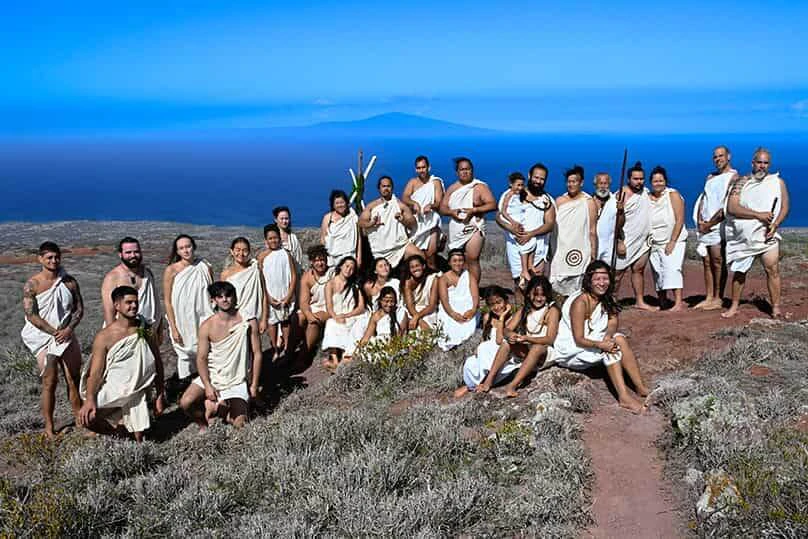
Today, Makahiki ceremonies are conducted throughout Hawai‘i. Here, Lono practitioners gather for a photo on Moa‘ulaiki in November 2025 following the opening of the 44th annual Makahiki season on Kaho‘olawe. (Kat Ho) 
Part of the ‘Ohana’s kuleana on Kaho‘olawe includes monitoring and stabilizing the islands 600 cultural sites and 3,000 physical features. This is the traditional Hale Mua in Hakioawa, the largest of the 600 cultural sites stewarded by the ‘Ohana. (Kat Ho) 
The ʻOhana has established residence on Kohemālamalama with this traditional hale hālāwai Nāmakapili at Hakioawa. (Momi Wheeler)
The ʻOhana showed the world that it is possible to hold the U.S. military accountable to clean up ʻāina ravaged by decades of military training. Under Title X, Congress appropriated $400 million to remove ordnance from Kahoʻolawe.
The military cleared 9% of the island to a depth of 4 feet and an additional 68% of the island’s surface – although none of the surrounding waters were cleared. Some $44 million (of the $400 million) was given directly to KIRC to begin its restoration of the island.
The final step is to solidify and make “paʻa” our pilina (relationships), respect, and reverence for our ancestral ʻāina as the aliʻi to which we are merely kauwā (servants).
The ceremonies conducted on the island and the I Ola Kanaloa! I Ola Kākou! Strategic Plan have now been elevated. Kahoʻolawe is listed on the National Register of Historic Places and recognized within Hawaiʻi, the U.S., and internationally, as a sacred place where Kānaka ʻŌiwi practices are mastered and uplifted.
For the past 50 years, the ʻOhana has been steadfast in its aloha kūpaʻa i ka ʻāina ʻo Kohemālamalama, making great strides built upon the sacrifices and commitment of the kūpuna who believed in its mission of aloha ʻāina.
Throughout 2026, the ʻOhana’s 50th anniversary will be a time of celebration and activation for all who live in Hawaiʻi to recommit and rededicate themselves to aloha ʻāina, to ea (sovereignty) and to the protection of Hawaiian lands from the devastation of military training.
For more information, go to: protectkahoolaweohana.org
This article is reprinted with permission from OHA's Ka Wai Ola newspaper: "La‘a, Ma‘a, Pa‘a: Sanctify, Sustain, Solidify" by Kaipu Keala, Hina Keala, and Davianna Pōmaikaʻi McGregor, in its January 2026 issue, Vol. 43 No. 1. Read more at kawaiola.news.
For the latest news of Hawai‘i, sign up here for our free Daily Edition newsletter.