I found myself walking down a stretch of the King’s Highway in Waikōloa a few months ago. The graveled lava rock was a little unstable, but the relatively flat and straight path in a decent pair of shoes was pleasant.
It was a quiet and clear morning. There were few clouds. The golf courses around the trail were empty. A solitary Japanese tourist lingered behind me some hundred-or-so yards back on the ground. He stopped to take a break at some unknown point and disappeared.
The heat made my haole skin sweat in short order. There were no trees along the brief trail. Although it was morning, the sun already felt harsh among the volcanic rock. The only sound was the crunch of the small volcanic rocks.
While staring up mauka towards Mauna Loa, a dead writer started talking to me.
The Journey of 300 Miles
Bob Krauss passed away in Honolulu in 2006. More than four decades earlier, he had joined a crew of well-supplied pilgrims to trek across the entire island — a span of approximately 300 miles.
My little walk was less than a percentage point of their journey. Waikōloa was towards the end of his original route across the entire island.
The route started in Kailua-Kona, but trailed in the opposite direction to the southernmost tip of the island before turning towards Hilo, proceeding to the northernmost point of the Island near Waimea before turning south again back towards Kailua-Kona.
There was no music to block Bob’s thoughts on the walk. His thoughts were all he had on the walk, and so he kept meticulous notes. Those notes inspired the publication of "The Island Way" in 1975. As its subtitle explains, the book evolved into an account interspersed “with inquiries into Island behavior and an Island approach to our global future.”
It was more than a travelogue full of opinionated visions. In fact, his semi-religious odyssey was an unwitting political vision for Hawai‘i’s future. As a result, it resides as a forgotten fever dream. While it is long out of print, maybe you can find a copy at the annual Friends of the Library book sale in Honolulu.
As I walked along that trail for less than an hour, I started to wonder where an island way would take Hawai‘i in 2026, and whether we need more people to walk along that journey.
There is a clear and present case for taking Bob Krauss’ walk across Hawai‘i Island, in part thanks to its enduring influence over Hawai‘i’s culture.
The Island Way and Palaka Power
Perhaps no figure reconciles the vision of "The Island Way" with Hawai‘i’s political journey more than former Governor John D. Waihe‘e.
Waihe‘e’s involvement in state politics took shape in the ’70s, and was indelibly shaped by the meeting of the Island Way with David Hagino’s tract "Palaka Power." The latter tract appeared shortly before the 1978 Constitutional Convention, and would go on to provide a framework for delegates like a young Waihe‘e, who himself was raised along the Hamakua Coast of Hawai‘i Island.
While Krauss wrote Island Way a few years before Hagino’s manifesto, the two were products of the same decade of political, economic, and socio-cultural transition in the young State of Hawai‘i.
“Politically speaking, David [Hagino] was the first person that clearly articulated that dichotomy, and Bob Krauss was writing a book in a political context,” Waihe‘e explains. “Bob Krauss was doing it more as a social-cultural expression, but they both were heading to the same place.”
Krauss, through "The Island Way," also provided a critical political lens that had been lacking in the State of Hawai‘i up to that point. More than three years after its publication, "Palaka Power" expressed Hawai‘i’s unique political culture through the working-class fabric of cloth adorned by plantation workers, dock laborers, and paniolo.
To some, its succinct and sharp tone could be seen as divisive in how it sought to distinguish Hawai‘i’s people and culture from the rest of the United States. Meanwhile, Krauss produced a long, expressive, and observational tome that neutralized the provocative manifesto.
“'The Island Way,' for me, was like a diplomatic version of 'Palaka Power,'” explains Waihe‘e.
"The Island Way" foregrounded the uniqueness of Hawai‘i in greater depth. “There was a difference between how we live and function on an island versus how we live and function on a continent,” he clarifies. “David [Hagino] went on to discuss, in 'Palaka Power,' how that philosophy was being represented — or challenged —by various institutions politically in our society.”
Waihe‘e interpreted "Palaka Power" to argue that the values of Hawai‘i’s institutions needed to be grounded in an island context, not a continental context. His reading of "Palaka Power," however, is only underlined by "The Island Way."
The Limitations of An Island Society
"The Island Way’s" philosophy is informed by the transformation of the world into a singular island community, where globalization left people more reliant and vulnerable to global trends. Naturally, such a shrinking world needed to treat the world’s resources in a finite capacity.
While Hawai‘i was becoming more like America, the world was becoming more like Hawai‘i.
There were variants of an Island way of living to be found in the high cost of island living, the politics of dealing with people, the role of the individual, religion, environmental destruction and environmental renewal, housing, warfare, and even romance.

They were all informed by the limited resources and communal nature of an island society.
“Our basic reality of an island is limitation,” Krauss concluded in 1975.
One review found Krauss to be bombastic in his diagnosis of society’s ills. “At times,” Warren Iwasa of the Observer wrote, “he allows a commonplace incident or a mildly worrisome set of circumstances to conjure up the specter of a futurist nightmare.”
The Hawai‘i Island explored by Krauss was subject to limitations. “Rising land prices all over reflect an island limitation to land. Re-occurring shortages in grocery stores and shopping centers and gasoline stations are clues to limitations of food, oil, fertilizer, metals, paper, rubber, and all the rest. Limitation to space has prompted concern and disputes over zoning, shoreline development, population control, protection of the environment and exploitation of the ocean.”
The rhetorical division of palaka power — when layered over the ideals of the Island Way — is what appeared to power the energies and vision of the 1978 Constitutional Convention. There was a need to preserve Hawai‘i from an apocalyptic future beset with cultural erasure and environmental decay. History seemed to suggest that the antidote to society’s complexity was the past’s simplicity.
The answer was the Island Way. Simplicity could be realized by a return to the Island Way, or perhaps through the development of a new Island Way through such documents as the 1978 Constitution.
It’s a feeling confirmed by Waihe‘e. “I think the idea that planet Earth is an island, in my opinion, is as compelling as the idea that Hawai‘i was an island and needed to be treated as such in 1978.”
Taking a Walk
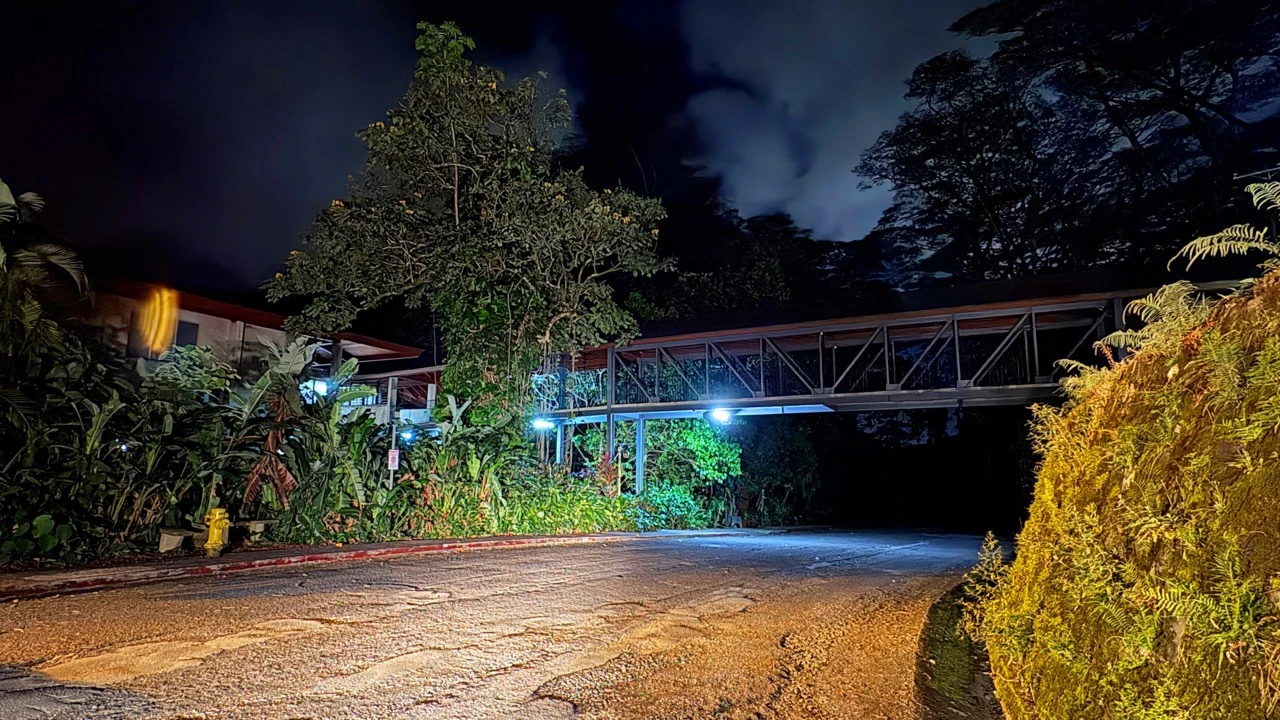
Some hours after my walk, I relaxed a rain forest on the other side of Hawai‘i. A mist gently floated down to the earth. I stood on a beaten path masquerading as a road for automobiles. Dense thickets of invasive guava formed walls along the path.
Few people in this world are ever afforded the opportunity to trek across the island of Hawai‘i. We never get to live like Bob Krauss and survey all the towns and people of our islands in minute detail. We are not afforded such opportunities by the conveniences of a continental lifestyle and the subsequent demands set on such finite resources as time.
Perhaps more people need to make a trek across Hawai‘i in the same vein of such pathways as the Camino de Santiago, a pilgrimage route in Europe that ends in the Spanish town of Santiago de Compostela. One popular version of the route starts in France, spanning about 500 miles.
I had no time to take a walk around Hawai‘i. Instead of treking down towards the South of the island from Waikōloa and then beating back up towards Na‘alehu and the Puna district, I drove a car across the island. The car itself was imported from the continental United States, along with the gasoline that enabled me to make the trip in a few hours.
I try my best not to see Hawai‘i as a mystical place. It is another island in the Hawaiian archipelago, albeit a unique one. If I was not careful, O‘ahu could feel continental, a place dominated by reliance on Costco shipments.
While Hawai‘i Island is much larger than O‘ahu (and every other island in the archipelago), it also relies on Costco shipments, too. In many respects, the islands are more continental than they’ve ever been. Like people in Honolulu, people in Hilo and Kailua-Kona live continental lives, too. While Hawai‘i has arguably become more connected to the United States, the world has also become more of an island.
To an O'ahu urbanite, the Hawai'i of Bob Krauss is a foreign place. It was not accessible by car or plane. It was a romantic vision of the past and a political ideology enshrined in such living documents as Hawai‘i’s Constitution.
When Krauss was walking across Hawai‘i in 1973, the estimated population of Hawai‘i Island stood at 76,400 residents. Today, it surpasses more than 200,000 residents. The islands are taking new paths.
We’ve embraced the necessity of weighing natural limits to an island lifestyle, but we also enjoy the luxuries of continental connection. We’ve embraced the Island Way, but only on a selective basis.
In many respects, understanding the evolving nature of these islands requires pilgrimages in the style of Krauss. “I think it would be great if someone did an update of it because what his book was about was getting to know people–getting to know Hawai‘i,” Gov. Waihe‘e notes.
We should spend some more time getting to know Hawai‘i. There are still pieces of the Island Way among the living, even if it is difficult to survive under absolute island conditions.
I can’t say how hard it is to find the Island Way, but I think it is worth a try.
For the latest news of Hawai‘i, sign up here for our free Daily Edition newsletter.