Kevin Hopkins met his late wife Margarita “Dayday” in the Philippines while he was in the U.S. Peace Corps. She had come to visit her sister when they crossed paths and the pair hit it off, he recalled. They were married within five months, which turned into 48 years before she passed in November 2021 after a four-year battle with ALS. She was 71.
After spending time abroad, they moved back to the Mainland in 1985 and then to Hilo three years later, where Hopkins accepted a role as a professor at the University of Hawai’i at Hilo. Dayday would go on to become a government economist, overseeing the county’s agriculture and natural resources programs and later its Department of Research and Development. A strong advocate for the local Filipino community, she spent more than 20 years in public service.
“She knew everyone and was much more influential than me. I was mostly known as Dayday’s husband,” Hopkins said with a laugh.
He added: “In 2018, my wife was giving a speech and was having trouble talking. So, everyone there thought she had a stroke. We later got some scans done, and it wasn’t that. With ALS, symptoms can either show in extremities – like your arms and legs (Limb-onset) or in your neck and head (Bulbar-onset); speaking can be the first thing they lose. Unfortunately, we still don’t have a good diagnostic test for it – it’s diagnosed by elimination, which is a very frustrating process.”
He said he couldn’t remember how he came across the ALS Network but was glad he did. The nonprofit is focused on prevention strategies, treatments and cures for amyotrophic lateral sclerosis, or Lou Gehrig’s Disease.
“I’ve been a part of the group now for several years. They gave to us without asking anything, and I feel I have an obligation to help other families that are going through the same process," said Hopkins, who serves on its Community Research Committee.
He described the main role as reviewing grant applications across the country.
“We’re trying to fill in the gap,” he said. “And we are all people who have experience with ALS, either ourselves or as caregivers.”
On Jan. 24, Hopkins and his team will be honored by the ALS Network with the 2026 Essey Commitment to Cures Award at its annual Champions for Cures and Care gala in Pasadena, California. Proceeds from the event will fund the organization's mission.
“The Community Research Committee embodies our belief that people affected by ALS must have a voice in shaping the research that will change the future,” said ALS Network President and CEO Sheri Strahl in a statement. “Their insight and dedication help guide funding decisions toward the most impactful and essential work.”
Remembering Dayday
When Dayday was diagnosed with ALS, doctors gave her two years to live. She lived for four though the disease slowly took away her ability to walk, speak, swallow and, eventually, breathe. She had lost weight and was tube-fed for two years, Hopkins said.
“It was a lot of decision-making,” he said, giving an example of learning the ins and outs of a PEG tube. “That was very scary for me at first, feeding from a tube. I eventually taught my teenage granddaughters to do it, and they helped.”
She continued as a guest lecturer at UH Hilo until early 2019, and Hopkins finished up the semester for her, he recalled.
Over a two-year period, they traveled to Stanford every three months for care, and later to Phoenix for experimental treatments. The Philippines was next on the itinerary to see family.
“While we were there, we even hunted down faith healers, just to try it. We were at that point.”
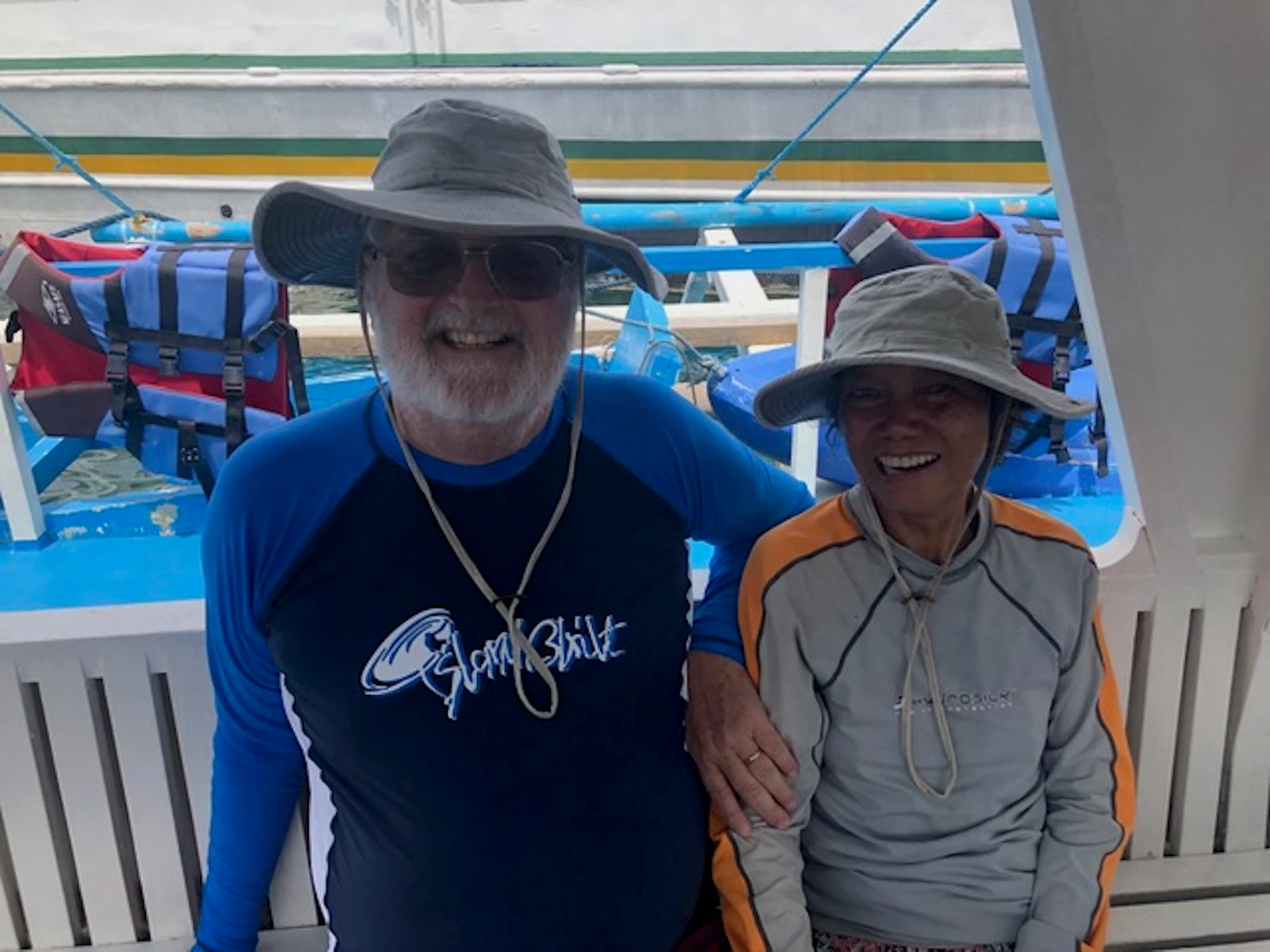
In February 2022, the couple took their last trip to Oʻahu for an Aquaculture Society meeting said Hopkins, adding, “Fun knows no boundaries."
Part of what allowed the pair to travel so often was ALS Network’s help with equipment such as motorized wheelchairs and ventilators. They were also able to create an ALS support group on the island (no longer active) also with the organization’s aid.
Hilo Medical Center was “great for care,” as was the hospice team, Hawai’i Care Choices, he noted.
But for Hopkins, the task of primary caretaker was fatiguing.
“I had a medical emergency myself before she passed. It’s a common thing that can happen to ALS families, the caregivers may become ill,” he said.
Their family and friends offered support, and as for Dayday, “She fought to the end," according to Hopkins.
“I saw her take her last breath and immediately turned off the machine (for the ventilator). Most of the family was there. And an unsaid thing among us was to get all of the machines out; we didn’t want to see them anymore near her,” he said. “Afterwards, the community was generous. We created a scholarship at UH in my wife’s name, for those studying agricultural economics.”
Hopkins also assists with ALS Network’s annual walk, he said, noting that 2020 was the last time they participated altogether as a family.
“Doing good feels good. I get great satisfaction being able to help people in some way,” he said. “As an active member of rotary, I’ve learned that in joining any group you leverage your impact.”
Hopkins retired after more than 30 years as a Professor of Aquaculture in July 2021. Beyond community service, he enjoys traveling and "living vicariously through" his three adult kids and 11 grandchildren.

For the latest news of Hawai‘i, sign up here for our free Daily Edition newsletter.
Kelsey Kukaua Medeiros can be reached at kelsey@alohastatedaily.com.