
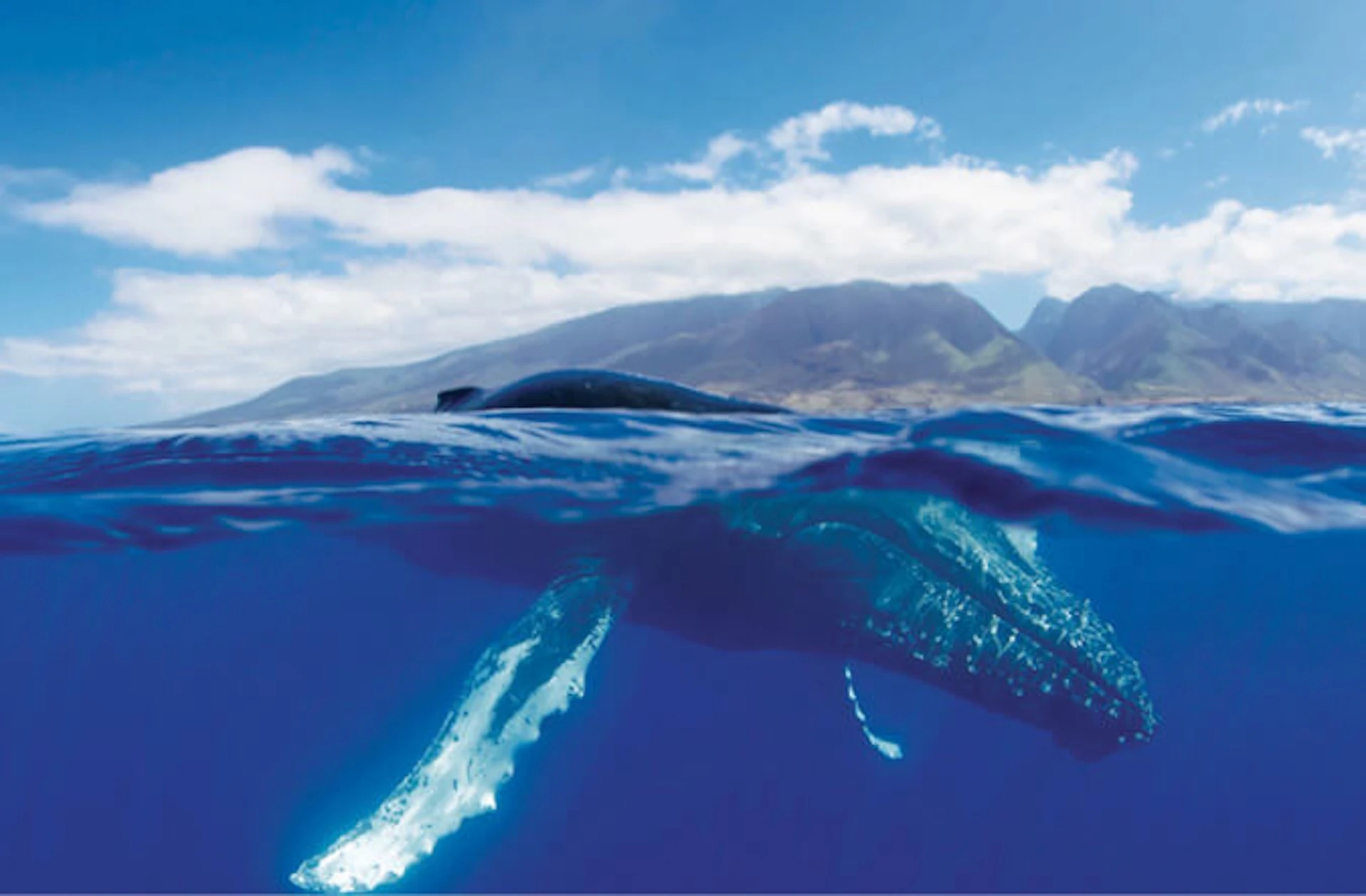
The annual return of koholā (humpback whales) to Hawaiian waters during the fall and winter is one of the visible signs of seasonal change.
Traditionally, koholā are acknowledged as ancient beings and considered to be a kinolau (manifestation) of Kanaloa, the god of the ocean – which is why they may be referred to as “Kanaloa” by cultural practitioners. Honored by some ʻohana as ʻaumākua, they are said to have helped the ancestors navigate the Pacific.
Although many residents give their arrival little thought – or relegate it to commercial whale watching opportunities – for those who respond to distressed or stranded Kanaloa, it represents a period of increased risk.
In this period following Ke Ala Polohiwa a Kanaloa (the winter solstice), those tasked with this kuleana are preparing for what may lie ahead.
On Hawaiʻi Island, a designated marine mammal response group using a cultural approach is bringing forth a cooperative model of response in a space where cultural practices and Western governance have frequently clashed.
“Our vision is a future Hawaiʻi where communities on every mokupuni (island) are well equipped with the connection, knowledge, skills, experience and authority to properly care for distressed and stranded Kanaloa,” said Roxane Keliʻikipikāneokolohaka, co-founder, executive director and lead kiaʻi of Kiaʻi Kanaloa, a statewide marine mammal response network comprised of Hawaiian cultural practitioners.
She added that developing community-led approaches is becoming more critical as federal laws created to protect marine mammals are in jeopardy under the current administration.
The emergence of a community-led response model was born from more than a decade of conflict, during which cultural practices and community preferences were often disregarded and sometimes criminalized in favor of federal decision-making and laws.
A significant point of conflict is the practice of euthanasia by the federal government when Kanaloa are severely injured or dying.
“Once the Kanaloa is euthanized, it cannot go back into the ocean unless it’s in ash form. The burial of ashes is not our practice, nor does it provide the means for the Kanaloa to feed Moananuiākea as it was intended,” said Keliʻikipikāneokolohaka.
Two incidents, about 10 years apart, illustrate the shift from conflict toward a more cooperative model of responding to strandings.
In 2015, NOAA (National Oceanic and Atmospheric Administration) issued citations to Keliʻikipikāneokolohaka (then Stewart) and Kealoha Pisciotta for violating federal law after they responded to the June 2014 stranding of Wānanalua (a melon-headed whale) in Kawaihae on Hawaiʻi Island.
The two performed a Hawaiian sea burial after NOAA left the scene, according to an NBC News report. In 2018, NOAA ended up dropping the charges against the women after legal challenges and negative public attention.
In Native Hawaiian culture, Kanaloa are viewed as living ancestors, having appeared before kānaka in the Hawaiian origin chant, the Kumulipo.
Thus, Keliʻikipikāneokolohaka said responders view their work to care for Kanaloa no differently than they view the care of kūpuna in an emergency room or hospice-type situation except that “we are dealing with an entity that is a living ancestor, one who embodies both a familial and akua form at the same time.
“We facilitate the transition of Kanaloa according to their directive. They may choose to re-enter Moananuiākea, have a bit of a respite, or they may choose to transition from the physical realm to the spiritual realm.”
In 2023, NOAA approached the Hawaiʻi Island-based Kiaʻi Kanaloa about becoming a formal stranding response partner, giving them the authority to respond to all strandings on the island.
After consultation with family, elders and community leaders, the group decided to accept the role and now has a formal agreement with the NOAA National Marine Fisheries Service Pacific Islands Regional Office.
The new agreement was put to its first test in July 2024 when Kiaʻi Kanaloa was called by the Leleiwi community in Hilo to respond to a distressed whale. Kiaʻi Kanaloa worked with the community and the Division of Aquatic Resources in coordinating a community-led response.
“The community had full advocacy in handling the response from start to finish, with three generations of one ʻohana involved in the ceremonial preparation and the kanu kai (ocean burial),” said Keliʻikipikāneokolohaka. “That kind of response epitomizes how we think these events should be handled in Hawaiʻi.”
In November 2025, Keliʻikipikāneokolohaka traveled to Aotearoa (New Zealand) for the World Indigenous Peoples’ Conference on Education to speak about Kanaloa response work in Hawaiʻi and Aotearoa. There, she co-facilitated a workshop called “Kanaloa Cognizance: Countering the Criminalization of Ancestral Duty and Ritual” with Bonita Bigham, a Māori affiliate of Kiaʻi Kanaloa,
About 100 people participated in the workshop, which culminated in a written statement calling for changes to the Convention on International Trade in Endangered Species of Wild Fauna and Flora (CITES).
“We call on CITES to enable Indigenous people to travel freely with sacred cultural items of a personal nature, to use them in culturally relevant contexts and ceremonies (including gifting), and to recognize the ancestral relationships and connections that exist between marine mammals and Indigenous peoples worldwide,” the statement read.
In addition to training and advocacy, Kiaʻi Kanaloa is in the process of developing a predictive framework for when communities need to be on high alert for strandings. Through the process of kilo malama, they are studying historical stranding records and cross referencing them with significant earth and kānaka events, such as or natural disasters or deaths, to identify patterns.
According to NOAA, about 20 whale and dolphin strandings occur in the Hawaiian Islands in an average year. Strandings happen year-round, with dolphin strandings typically peaking in the summer, and large whale strandings in the winter during migration season. The University of Hawaiʻi Hilo Marine Mammal Lab has collected 30,000 observations and identified more than 5,000 individual whales over the past three decades during migration.
Illness, injury and disease have all been tied to the obvious causes of Kanaloa in distress.
In June 2025, three dolphins stranded on east Oʻahu shorelines over a 7-day period tested positive for Brucella ceti, a bacterial infection that can transfer from animals to humans. In all cases, cultural practitioners were present to advise the UH Mānoa first response team.
Keliʻikipikāneokolohaka said preparations continue to be made on all fronts to increase communities’ ability to meet their cultural responsibility to care for Kanaloa as our living ancestors.
To report a marine mammal stranding, call the Kiaʻi Kanaloa response hotline at 808-987-0453, or the NOAA Fisheries hotline at 888-256-9840.
This article is reprinted with permission from OHA's Ka Wai Ola newspaper: "Caring for Koholā-Kanaloa as Living Ancestors" by Lisa Eller, in its January 2026 issue, Vol. 43 No. 1. Read more at kawaiola.news.
For the latest news of Hawai‘i, sign up here for our free Daily Edition newsletter.


