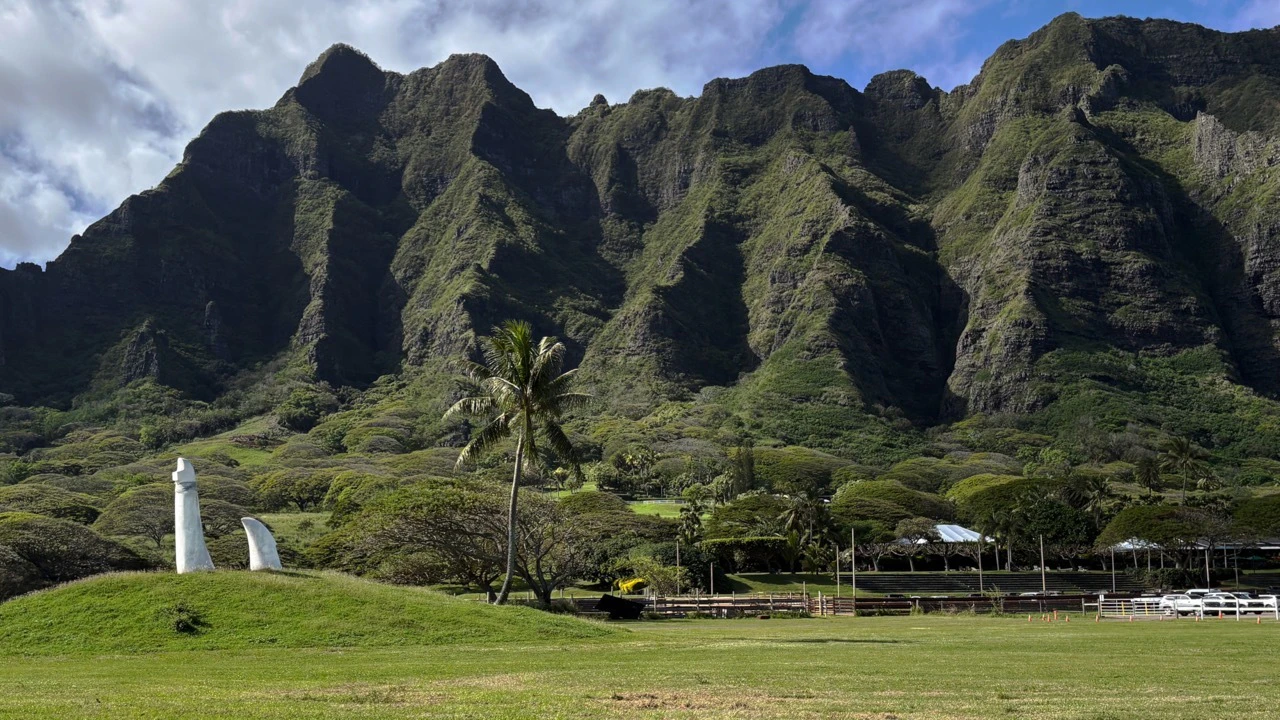
In ancient times, this was sacred ground. Kualoa was a wahi kapu, a place set apart for chiefs. In our oral traditions, newborn aliʻi were brought here to be raised in discipline and trained in warfare, raised with an understanding of their chiefly status. Those who broke kapu fled here seeking refuge, for Kualoa was also a puʻuhonua, a place where life might be spared if protocol was followed.
Even at sea, the land commanded respect. Any wa‘a (canoe) passing offshore was said to have lowered its sails in silence, acknowledging the mana of the valley before continuing on. This practice wasn’t limited to just fishermen and commoners, as it is said that Kamehameha I was also careful to acknowledge the sacredness of Kualoa, dropping his sails as he went by.
But Kualoa’s sacredness did not only place demands on those who passed by, it tested those who ruled.
Shortly after becoming aliʻi of Oʻahu, Kahahana called together a council of the island’s ali‘i along with the kahuna nui, Kaopulupulu. Kahahana presented the demands of his uncle, Kahekili of Maui, who sought control of Kualoa and the palaoa pae, the shoreline where whale bones were said to drift ashore.
Some ali‘i argued that the request was reasonable, a fair return for the protection and support that Kahekili had shown Kahahana during his rise to power. Others hesitated, uneasy with the implications of giving the Maui ali‘i such control.
But Kaopulupulu did not hesitate. He warned that to surrender Kualoa was a forfeiture of O‘ahu’s sovereignty. Kualoa, he reminded them, was among the most sacred lands on the island. It was home to the revered drums of Kapahuʻula and Kaʻahuʻulapunawai, and to the sacred hill of Kauakahi a Kahoʻowaha. To give up the palaoa-pae would not only dishonor this history but also disrespect the gods themselves. Kaopulupulu argued that Kahahana had no right to surrender the very emblems of the island’s independence.
Despite Kaopulupulu’s convincing the council and the agreement to deny Kahekili’s demands, things took a darker turn. Through manipulation and influence, Kahekili later convinced his nephew not only to relinquish Kualoa but also that Kaopulupulu was a traitor. With that accusation, the priest was killed. Soon after, Kahahana was also put to death, and Kualoa passed fully into Kahekili’s control.
The ancient stories tell of gods and goddesses, like Hiʻiaka, Pele’s sister, who battled a great moʻo in this valley. When she destroyed the creature, its body became the foothills, and its severed tail was cast into the sea, forming the tiny island of Mokoliʻi (some call it Chinaman’s Hat). Other tales are of Kamapuaʻa, a demigod who was half-man/half-pig, hiding in Kualoa while fleeing Pele’s wrath, tearing through the mountains as he escaped, leaving the deep cuts and ridges that still mark the land.
Then there’s the work of feeding people, which has its own kind of sacredness. Along this coast sits Moliʻi Fishpond. Built to raise and fatten fish, it’s estimated to be 800 to 1,000 years old. But the pond isn’t a relic. It’s one of the few original Hawaiian loko ‘ia (fishponds) still in use, raising and harvesting fish using sustainable practices. A reminder of the area's abundance.
Then change came, as it always does. During the Māhele, Hawaiian lands that had once been held through kuleana (responsibility) were divided by law and written documents. Kualoa was pulled into that new world, too. In 1850, King Kamehameha III sold roughly 622 acres at Kualoa to Dr. Gerrit P. Judd, his missionary doctor and advisor. Over time, through later acquisitions by his son, Charles H. Judd, the holdings expanded to nearly 4,000 acres, becoming Kualoa Ranch, run by the Morgan family line.
Sugar followed, briefly, with the Kualoa Sugar Mill rising near the road. The mill was built in 1864 by Judd’s son-in-law, Samuel G. Wilder. However, it didn’t last long. In 1866, Samuel Wilder’s nine-year-old son fell into a vat of boiling syrup and died from the severe burns a few days later. The sugar venture did not last, and the mill processed its final crop in 1868. The land was then used for ranching.
Yet for all the eras that passed through Kualoa, the valley itself saw little change. The sacredness, the mana, never diminished. And some say that when night settles in Kualoa, and the mountains disappear into shadow, the valley begins to tell its stories again.
In 1925, a story appeared in The Honolulu Advertiser’s editorial column, “The Bystander,” that described ghost stories shared on a Sunday visit to Kualoa. The author wrote that his host claimed to often see the specter of his grandfather, Charles H. Judd, pacing on the lawn in front of the houses. And on every full moon, the ghosts of Kamehameha I and his entourage would march past the gates toward Hau‘ula.
That’s not the only tale of the huaka‘i pō.
A few years ago, a young man shared his own story with me. He used to work as a guide for the ranch, leading visitors through the valleys in all-terrain vehicles. One late afternoon, when the sun was already low behind the mountain, he returned to the trail overlooking Kualoa Beach and Mokoli‘i. A woman said she left her backpack, and the young guide volunteered to go back and look for it. He realized it was getting dark pretty fast, and he didn’t want to get stuck out there by the time it got fully dark. He got to the spot, turned off the motor, and got out of the vehicle to look around. The young man quickly found the bag, tossed it into the back of the vehicle, and jumped in. But it didn’t start.
Slightly irritated, he kept trying the ignition until he heard a sound that was completely out of place. He swore it sounded like drums, but tried to tell himself that it must be something else. All of a sudden, a gust of wind ripped past him, kicking up dirt everywhere, forcing him to cover his face. As he leaned forward against the steering wheel, he heard footsteps. He wasn’t aware of any other sound, no talking, no chanting, just the sound of dozens of feet marching. He froze in his seat and prayed, keeping his face in his palms, refusing to look up. After a few long minutes, the pounding sound was gone, and he finally lifted his head. He looked around to see nothing out of the ordinary. He turned the ignition key, and his ATV started on the first try. He drove back carefully, not wanting to drive too fast and meet up with whatever just passed him.
He believes he encountered the night marchers and was thankful to make it out unscathed. However, although he enjoyed his job, it was the final straw in a series of creepy encounters that led him to quit.
For the latest news of Hawai‘i, sign up here for our free Daily Edition newsletter.