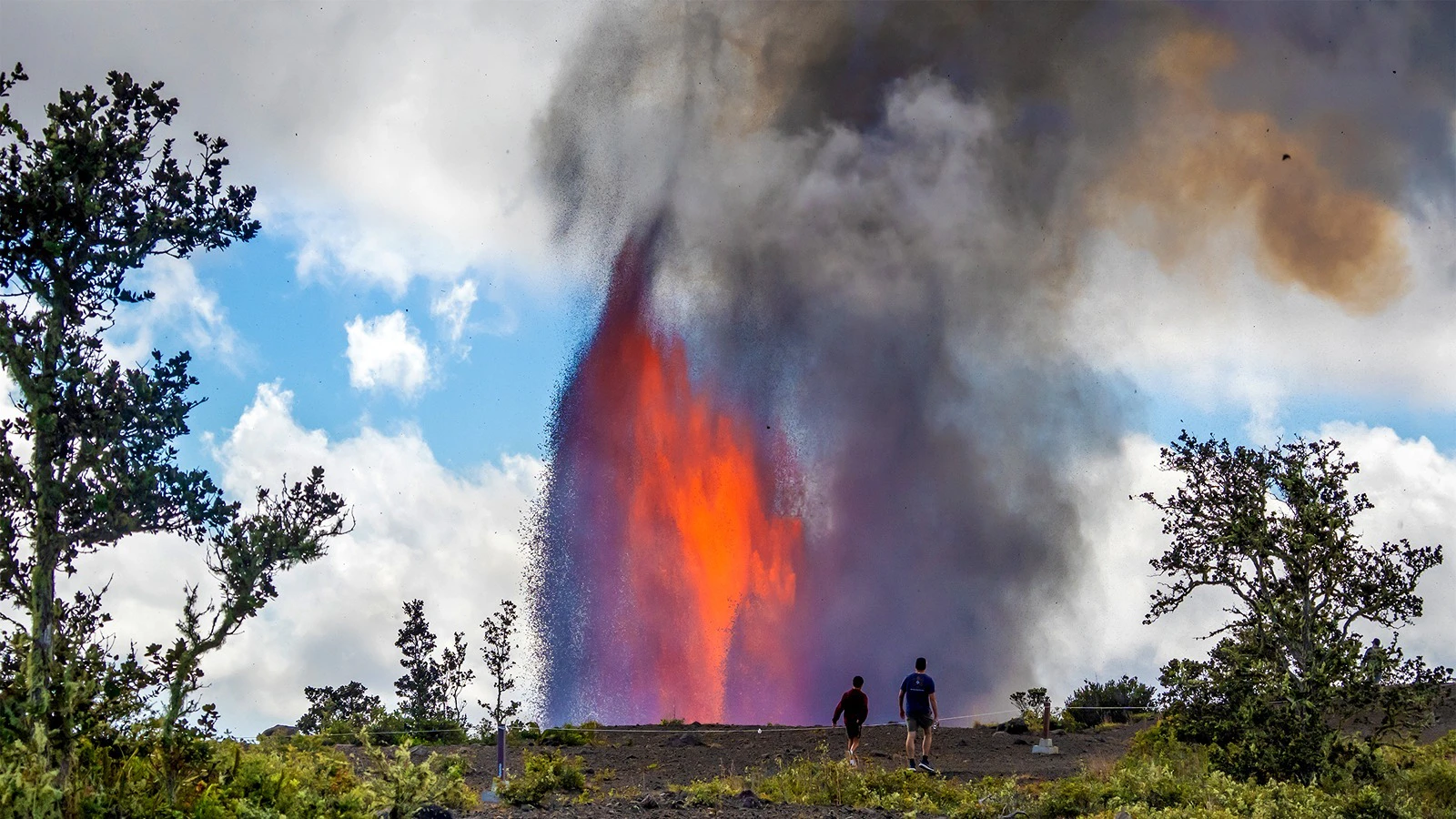
An estimated 14 million cubic yards of lava erupted during Kīlauea volcano’s fiery display over the weekend.
That seems like a lot of lava — but just how much is it?
Aloha State Daily was curious, so we reached out to experts who would know.
Katie Mulliken, a geologist at the U.S. Geological Survey’s Hawaiian Volcano Observatory, says that 14 million cubic yards, or 10.6 million cubic meters, is the volume of about 4,500 Olympic swimming pools and 2,000 Goodyear blimps.
For some additional perspective, according to themeasureofthings.com, 10.6 million cubic meters is also 150 times as big as Spaceship Earth in Walt Disney World’s EPCOT, 400 times as big as the Lincoln Memorial reflecting pool, 950,000 times as big as a concrete mixer truck and 15 million times as big of an average, four-person hot tub.
(As a comparison, there’s 3.25 million cubic yards of concrete in the Hoover Dam and 4.36 million cubic yards of concrete in the dam, the power plant and appurtenant works, according to the U.S. Bureau of Reclamation. That’s enough concrete to pave a standard highway 16 feet wide from San Francisco to New York City, the bureau website notes).
Kīlauea has been erupting intermittently since Dec. 23, 2024, largely from two vents in Halema‘uma‘u crater within Kaluapele, the summit caldera.
“The volume of episode 41 is the third largest seen for this eruption so far, so it wasn't necessarily surprising,” Mulliken told ASD in an email. “Each episode has been different and the volume for each episode is related to the rate that lava is being erupted and the duration of the episode.”
The volume of the most recent episode is only surpassed by two others, according to Mulliken.
Episode 25 on Oct. 17- 18, 2025, lasted 12 hours and had fountains that measured 479 meters, the tallest recorded to date. During this episode, 12.1 million cubic meters of lava erupted.
Meanwhile, 13 million cubic meters of lava erupted during episode 3. That episode was longer, lasting from Dec. 26, 2024, to Jan. 3, 2025, but had shorter fountains, the highest of which measure 86 meters, she noted.
By comparison, a total of 800 million cubic meters of lava erupted during the four-month-long eruption of Kīlauea’s lower East Rift Zone in 2018, Mulliken says.
“In total, this ongoing eruption has erupted about a quarter of that volume.”
The current eruption is currently paused again, but episode 41 — which started and ended on Saturday, Jan. 24 — blanketed Hawai‘i Volcanoes National Park and some surrounding Big Island communities with tephra and ash, prompted temporary park and road closures, and covered about 80% to 85% of the Halema‘uma‘u crater floor. All areas that were closed due to the volcanic hazards have since been reopened.
HVNP spokesperson Jessica Ferracane told ASD in an email that the park has enacted a few brief, temporary closures in specific areas like Uēkahuna, the summit region of the volcano, due to air quality or tephra fall during this eruption.
But the last time the park saw an extended closure was during the 2018 eruption due to the Kīlauea summit collapse and damaging earthquake, she says. The park was closed from May 11 to Sept. 22, 2018, a total of 134 days, although the Kahuku Unit remained open.
A little more than a year after the current eruption began, the fiery display continues to draw throngs of visitors to HVNP.
“Visitation skyrockets during eruptions, especially if they occur on the weekends or holidays,” Ferracane says. “Since the eruption began on Dec. 23,2024, park visitation has increased by about 34% through 2025. Traffic can become congested on Highway 11, parking lots fill up quickly, especially on the east side of the summit, and trails and overlooks are busy with visitors eager to see an eruption.”
There were a total of 1,433,593 recreation visits to HVNP in 2024 and 1,877,855 in 2025.
Hoping to catch the excitement?
Ferracane offers a few tips for people visiting the park during an eruptive episode:
- Expect the park to be busy with heavy traffic near the entrance and along Highway 11.
- Slow down: heed the posted signs, expect detours and listen to park rangers.
- Hit the Welcome Center first. It offers “excellent eruption viewing” with plenty parking nearby. After entering the park, take Crater Rim Drive West to Kīlauea Military Camp, about a mile away.
- Park in designated areas only. If you park in the road — or block emergency access or other vehicles — you’ll get towed.
- Pay attention to the air quality — volcanic gases, or vog, can be hazardous to everyone. You can check the latest conditions here.
- Stay away from cliff edges and keep keiki close.
And stay out of closed areas. Ferracane says “great overlooks” of Kaluapele, the Kīlauea caldera, are open across from the Welcome Center, at Uēkahuna, along Crater Rim Trail and old Crater Rim Drive.
(ICYMI: First responders had to rescue a 30-year-old Boston man in June after he fell 30 feet from a steep cliff in the park trying to get a closer glimpse of the ongoing eruption). - Pedestrians should pay attention to traffic and use sidewalks and crosswalks.
- Look out for nēnē, or native geese, on roads, roadsides and parking lots. Never feed nēnē and give them space.
- Be prepared for rain, reduced visibility if it is raining or cloudy, and cooler temperatures.
In an update Thursday, HVO said episode 42 of lava fountaining is currently anticipated to begin between Feb. 9 and 20, but that window will be refined as more data becomes available.
For the latest news of Hawai‘i, sign up here for our free Daily Edition newsletter.
Stephanie Salmons can be reached at stephanie@alohastatedaily.com.