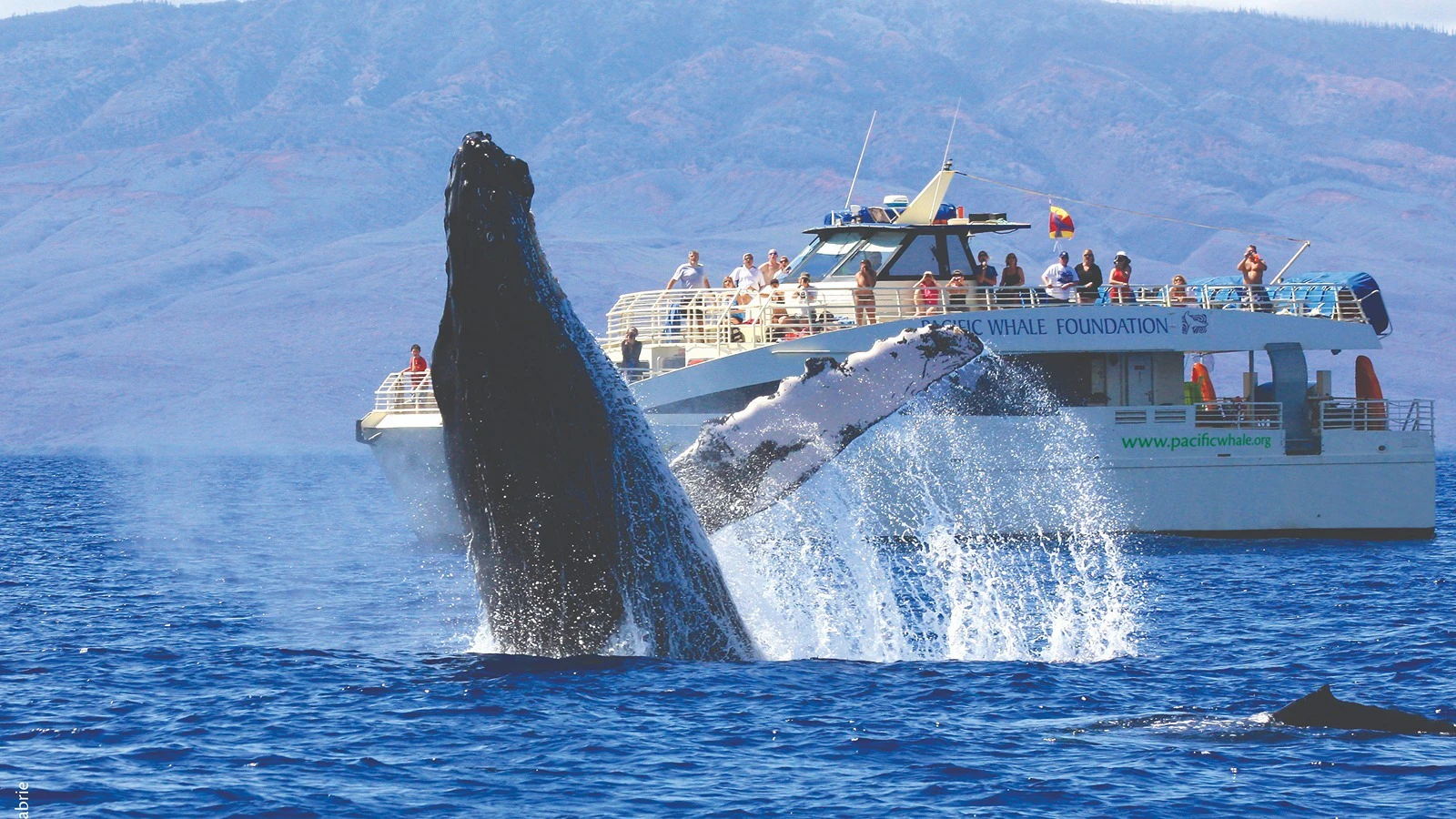
We’re in the midst of humpback whale season, the time of year — typically November through May — when thousands of North Pacific humpbacks make their way to Hawaiʻi’s warm waters to mate, give birth and raise their young.
Since the Pacific Whale Foundation began working in Maui County waters nearly 45 years ago, the subpopulation of humpbacks in the North Pacific has grown from about 1,000 to somewhere between 25,000 and 30,000, Morgan Wittmer, EcoTours Manager with PWF’s PacWhale Eco-Adventures told Aloha State Daily. Of those, about 12,000 are expected to come to the Islands this season.
That “massive change” is attributed to the attention given to these animals and protecting the mammals and their habitat, she says.
Aloha State Daily spoke with Wittmer to learn more about whales in Hawaiʻi, the work the Pacific Whale Foundation does and more. Here’s what we learned.
- Pacific Whale Foundation was founded by Greg Kaufman in 1980 “to protect a declining humpback whale population from global threats,” its website notes. The nonprofit owns PacWhale Eco-Adventures, whose profits support the Pacific Whale Foundation’s work.
“We are together. We do share the same mission to protect the ocean through science and advocacy and inspire environmental stewardship,” says Wittmer. “We’re kind of linked perfectly that way, but we give our money back to the same programs that we talk about on board, so that’s pretty neat.”
According to Wittmer, when PWF began doing research in Maui County waters about 45 years ago, they realized that “people were very interested in whales and wanted to learn about them and go out on trips. That was after the whole ‘Save the Whales’ movement was starting to blossom, and people were marching in the streets and listing to whale song, and so people started to want to go on whale watches.”
At that time, there were only about 1,000 humpbacks in the North Pacific subpopulation, and only about 600 would come to Maui waters.
“They started chartering a boat to bring people out and they quickly found people were very interested in learning more from a scientific perspective and that’s what they had from their research background,” Wittmer says. “It took some figuring out, but ultimately, they ended up creating a boat tour operation that could be one of the many funding arms of the organization.” - Since the 1980s, when Wittmer says there started to be more interest in these animals, “tons of organizations have dedicated their time to protecting these animals, learning more about them so they can be intelligently protected — regulating fisheries, marine debris, traffic out there.”
Because of those efforts from so many, the humpback population has increased to between 25,000 and 30,000, she notes.
The animals, though, are hard to count, Wittmer says. “They’re underwater and on the move and they’re gigantic and hard to put a suction cup tag on.”
Wittmer is unable to provide global humpback whale numbers, but says, “they’ve all grown and increased due to worldwide regulations on whaling in general.”
The International Whaling Commission is the global body responsible for the management of whaling and the conservation of whales. - PWF has a CORE set of disciplines: Conservation, Outreach, Research and Education.
Conservation is “active work out in the field to engage the public and clean up habitats,” Wittmer says. That includes marine debris retrieval.
“We have an amazing team that goes out and gets old nets that are on beaches or in the water,” she says. “They do reef cleanups and they do a lot of restoration programs. We have a program called Mālama Pono and we work with other community groups to engage people in volunteer projects.”
Conservation and outreach both involve advocacy efforts. Meanwhile, the research team collaborates with other organizations to do active research.
“They’re doing a lot of dolphin research right now, some humpback whale research too, and all that’s designed to get more information so we can intelligently protect them and then advise on management practices within the county, whether it’s for fishing or boat traffic speeds or should we put them back on the endangered list? Research is finding those answers.”
And the education team largely work with keiki, offering camps in the building and on boats, along with keiki whale watches, Wittmer says.
PWF and Norwegian Cruise Line Holdings have partnered to expand the Keiki Whale Watch program, “significantly increasing access to hands-on ocean education for Maui students in grades two through eight,” a recent announcement noted. In 2025, PWF served 1,109 students through Keiki Whale Watch, its flagship education program, and the partnership will allow the nonprofit to at least double the number of students served in 2026, the announcement noted. - Before the Covid-19 pandemic hit in 2020, the boat tours saw between 350,000 and 400,000 visitors a year, Wittmer told ASD. The numbers dipped but recovered a bit before 2023 wildfires ravaged parts of Maui and destroyed Lahaina. They’re now running somewhere around 160,000 to 180,000 visitors per year, she says.
“After the fires, we did lose a retail space in Lahaina, and one boat completely was lost to the fire. Two others were damaged, and so Lahaina became a place that we couldn’t operate out of at all,” Wittmer says. The tour company, which moved its operations to Māʻalaea, still doesn’t operate out of Lahaina, although some operations are being allowed.
“We just haven’t moved that way yet out of respect for the community and our busy schedule here,” she says.
With the move to Māʻalaea, the company revamped its schedule and offerings, and shrunk its operation in general, which ultimately meant less money for the foundation, Wittmer explained.
“They had to rely more heavily on grants and donations at that time, but with this busy year, we’re hoping to make a good donation back to Pacific Whale Foundation,” Wittmer says. “It’s looking like a good whale season and then maybe next spring or summer, we’ll move back to Lahaina when the time is right.” - There are two more opportunities to help with the Great Whale Count this year: Feb. 28 and March 28.
According to the PWF website, the annual Great Whale Count is where volunteers count whales from the shore as part of a long-term survey of humpback whales in the Islands. There are a number of sites along the Maui coast.
“This event provides a snapshot of trends in relative abundance of whales and is one of the world’s longest-running community scientist projects, dating back to 1995.”
It’s not a perfect process, but “we’re doing the same imperfect project every year, so you can at least see trends over time in terms of increases or decreases in the population,” Wittmer says. “It’s just a very cool way to get people engaged in whale research in a citizen science way.”
Register online here. Participants must arrive by 8 a.m. and stay until noon, and they’ll visually scan an assigned area of the ocean for whale activity and report any activity to the site leader, the site notes. - The 45th annual World Whale Day is coming up, but PWF is celebrating with a weeks’ worth of activities and events across Maui. You can find the full lineup here, but it all culminates 9 to 11 a.m. Sunday, Feb. 15, with the World Whale Day Parade along South Kīhei Road.
For the latest news of Hawai‘i, sign up here for our free Daily Edition newsletter.
Stephanie Salmons can be reached at stephanie@alohastatedaily.com.