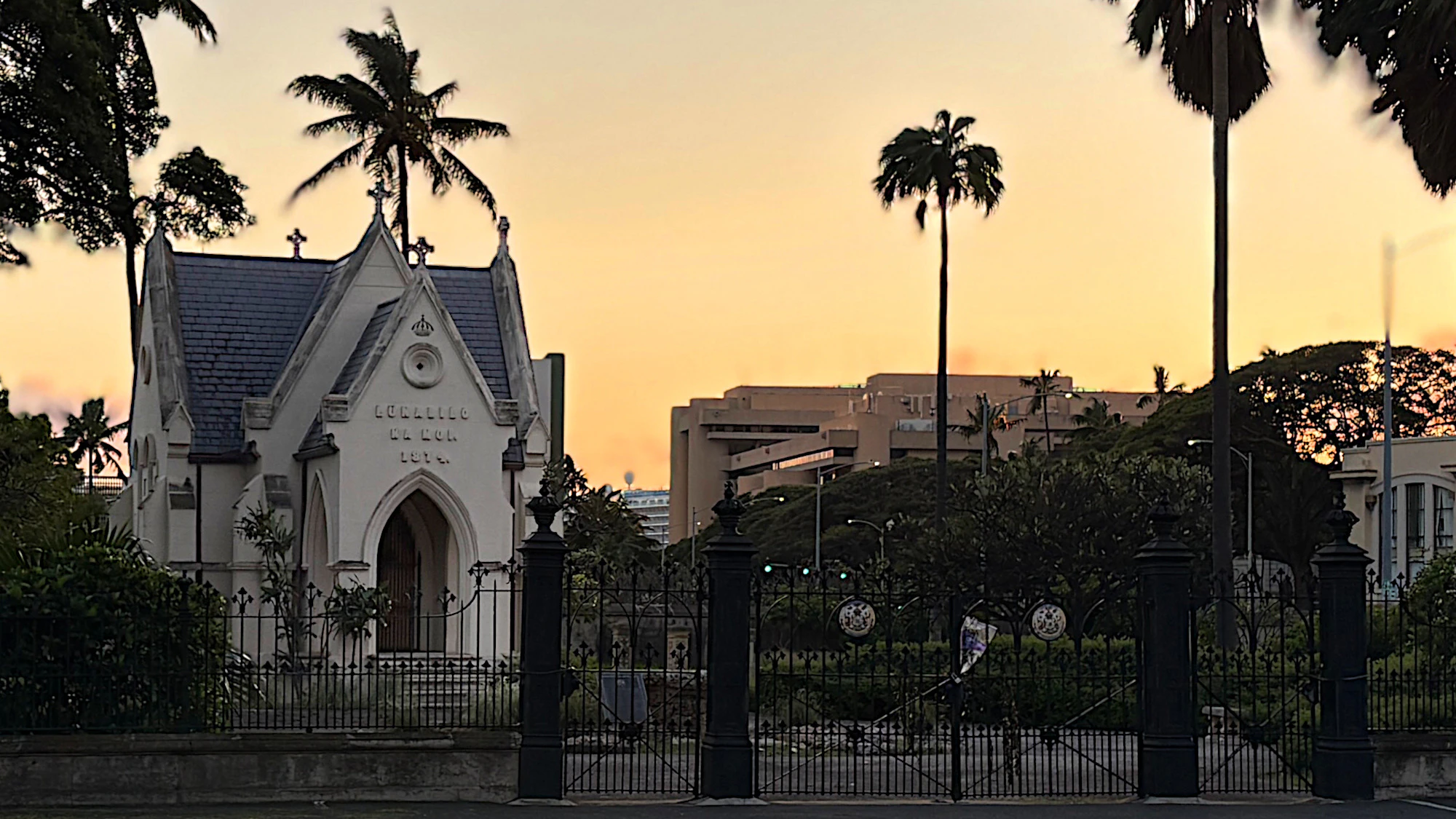
Not far beneath the paved roads, apartment buildings, and high-rises, a hidden system of underground caverns and spring-fed ponds once nourished wetlands, lo‘i kalo, and freshwater ponds across the Mō‘ili‘ili district. This karst, the underground cave system, was formed by eons of erosion of the coral limestone base that consists of beach sediments, marine organisms, and fragments of shells and water-worn coral. The Mō‘ili‘ili Karst is thought to be part of the original channel of Mānoa Stream, and contained fish that lived so long in the darkness that they were blind.
It is said that when someone asked an old fisherman in the area where he was going, he’d say, “I’m going holoholo,” out for a walk. For if he announced he was going fishing, the fish that lived underground would hear his plans and spread the word, and the fisherman would have no luck that day.
The water in the underground streams rose to the surface in sacred ponds. Among these, one of the most important was Kapa‘akea, also remembered as Kumulae and then later called Hausten Pond. Like nearby Kānewai, Kapa‘akea was believed to possess healing qualities and was associated with restoration.
The pond was a favored retreat of Princess Victoria Kamāmalu, who inherited the land from her mother, Kina‘u, daughter of Queen Ka‘ahumanu. Kamāmalu died in 1866 with no heirs, and Kapa‘akea eventually came under the ownership of Princess Pauahi and the Bishop Trust. In the 1920s, it was purchased by John McGuire, whose wife, Emma Kaleimoku Ai, established a sanctuary for her family. The property overflowed with a wide variety of tropical flowers, plumeria, ulu, and kukui trees, as well as Hawaiian medicinal plants and herbs, and, of course, Emma’s graceful willow trees that would eventually give the place a new name. The family even had a diving board over the freshwater pond to entertain the children and visitors. The pond was stocked with koi that were said to have interbred with the fish inhabiting the underground streams.
After McGuire’s passing, Emma remarried Henry T. Hausten. The family began hosting political dinners and occasional lu‘au for important guests. With the help of Emma’s daughters, her sister, and her brother, things quickly evolved into a full-time business and eventually into The Willows.
Since their official opening in 1944, The Willows welcomed everyone with beautiful settings, warm hospitality, and delicious food. On almost any given day, one would see average working families having a quiet meal alongside the rich and famous. The Willows catered to everybody, perhaps even the otherworldly.
One afternoon, while I was still teaching at a Hawaiian immersion school, a parent asked if she could share her story with me.
She said she used to work as a cashier at The Willows restaurant. At night, she counted the money from the day’s sales in what she called “the cage,” while a security guard kept watch. One night, out of the blue, they heard Hawaiian music coming from the main part of the restaurant. They could hear lively conversations and the sound of cutlery on plates. But the restaurant had been closed for hours.
After locking the cage door, she and the guard went to check, but the place was empty and completely quiet. The silence was unnerving, but the two were not going to wait for the proverbial shoe to drop. They decided she would quickly finish counting the cash, and then they would leave as soon as she was done. But as she neared the end of her count, they heard splashing in the pond and the sounds of laughter and fun.
Once she finished her work, she and the security guard braced themselves to leave, trying to ignore anything else they might see or hear.
“The laughter and splashing kept going until we left the restaurant,” she said, “When we got to the parking lot, we heard the Hawaiian music again. The security guard quit the next day, and later that week, I started working at the airlines.”
I shared a bit of the pond's sacred history, and she looked as if she had just remembered something important.
“Oh!” she exclaimed, “Menehune!”
She added that sometimes, while counting money in the cage, they would finish and look up to see tiny footprints all over the ceiling and walls, as if children had been stomping around, though they never heard any footsteps. A staff member once told them there was supposed to be a menehune path through The Willows, but no one knew exactly where it was.
Of course, not everyone who worked at the Willows had a supernatural experience, but based on her stories, there was enough happening that it was hard to keep security guards on staff.
Sadly, The Willows closed in 2018 after serving the public for nearly 70 years. I wonder if the neighbors still hear the music, laughter, and celebrations.