Hunt Military Communities, a subsidiary of Texas-based Hunt Companies Inc., has made its largest investment in technology set to be deployed across its properties nationwide. In Hawaiʻi, that touches more than 200 employees and over 7,000 homes operated of by ʻOhana Military Communities.
Since August 2021, Brian Stann has served as CEO and president of Hunt Military Communities out of Georgia. He says $8 million was directed toward this initiative over the past four years.
“We are in an operationally intensive business. We’re delivering 400,000-plus work orders a year,” he told Aloha State Daily. “So, you need great technology to help you manage those processes in a way that promotes quality assurance and quality control.”
Stann said Hunt Military Communitiesʻ home turnover rate averages about 40% annually. "It was 38.65% for 2025. That is fairly consistent across all branches and installations with some variation at certain bases with specialized training."
The process improvement technology, he says, helps with leasing, maintenance and more, which brings “much better service to our residents.”
“The biggest improvement has been our maintenance service delivery or work order delivery, and that’s been evidenced by the improvements to operating KPIs [key performance indicators] that our military partners track,” Stann said.
According to the company, “From AI-enabled work order intake to centralized resident portals and automated business processes, the approach is improving accuracy, speed, visibility and consistency across installations while reducing administrative burden on onsite teams.”
Stann adds that the tech also benefits Hunt’s bottom line.
“These housing projects are their own financial entity; they are meant to be self-sustained, meaning that that don’t require further investment from the military. ... They need to produce enough cashflow to reinvest back into the homes, communities."
In Hawaiʻi, the number of financial deposits from the housing projects increased by 73% in 3 years, totaling $42 million in 2022 and $73 million in 2025, he explained, adding, “This is money that gets deposited in accounts that are controlled by our military partners, and [Hunt] maintains the asset management and sustainment plans, and then we recommend what projects need to be done to continue maintaining these home. They release the funds and we use those funds to do the work.”
Stann said for the tech design, Hunt initially worked with a third-party IBM company and leveraged firms to help with the coding but has since taken ownership of it. It was built in Salesforce and then integrated into Hunt’s property management software system, he noted.
Though this type of customer relationship management tool was launched in 2023, ʻOhana Military Communities is continuing to beta test the software.
When asked about implementation challenges, he said, “Change management is hard. Getting them (staff) to buy into a new tool is hard. But you overcome that with leadership and being a team. ... Their feedback has been essential.”
Stann said more tech is coming down the pipeline.
The former U.S. Marine sees his work now as a continuation of his service to support military family members.
“Housing is a very emotional subject. I think it’s really important to be well-trained in communication and solving problems … they (staff) need to be ready to de-escalate situations, solve problems same-day and take real pride in that,” he said. “We exist to take that stress off their plate ... there’s a lot of sacrifice that comes with being in the military.”
The most rewarding part of the job, he said, is working with people and partners.
“I love being able to solve these complex problems so that they can focus mostly on what they do best – and that’s training for the defense of this nation.”
Integration in the Islands
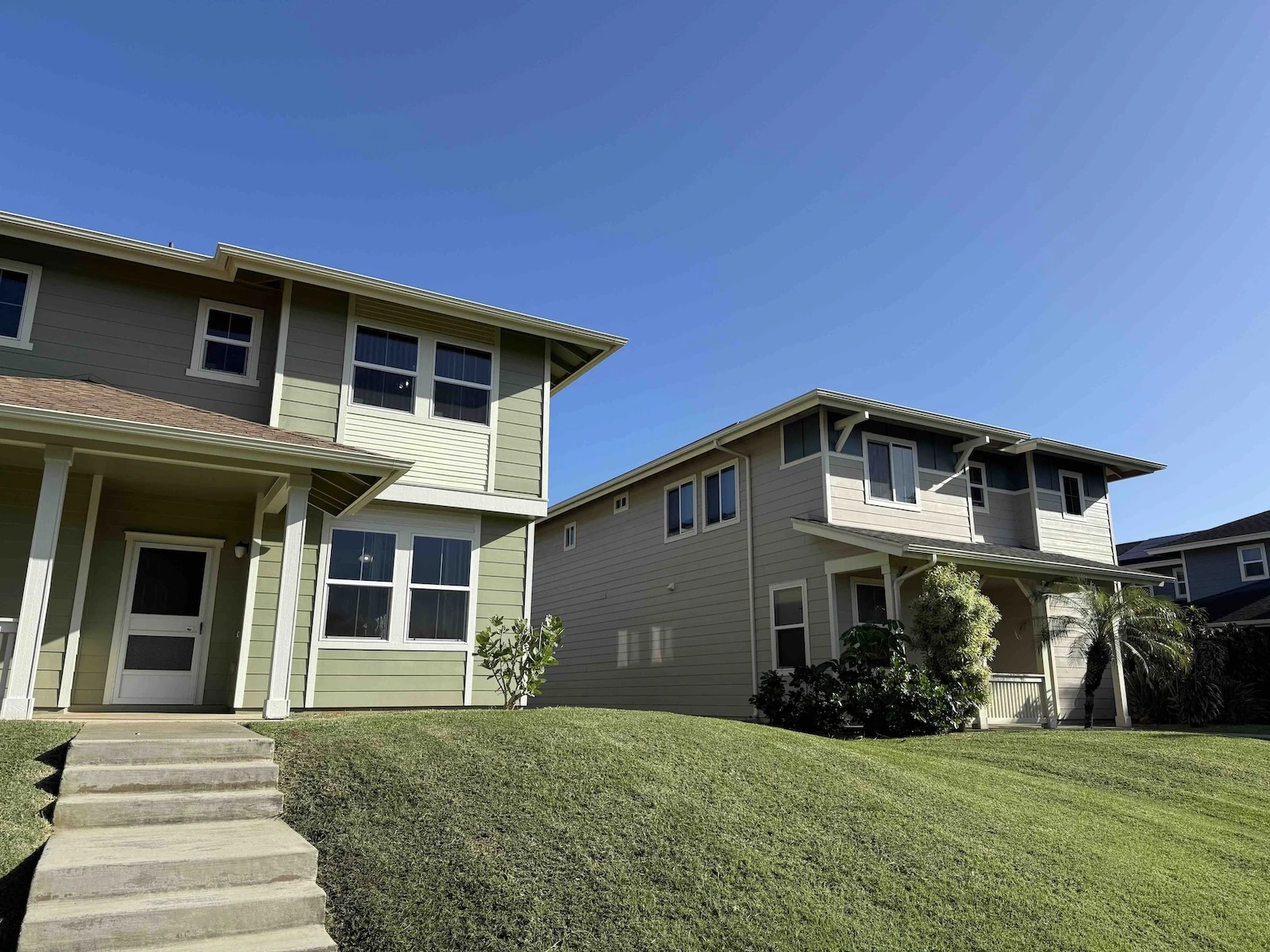
Jeff Choi, vice president of operations for ʻOhana Military Communities, recently gave ASD a tour of homes at Joint Base Pearl Harbor-Hickam.
He shared how it’s been adopting the new technology and other local updates.
“One of the really exciting things — and I've been doing this for just over 20 years, in military housing for five — is that Brian [Stann] decided he was going to build the technology and not wait for somebody else to catch up ... itʻs built for what we do,” Choi said.
According to Choi, some of the tech initiatives, including custom mobile apps, have been rolled out in Hawai’i, with more planned.
Out of its nearly 200 employees in the Islands, there are about 90 technicians, he said, adding, “We aim for best in class service 24/7.”
Under military contracts, there are strict rules and regulations ‘Ohana Military Communities must abide by, he said. One, for example, is that in an emergency situation, their response time must be 60 minutes or less. He explained that typically includes plumbing leaks, electrical issues and more.
“Our new app, I’m calling it a ‘shot clock’, is designed with these very specific requirements for military housing,” Choi said with a smile. “So, I think it’s going to make our technicians lives easier.”
The quick response time, he added, is also “a great benefit of living here.”
Currently, technicians are still beta testing the work order app, Choi told ASD. Once out of the testing phase, residents will be able to download the app to view status of work orders.
Other tech initiatives on the leasing side helps community managers, who have been using tools that aid with move-outs since last a year. In the works is another for incoming residents.
“That has really upgraded the quality of the turn process for us, just the overall inspection of the houses; We want everything checked. We want the appliances checked. We want the flooring and the paint checked – it’s been a big piece of what we do,” he noted. “This way inspection lists are just kind of uniform and standard across the company. We take pictures and document it, and its been exciting to have a custom app for that, too.”
Hunt’s leadership has assisted the local team through training and support, Choi added.
For Brent Arakaki, Hunt Military Communities’ director of development, the backend of the home turning software will help long-term.
Choi said, for example, if they were to replace HVAC systems in a neighborhood, developers would be guessing at its age, make and model with minimal information.
“That data is piecemeal right now, but these apps should complete that picture.”
Arakaki added: It takes time. Understanding how that would help from an asset management and strategic standpoint to fine-tune the investments, that would help tremendously. And it might not cause us to do a project every 15 years based on the volume of assets, maybe we do two or three. But we extend the life cycle of certain units because we have more data. We might approach projects differently, and we can identify which models are not working. That type of feedback will be helpful in our procurement, selection and conservation of resources.”
Development updates
Arakaki says there is $57 million in construction volume carrying over to 2026 in multiyear projects. With $42 million in additional funds this year, a total of $99 million in backlog construction volume remains. “We just can’t finish that level of work in year.”
Funds go toward exterior painting, roofing, air conditioning replacements, landscaping and irrigation, and more. Local companies are contracted for the work, Choi said.
In terms of developing new housing in Hawaiʻi, Arakaki told ASD they are waiting.
“Congress decides if they want to build out the forces in Hawaiʻi to add on phases, so this would be Phase 7, warranting more Navy or Marine housing. Then we compete on that for the contract. They did have an exercise two years ago to look for vacant land … but until that gets approved, then it’s not a real project."
The previous Phase 6 development cost $144 million, Hunt confirmed, adding, “Phase 6 was Hunt Military Communities' last development phase in Hawai'i, delivering 260 new homes between 2017 and 2018. The project was located on Marine Corps Base Hawai'i to demolish, rebuild and privatize the last remaining government-operated family housing units.”
For the latest news of Hawai‘i, sign up here for our free Daily Edition newsletter.
Kelsey Kukaua Medeiros can be reached at kelsey@alohastatedaily.com.