A place of gentle rains, verdant forests, and an almost daily arch of color across the sky, Mānoa has long been known as the Valley of Rainbows. In Hawaiian tradition, this beauty is explained through the story of Kahalaopuna, the famed “Rainbow Princess” of Mānoa.
Long ago, Kahaukani, the strong, swirling wind deity, and Kauahuahine, the gentle, misty rain deity, were united, and from them was born Kahalaopuna, a young woman of extraordinary spiritual radiance whose presence was marked by rainbows. From infancy, she had been promised in marriage to Kauhi, a high chief of Kailua.
But jealousy and deceit intervened. Two lesser chiefs falsely boasted of intimacy with Kahalaopuna. Hearing the lies and never having met his betrothed, Kauhi believed them. Consumed by jealousy, he sought her out and, despite her innocence and gentle nature, attacked and killed her. Through the aid of a large pueo who was a god and a relative of Kahalaopuna, she was restored to life several times as Kauhi continued his cruelty across the mountains and valleys of Oʻahu.
After Kauhi killed his betrothed one last time and buried her under the roots of a huge koa tree, the pueo was unable to retrieve her. However, her story did not end there. Her spirit came across a kind young ali‘i named Mahana and directed him to where her body lay. After he pulled her from the shallow grave, he brought Kahalaopuna to his home in Kamō‘ili‘ili. Mahana’s brother, a powerful kahuna, and their two spirit-sisters were able to once again restore the young maiden to life.
When the truth of her murder was revealed before the ruling ali‘i, Kauhi confessed to his actions. Justice followed, and Kahalaopuna was freed from her betrothal and allowed to choose her own future. She married Mahana, who had shown her love and loyalty.
Yet their peace did not last forever. In time, Kauhi returned in the form of a shark and claimed Kahalaopuna’s life as she was swimming just off the shore at Kaimana Beach. With her passing, her parents returned to their elemental forms as the Wind and Rain of Mānoa. Their presence, it is said, still brings the valley its gentle showers and brilliant rainbows — everlasting reminders of Kahalaopuna.
Mānoa Valley was known as a place favored by aliʻi, including King Kamehameha I, King Lunalilo, Princess Ke‘elikōlani, and Queen Lili‘uokalani. Its cool winds and steady rains made it one of the most fertile and desirable regions on Oʻahu. Queen Ka‘ahumanu kept her home in the valley and passed away there in 1832.
Extensive loʻi kalo spread across the valley floor, fed by numerous streams descending from the mountains. The valley also contains significant travel routes that connected Mānoa to Waikīkī and other parts of O‘ahu. Through generations of use, the trails running through Mānoa became associated with processions of high-ranking individuals and their attendants. In later years, these ancient routes would be recognized in stories of the huaka‘i pō, the ghostly processions said to retrace the footsteps of aliʻi and warriors.
Even today, many believe Mānoa remains under the watch of its ancestors, particularly in the back of the valley in the area known as Paradise Park. Visitors and caretakers have long reported unexplained whispers, quiet chanting, shadowy figures, moving pōhaku, and the unmistakable sense of being watched by unseen eyes.
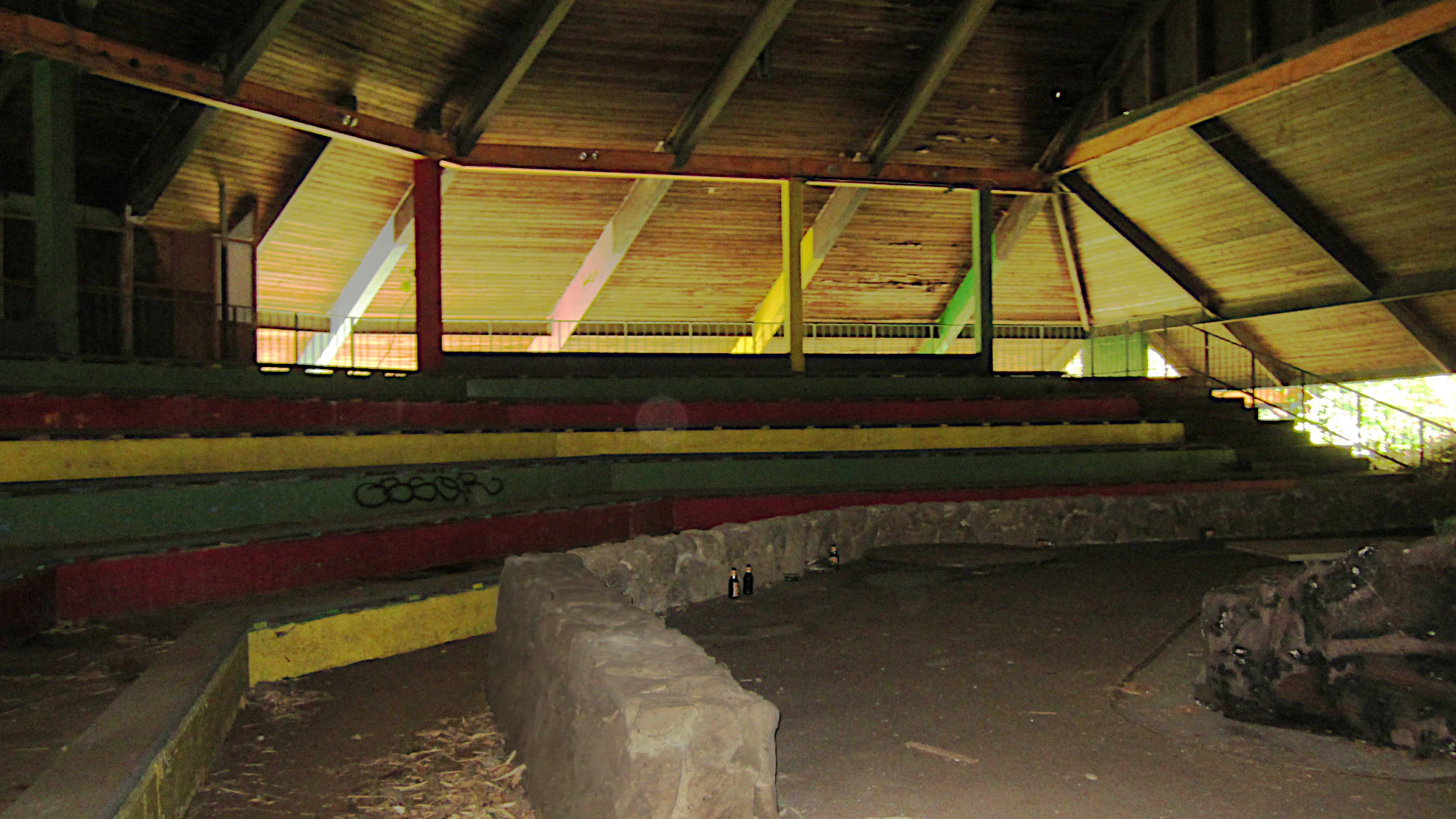
Paradise Park has welcomed visitors to its botanical and zoological garden since 1968. Many of us remember the tropical gardens and mazes, but we’ll never forget the birds! People walked past the aviaries with their huge collection of tropical birds, such as flamingos, macaws, and cockatoos, while others lined up to have their picture taken with the parrots on their shoulders. After walking the grounds, visitors converged on the Kamehameha Amphitheater to watch the birds perform circus tricks, like riding a miniature bicycle across a tightrope. In its later years, the park featured a dinosaur exhibit that set many a child’s imagination wild. Upstairs in the main building, Treetops Restaurant hosted quiet dinners with a beautiful and extensive view of the back of Mānoa Valley.
A significant decline in visitors, coupled with rising operational costs, caused the park to close its doors in 1994. The dinosaurs were packed up, and aside from a few escapees, the birds were sold to zoos and other aviaries. For a time, only the restaurant and offices remained.
Today, while the Rainbow’s End shop greets hikers and local explorers with coffee, snacks, and Pineapple Soft Serve, others attend dance classes and meetings in the halau and classroom that are available for hourly rental. Aunty Pua, one of the caretakers, shares her art gallery full of beautiful sculptures and paintings by local artists, with a large section featuring the works of Brooke Kapukuniahi Parker.
But the spirits of Mānoa remain active with consistent reports of strange encounters in the building, odd occurrences on the grounds, and even reported night marchers in the lower parking lot.
A few years ago, we were given permission to bring a group into the closed park to share stories of hauntings that occurred in the valley. We met in the lobby of the building and then walked down the gravel driveway to the main part of the park. We passed old cages covered with overgrown vegetation and explored a couple of buildings that were still structurally sound. And then we sat in the amphitheater for several minutes, listening for anything strange or unfamiliar. After the tour was over, we all walked back up the hill and sent our guests on their way.
A few in the group stayed with us as we went to the visitor’s center to meet with Aunty Pua. When we knocked on her office door, she came out, surprised and confused. She questioned us thoroughly about when we returned and whether anyone had come looking for her earlier.
She showed us the chicken skin on her arms and said that a few minutes after we brought the group down to the park, she glanced at the security monitor and saw me, my wife, and three or four others standing in the lobby. She said it was clearly us.
“You’re kind of unmistakable, even on a small monitor!” she told me.
She thought there was a problem with the tour or getting down to the park, so she came rushing out to see what we needed. But we weren’t there. Classes were over, the shops were closed, so nobody else was in the building. Rushing to the entrance, thinking we walked away, she saw no one. When we returned over an hour later with our group, we looked exactly the same as when she rushed out, and no one was there.
According to Aunty Pua, there are ghosts, spirits, and even night marchers that wander through Paradise Park, but doppelgängers were a new kind of haunting for her. Although the park is closed, it’s worth a drive to check out the shops and the gallery. If Aunty Pua is there, she’ll be happy to share a haunting story if she has time. But even if you don’t see any ghosts, the artwork is amazing, and the Pineapple Soft Serve hits the spot.