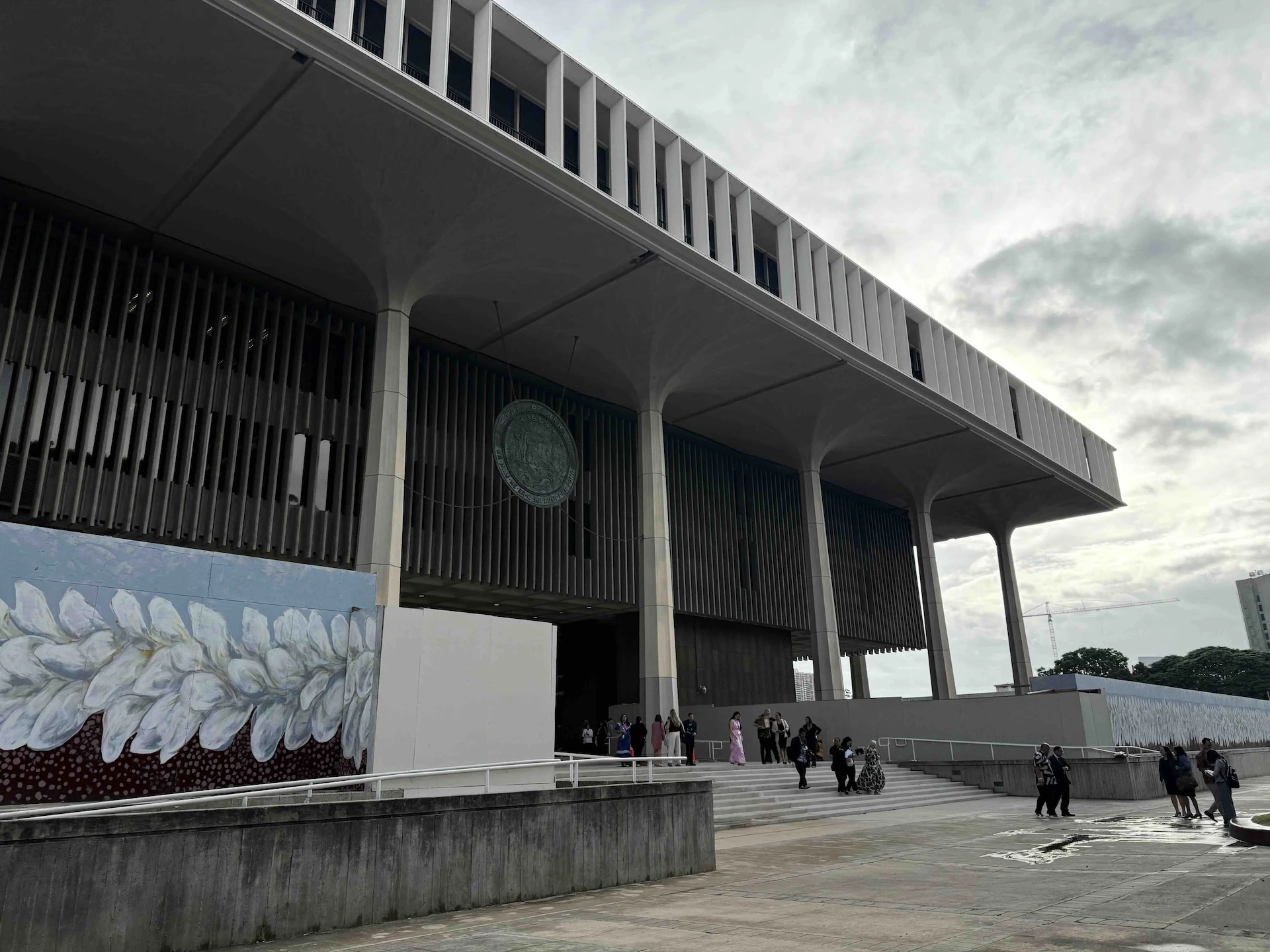
A state proposal to limit the governor’s emergency powers has been lambasted as government overreach.
Throughout the Covid-19 pandemic, then-Gov. David Ige made more than 20 consecutive emergency proclamations that suspended various state statutes without oversight from other branches of government.
Senate Bill 2151 is a measure drafted partially in response to those proclamations, attempting to define what the governor or any county mayor can and cannot do through an emergency declaration.
But the bill has drawn controversy from individuals who believe the bill signifies an attempt to codify extrajudicial authorities for the executive branch.
Testimony on the measure submitted in advance of a Senate Judiciary Committee hearing on Tuesday excoriated the bill, with dozens calling it governmental overreach empowering the governor to activate sweeping powers on a whim.
“[SB 2151 hands] one person — the governor — near-unchecked power to declare emergencies, suspend our rights, enter our property without permission, lock us down, seize assets, or disarm us, all with too-little real accountability from the Legislature or courts,” read one letter by resident Dawn O’Brien, which echoed sentiments repeated through much of the testimony at Tuesday’s hearing.
However, this is not what the bill does. Karl Rhoads, chair of the Senate Judiciary Committee and the bill’s primary introducer, told the committee Tuesday that he intended the measure to restrict the governor’s powers, and that much of the opposition facing the bill appears to be misdirected.
“There’s been a lot of testimony opposed to it seemingly thinking that this bill was expanding the governor’s power and it is certainly not,” Rhoads said.
As currently written, the bill prohibits any emergency declaration from overriding the state’s requirement to respond to public records requests in a timely manner.
Ige’s early Covid proclamations suspended the Uniform Information Practices Act, which requires public agencies’ records to be open to public inspection and review. They also included a partial suspension of the Sunshine Law — which requires state and county boards to hold meetings open to the public — to allow for meetings to be held entirely remotely.
By the 18th such proclamation, in Feb. 2021, the UIPA was only suspended insofar as agencies did not have to adhere to deadlines. However, the partial Sunshine Law suspension continued.
SB 2151 specifically prohibits a governor or mayor from suspending deadlines to respond to UIPA requests, or deadlines for the Department of Health to provide various patient vital records. However, the bill allows for a “reasonable delay” for the DOH to provide the latter during extenuating circumstances.
For those laws that can still be suspended through an emergency proclamation, another section of the bill specifically details how those suspensions can be carried out. As stated in the bill, any suspension of law cannot last any longer “than the governor deems necessary for the execution of emergency management functions.”
The same applies for county laws and emergency proclamations issued by mayors.
For every law suspended, the bill specifies that any emergency proclamation must identify the specific statutes affected and explain why the suspension is necessary for emergency management.
Furthermore, the bill introduced by Rhoads would amend the emergency powers law to allow the state Legislature to terminate a gubernatorial state of emergency by a two-thirds majority vote. The same goes for county councils, which could vote to end a county state of emergency by a two-thirds majority.
The latest version of the bill also amends the statutory definition of “emergency” to specify that it must be an imminent threat of a disaster that could cause “catastrophic harm and immediate danger” and that could be averted or minimized through timely action. Rhoads said Tuesday that this precludes the possibility of the governor issuing emergency proclamations regarding homelessness, which Rhoads noted “has been with us for many years.”
This isn’t the first time Rhoads has attempted to pass a similar bill. Last year, SB 353 — which proposed much the same changes as SB 2151, with much less public opposition — came very close to passing, but failed in April over disagreements between the House and Senate regarding various amendments made to the measure.
But while the bill may not be an expansion of the governor’s powers, it has attracted criticism from other directions. Several testifiers argued that the bill still allows the governor or mayor to be the sole judge of whether something is an emergency, and to continually re-issue consecutive proclamations despite an existing statute that automatically terminates a state of emergency after 60 days.
Nor does the bill remove existing statutes allowing the governor to enforce quarantines against people believed to be infected with a deadly contagion, or to seize and destroy property, or to authorize unpermitted entry onto private property, or seize firearms, all of which dozens of testifiers have demanded to be changed.
On the other hand, several groups voiced support for the bill, including the Grassroot Institute of Hawai‘i, which lauded the measure’s ability to both preserve the intent of emergency statutes while also checking the executive branch’s power.
The state Office of Information Practices, which responds to UIPA requests, took no stance on the measure, stating that the matter “is a policy decision for the Legislature to determine.” However, OIP confirmed that the suspensions of the UIPA during the pandemic “had a significant effect on requesters, agencies and OIP’s own operations,” with people experiencing long delays before receiving official responses to record requests.
The Senate Judiciary Committee took no action on the measure on Tuesday, with Rhoads deferring any decision on the matter until March 5. A corresponding bill, House Bill 2236, passed second reading in the House on Feb. 18, but has not yet been scheduled in that chamber’s own judiciary committee.
For the latest news of Hawai‘i, sign up here for our free Daily Edition newsletter.