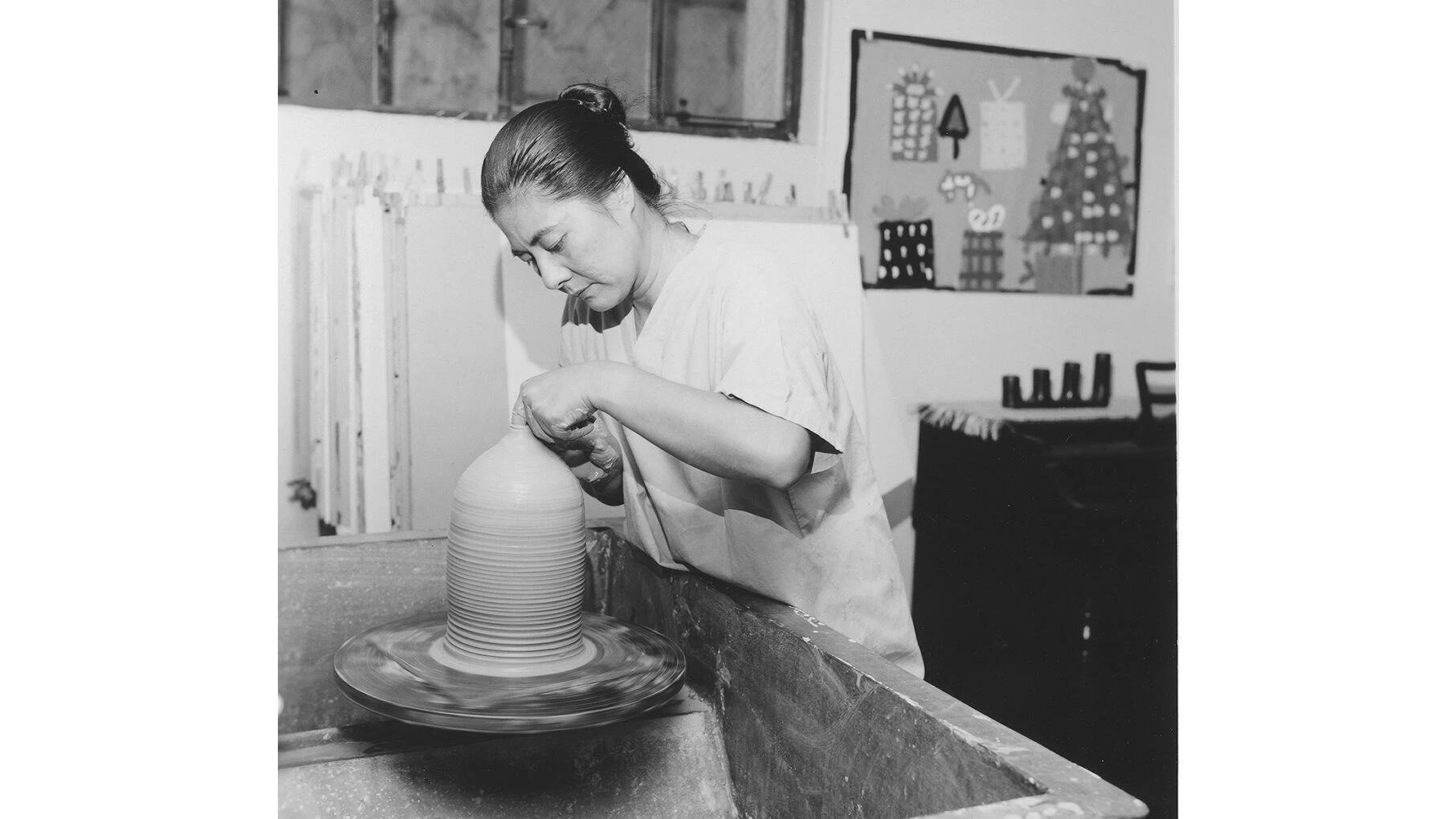
Influential artist Toshiko Takaezu (1922-2011) was inspired by the places that shaped her youth: Hawaiʻi Island, Maui and Oʻahu. She used glazes like Makaha blue and some of her work includes bits of volcanic sand.
In the art world, she took audiences by surprise when she used clay to create not just functional items, such as ice cream bowls, but her signature “closed form” ceramic sculptures, which included rattles, stones, textiles, paintings and bits of hidden poetry.
Through Sunday, July 26, more than 120 pieces of her work are on display at Honolulu Museum of Art as part of the special exhibit “Toshiko Takaezu: Worlds Within.” It features the artist’s paintings and textiles, as well as ceramics. Today, HoMA has more than 100 works by Takaezu in its collection, at least a dozen of which are featured in “Toshiko Takaezu: Worlds Within.”
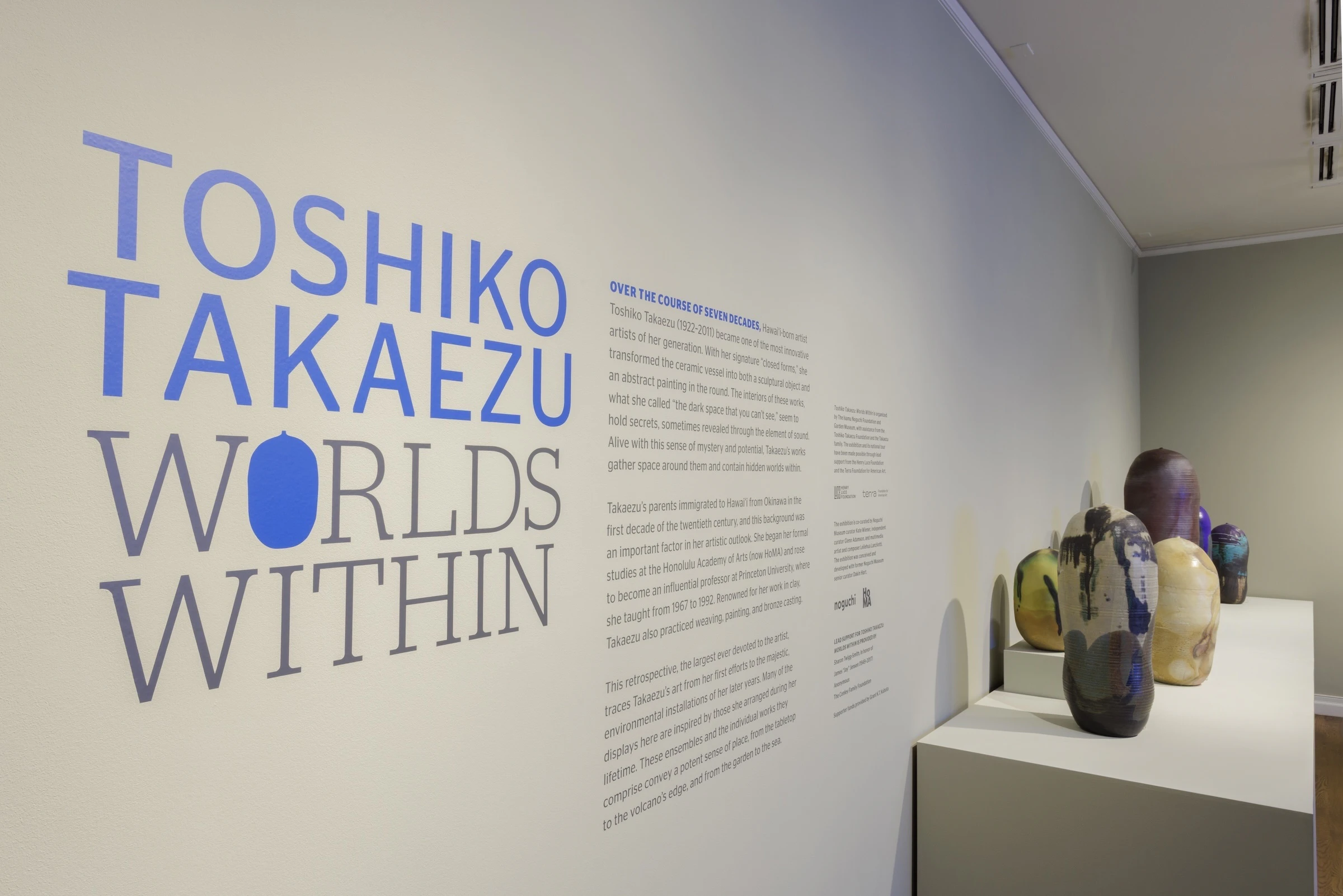
The exhibit "Toshiko Takaezu: Worlds Within" opened Saturday, Feb. 14. It runs through Sunday, July 26. (Courtesy Honolulu Museum of Art/Alec Singer) 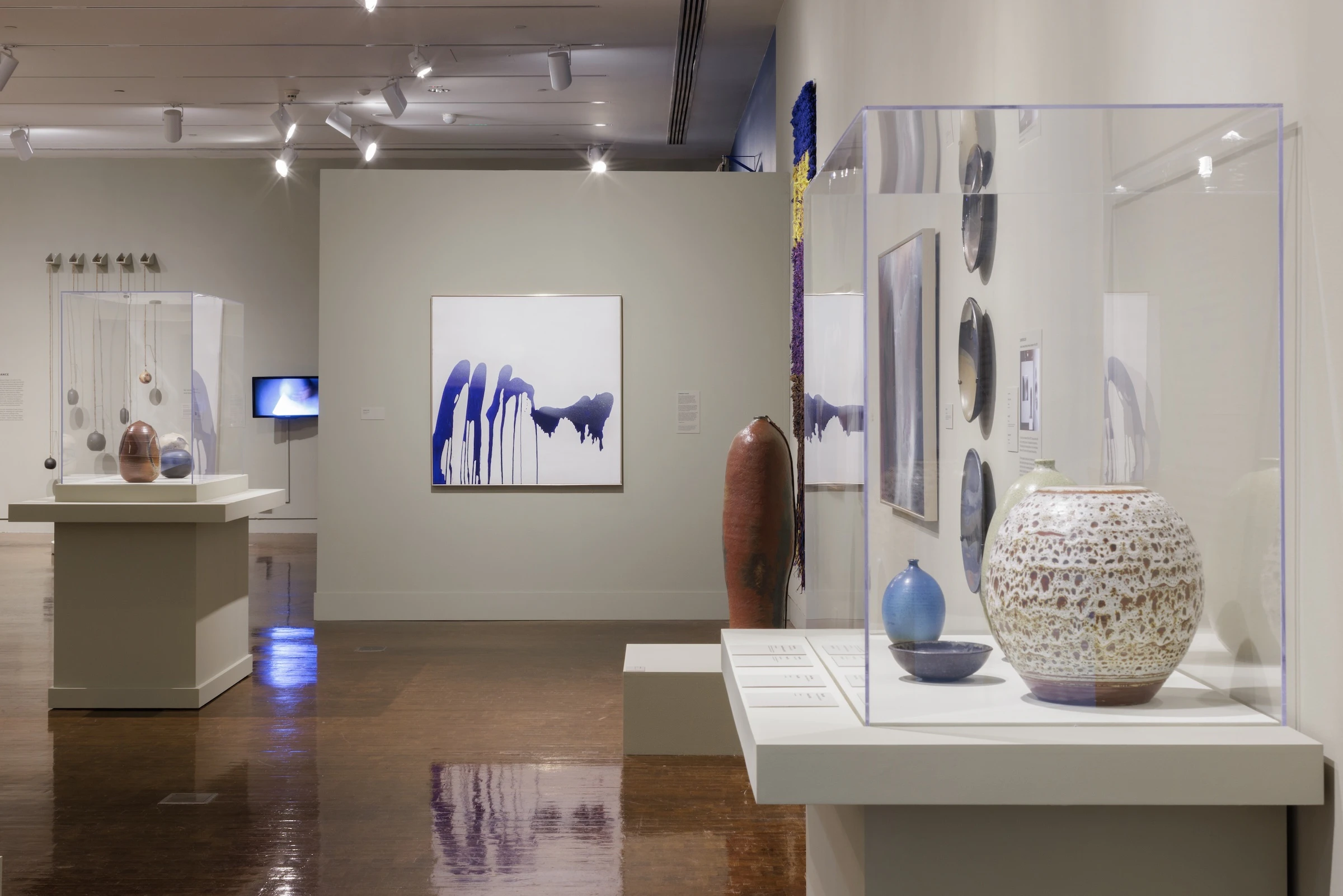
The exhibit "Toshiko Takaezu: Worlds Within" includes not just the artist's ceramics, but also paintings and tapestries. (Courtesy Honolulu Museum of Art/Alec Singer) 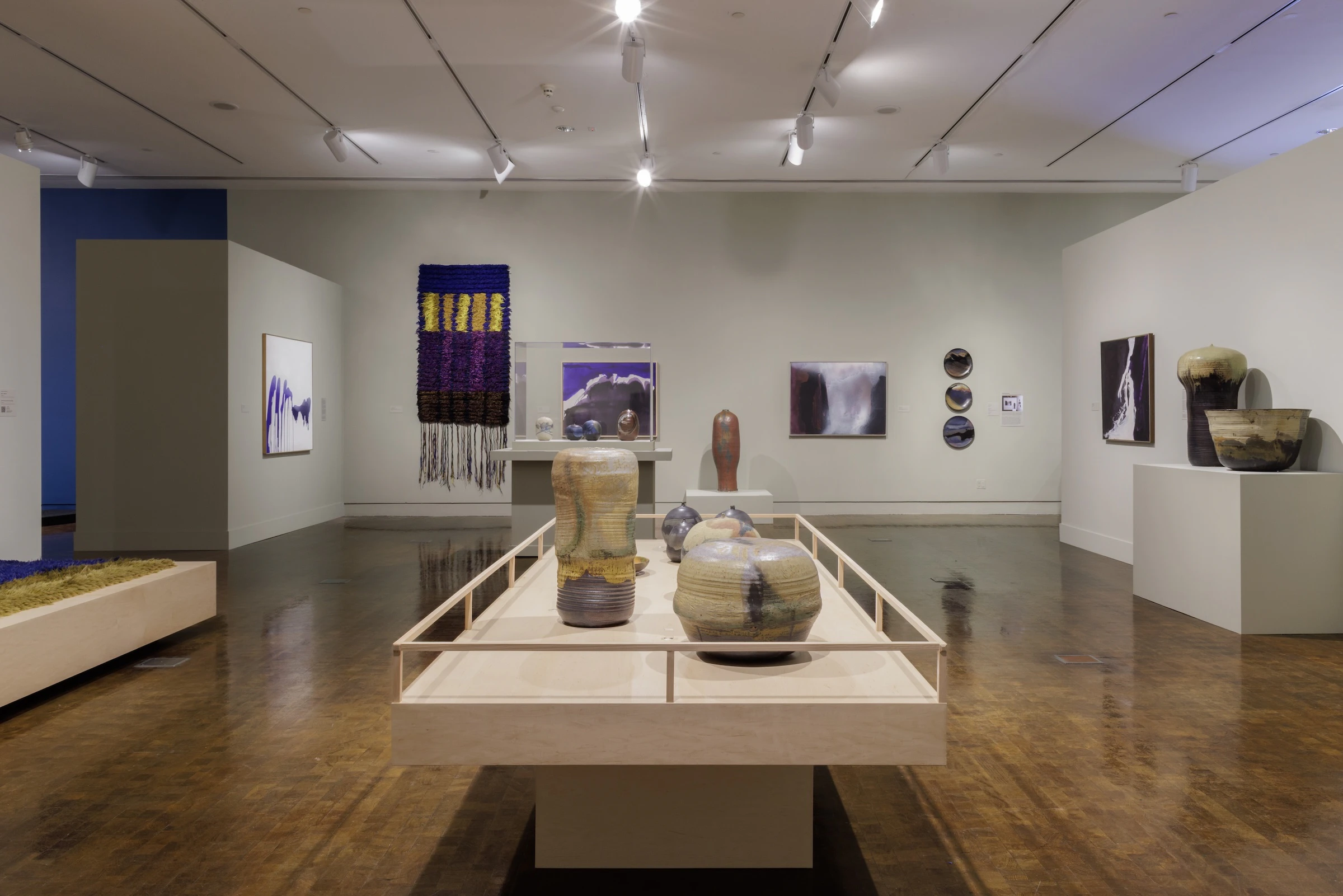
Toshiko Takaezu also created artwork from textiles, as displayed top left. (Courtesy Honolulu Museum of Art/Alec Singer) 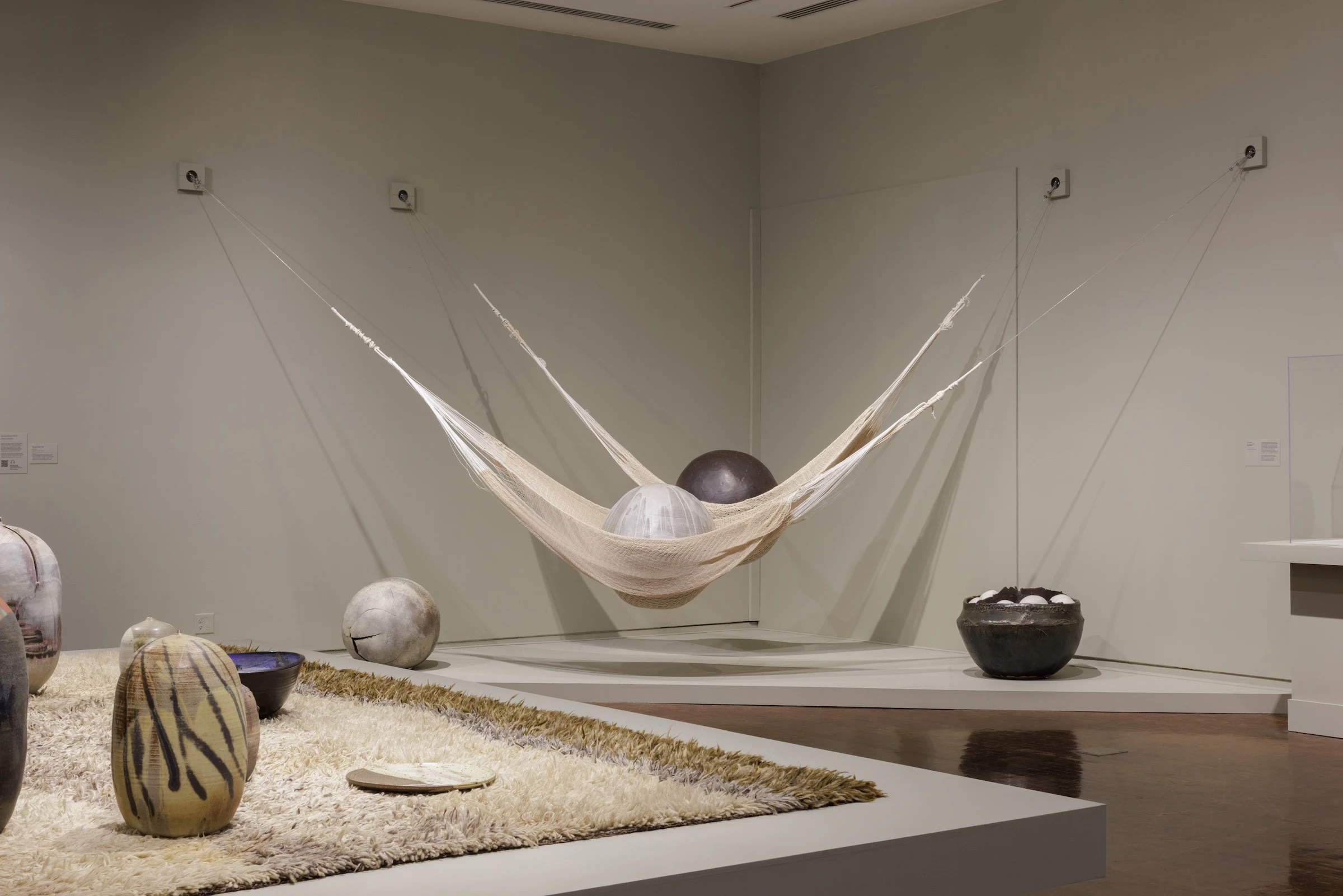
Toshiko Takaezu used nets to hold some of her drying pieces, but later decided this was a way to display her art. (Courtesy Honolulu Museum of Art/Alec Singer) 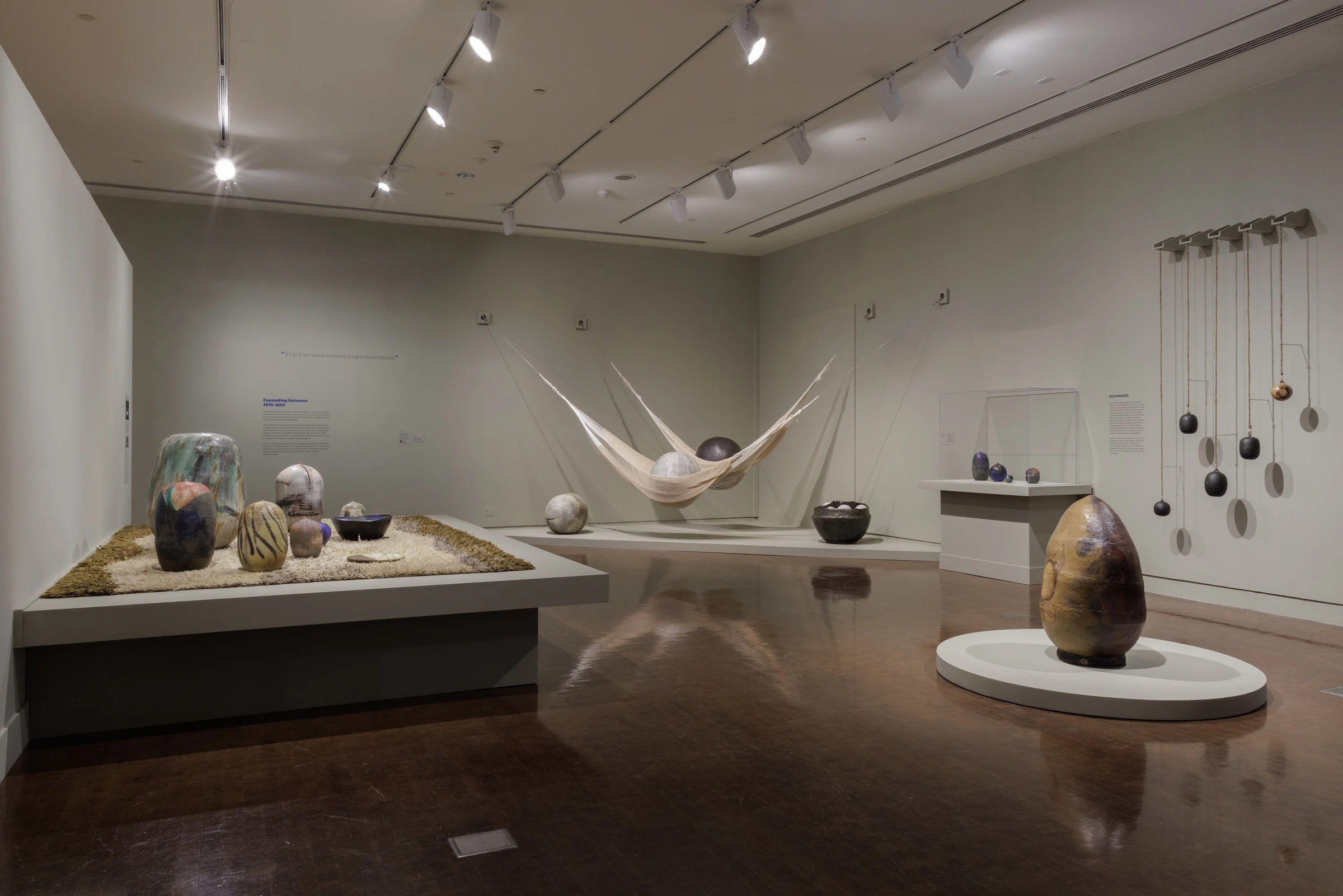
Toshiko Takaezu started making functional ceramic pieces, but eventually began creating "closed form” ceramic sculptures, which included rattles, stones, textiles, paintings and bits of hidden poetry. (Courtesy Honolulu Museum of Art/Alec Singer)
Sound plays a role in Takaezu’s closed form ceramic sculptures and Leilehua Lanzilotti, a Native Hawaiian composer and a co-curator of the exhibit, demonstrated some of them in videos. The museum also commissioned Dane Hi‘ipoi Nakama, a Hawai‘i-based artist, to create closed form ceramic works inspired by Takaezu’s art, which guests could hold and shake, giving the exhibit a hands-on component.
Takaezu’s relationship with the museum started in 1947, when she took painting classes at what was then known as the Honolulu Academy of Arts. More than a decade later, in 1959, Takaezu had her first solo exhibit at the museum, which was followed by a second one in 1973, and a retrospective of her work until that point, in 1993.
Takaezu eventually went on to take classes at the University of Hawaiʻi at Mānoa, and later began teaching adult classes at the YWCA in Honolulu. Eventually, she left Hawaiʻi to attend the Cranbrook Academy of Art in Bloomfield Hills, Michigan.
She traveled the world, including Japan to explore her family heritage, Bolivia and Peru to experience other cultures and understand Indigenous crafts; and Guatemala to visit Indigenous weavers, according to the Toshiko Takaezu Foundation, a nonprofit which works to preserve her legacy. She also taught at Princeton University.
Takaezu died in 2011. But she visited HoMA up until the year before, according to representatives of the museum. Today, the Takaezu Studio, which was her home in New Jersey, still serves as a creative space for public workshops, biennial raku firings for students of Princeton University’s ceramics classes, and artistic residencies.
Aloha State Daily spoke with Los Angeles-based Darlene Fukuji, who reflected on her great-aunt and the inspirations that shaped Takaezu as an artist and a certain ice cream bowl that art curators want to put behind glass.
How did Hawaiʻi impact Toshiko as a person? And her art? No matter where my Auntie Toshi lived, she embraced the nature that was around her. Of course, growing up in Hawaiʻi, on the Big Island and Maui, and then coming eventually to Honolulu or Oʻahu, the nature and environment were just so much a part of her identity and everyday life. She did a great job of capturing some of those colors and hues in a lot of her works. I know times are different now, but back then, she was putting volcanic sand into the glazes, especially after her visit to Devastation Forest and seeing the volcanoes erupt. Now, you wouldn't do that because we just know not to mess with Pele and what that can cause. But back then, I think it was more of a common practice. She definitely wanted to bring Hawaiʻi into her work — quite literally — and did so in a lot of different ways, too.
How did she get started? She was working as a housekeeper. They called it something different back then, but essentially a modern-day housekeeper. It was during World War II times, and [that family] had a production pottery company, which is the Hawaiian Potter's Guild. They did more production wear. So, when you first enter the exhibition, if you look on the left-hand side, there are some examples from that time there. … Because she ended up working for the family that had this production pottery company, that was her first taste into ceramics, and she quickly took to it. But she was also very interested in weavings. One of her first loves was fabric, tapestry weaving, and she captured a lot of Hawaiʻi colors through that, as well. That's how she got started.
I can’t imagine starting college in my 30s. And deciding you want to be an artist then. She started to take classes or audit classes at UH Mānoa, and that was the time when Claude Horan was starting up the program there, and they would bring in all these world-renowned artists to come and visit and do talks. And she got that bug and wanted to go to Cranbrook [Academy of Art] to study under Maija Grotell.
She went back to school in her 30s. Can you share more about that? I can't imagine deciding you want to be an artist in your later years, when everybody's kind of — I don't know what the normal was, but I'm pretty sure the normal was you get married. You have kids pretty early on. Not go to school and decide you're going to be an artist. But I think she knew she was meant for it, and she went with a group of other artists from Hawaiʻi as well, and went to Cranbrook.
How would you describe your great-aunt in three words? Poetic, bold and truthful. (She laughs).
You're laughing about that last one. Yeah, she was not afraid to tell people what was on her mind. Maybe it runs in the family. (More laughter).
How was she “poetic"? My take on her poeticness was the way that she spoke. I don't know how to describe it, but it was almost like the way she spoke was poetic. It wasn't in complete sentences all the time. It was these wise sayings that came across as simple, but very complex at the same time. That's what I mean by poetic. She just was a unique individual. She was a force and had this unique way about her and this draw to her.
What are some of the things you learned from her over the years? She lived mostly in the east coast, but would also live a good chunk of time during the summer and then winter times in Hawaiʻi when she wasn't doing workshops all over the place. But when I grew up with her, she always had this entourage around her. I don't know how else to describe it. Lots of friends. And I was young, so I don't quite remember who was who. I just kind of know familiar names, but she was always very adamant on using your hands to make things, to do things — and also education. She was always asking about school and taking a real keen interest in that and being very supportive.
She helped shape everyone in my family to see the importance of art in our everyday lives. She would make work, and it was meant to be used as functional ware, too. And I think in being a part of protecting and promoting her legacy, curators [will say things like], ʻOh my gosh, you use this as your fruit tray? Or you use this as your ice cream bowl? This is crazy!’ But she was very humble as a person. In a family, no one cares who you are or what you do, it's just your family. I had no idea she was a famous artist. Like you kind of knew, but not to the extent. And only, I think, in my older age have I started to get a better understanding of how prominent of an artist she is.
So, you have an ice cream bowl at home? Yeah, she made me an ice cream bowl. I lived with my grandma, her sister, for a good amount of time as well, since my parents were divorced. And all the siblings would come over almost every night and drink coffee and talk story, so I have fond memories of all of the siblings — especially the sisters — being very, very close and supporting one another. My Auntie Toshi supported so many people in our family. We wouldn't be who we are if not for her support and generosity.
What was it like to attend the opening of the exhibit? That was definitely a full circle moment. I'm so pleased with the locals who came out to support her legacy. And it was kind of this family reunion where east meets west, because she lived in both the eastern world and western world. And Hawaiʻi is kind of in the middle of all of that, too. And it was a lot to process, so I started just writing my reflections, and then decided to do a poem that I can send to you. Because it just took me a long time to get over this excitement and high of seeing everybody together, from family to her friends to the next generation of [artists].
Toshiko Takaezu’s Homecoming
The great abstract expressionist sculptor
from Hawai‘i, who paved the way for many
reaching for the stars and shaping her own moons
an Uchinanchu woman painting in the round
Closed forms holding secret messages
Rattles with their own voice
Fingerprints tattooed into the glaze
Weavings in the hues of Hawai‘i
Full circle back to where she first took a clay class
still drawing big crowds
creating reunions of friends, families, artists, students, and apprentices
giving honor to the land that shaped her
For me it has been a journey of a lifetime
seven years in the making,
ensuring her place in history.
Her flowers were given
this Valentine’s Day.
-Darlene Fukuji, reflecting on her great-aunt, Toshiko Takaezu
HoMA offers free admission for kamaʻāina on the third Sunday of each month, which includes access to the special exhibit. Explore the galleries and outdoor spaces, plus get creative and become the artist while taking part in hands-on activities. HoMA also offers a number of curated art talks and classes that correspond with this special exhibit.
For the latest news of Hawai‘i, sign up here for our free Daily Edition newsletter.
Katie Helland can be reached at katie@alohastatedaily.com.