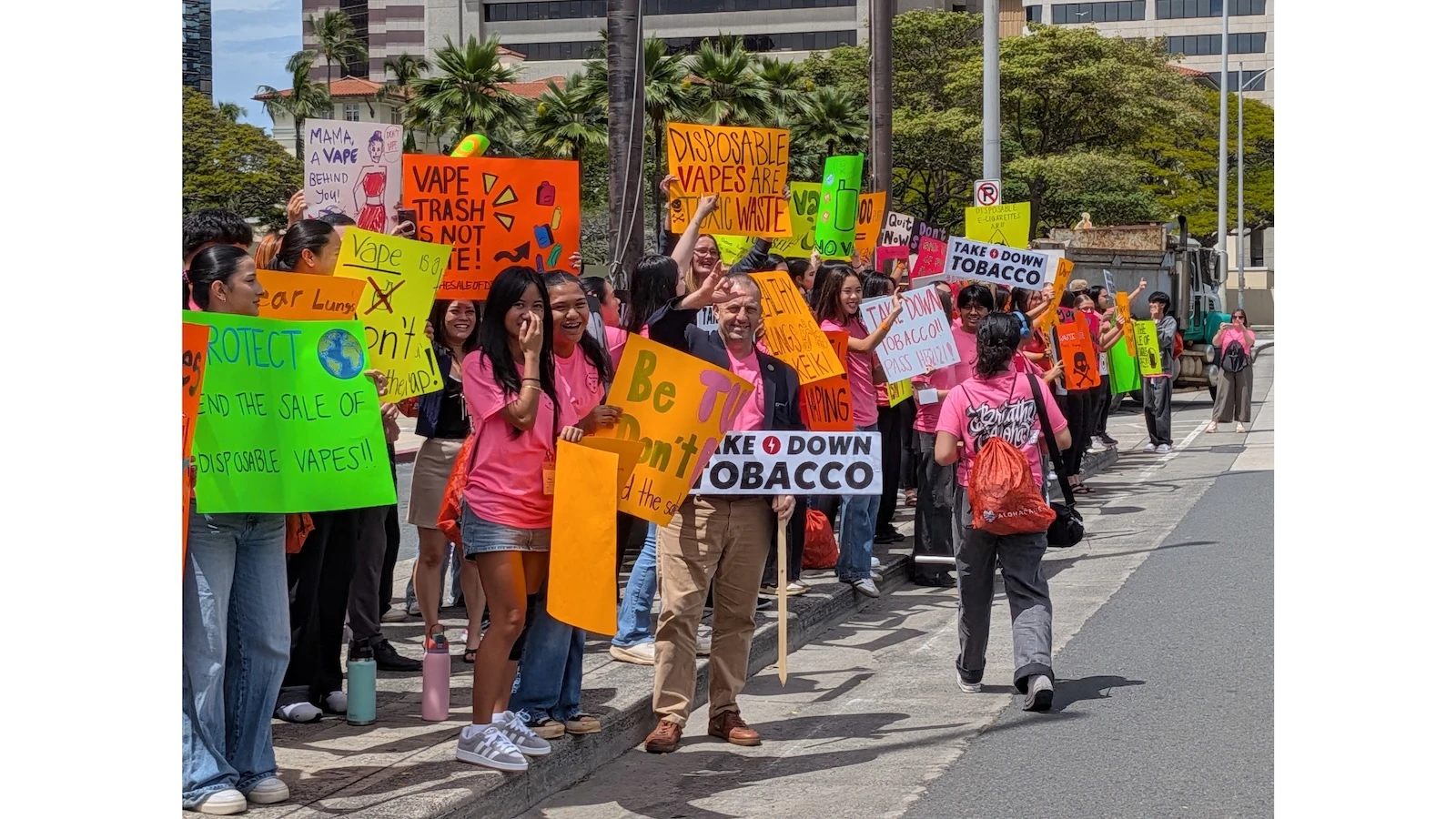
Yesterday, we covered a rally at the State Capitol that supported an arsenal of bills aimed at disposable vapes. There are bills to ban the devices entirely and bills that would enormously hassle businesses that sell vapes, likely intended to make so difficult to sell here that businesses just throw their hands in the air and give up on their own. Consider those latter bills passive-aggressive bans, "nudge theory" bills that hector citizens into compliance.
The arguments on disposable vapes are all over the map and I can't make any sense of the contradictory angles lawmakers in Hawai‘i bring up. It's just an all-you-can-eat buffet of sound bites that destroy rational thoughts.
Where to begin?
Let's start with the fact it is already illegal to sell vapes of any kind to anyone under the age of 21 in Hawai‘i and has been since Jan. 1, 2016.
You wouldn't know that from the photo of earnest, well-intentioned teenagers lining Beretania Street, demanding that lawmakers protect them from vaping. You certainly wouldn't know that from Dr. Gov. Josh Green standing right in the middle of these kids, holding a sign that reads "Take down tobacco."
Green can find the law here — he might be surprised to find that he already has the tool to solve just about every problem yesterday's rally was about.
Vaping is ubiquitous in high school bathrooms? Confiscate the vapes. Suspend the kids vaping. It's already contraband. Enforce the law.
Stores can't sell to anyone under 21 but somehow teenagers have vapes?
Enforce the 10-year-old law you already have. Maybe, instead of spending time on making vaping even more illegal, the Lege ought to hold some hearings on why Act 122 hasn't worked.
Who blew it? Somebody blew it. (Including some parents. I have no idea why the legal choices of adults have to be based on whether or not some parents can keep their own kids under control.)
Other impressions, looking at the messaging we see in the photo of the rally:
There's a novel argument being deployed here against the "toxic waste" of disposable vapes because they contain disposable batteries. This from a state government that has mandated a conversion of gas-powered automobiles to EVs, containing giant, toxic batteries. Also, what's the difference between the battery thrown away in a vape and the piles of AA and AAA batteries Hawai‘i households throw away all the time? No one even attempts to make logical sense of this. Don't think. Just visualize the toxic waste and ban, ban, ban!
Hawai‘i has a continued, and deliberate, campaign to refer to electronic vapes as "tobacco products." Dr. Gov. Green is literally holding this argument in his hands in the photo. It is, however, not true. There is no tobacco in the electronic alternatives. There is nicotine. That doesn't make them tobacco products any more than Excedrin is a coffee product because it also has caffeine. When government won't call something by its true name, something is wrong with what it's doing.
What local government is doing on vaping is actually making it harder for adults who smoke real, actual tobacco cigarettes to quit them. Consider that the UK's National Health Service — and don't American Democrats just love the UK's NHS? — actively encourages smokers to move to e-cigarettes to lower their personal health risk while lowering the socialized costs of treating the illnesses associated with smoking.
With that in mind, has Dr. Gov. Green or the state Department of Health attempted to calculate the costs of banning a popular alternative to smoking? How many needless lung cancers and heart attacks will people have as a result? The number isn't zero. It's just not a number the state cares about.
So if there's no tobacco in these products, just nicotine, and the nicotine itself is the problem, why is there never any legislation against the gum, the patches, the lozenges and such that you can buy in Hawai‘i stores, beyond age restrictions? The gum comes in delicious flavors, just like the vapes. Does it not also lure the young ones to a life of vice? What, if anything, makes gum-based nicotine better than vape-based nicotine?
One possible answer to that has nothing to do with our health and everything to do with moneyed interests behind the scenes. Consider that Nicorette, a major brand producing nicotine gum, patches, inhalers, lozenges and more, is owned by something called Haleon, a company spun off from pharmaceutical giant, GlaxoSmithKline, now known as GSK. Look into the ownership of the nicotine products sold as healthcare and you'll find Johnson & Johnson, Pfizer and so on.
Look into the ownership of vaping companies sold as cigarette replacements and you find tobacco companies.
One sector is government approved, the other not so much. How approved? "Nicotine replacement products including gum and transdermal patches are on the World Health Organization's List of Essential Medicines," notes Wikipedia, with link to WHO to prove it.
Essential. Medicine.
"The spice must flow." If you've read the science fiction classic "Dune," or seen the movies based on it, you know the whole plot is about monopoly control over a mind-sharpening drug called "spice." Here and now, on Earth, powers as big as WHO and as small as yesterday's little rally in Honolulu are playing their parts in a larger drama about who will control — and profit from — the lucrative nicotine trade. Hawai‘i has thrown in with the pharma giants. That's all that is happening. Nothing else said about health or addiction is even relevant, because official Hawai‘i has zero intention of purging nicotine from our system at all.
Final thought: I don't know what to make of a state government that clamps down on one vice — for our own good! — while enthusiastically exploring the legalization of gambling and recreational marijuana because the state is desperate to replace lost federal revenue. Neither of those are exactly safe.
Nanny state is gonna nanny, until revenues drop and then all of a sudden it's, "Hey, what we need now are some stoned slot-machine players we can tax! And lots of 'em!"
See, it's true. When you're addicted to something, like tax revenue, you can rationalize just about any anti-social behavior.
A. Kam Napier is editor in chief of Aloha State Daily. His opinions in Pipikaula Corner are his own and not reflective of the ASD team.
For the latest news of Hawai‘i, sign up here for our free Daily Edition newsletter.
A. Kam Napier can be reached at kam@alohastatedaily.com.