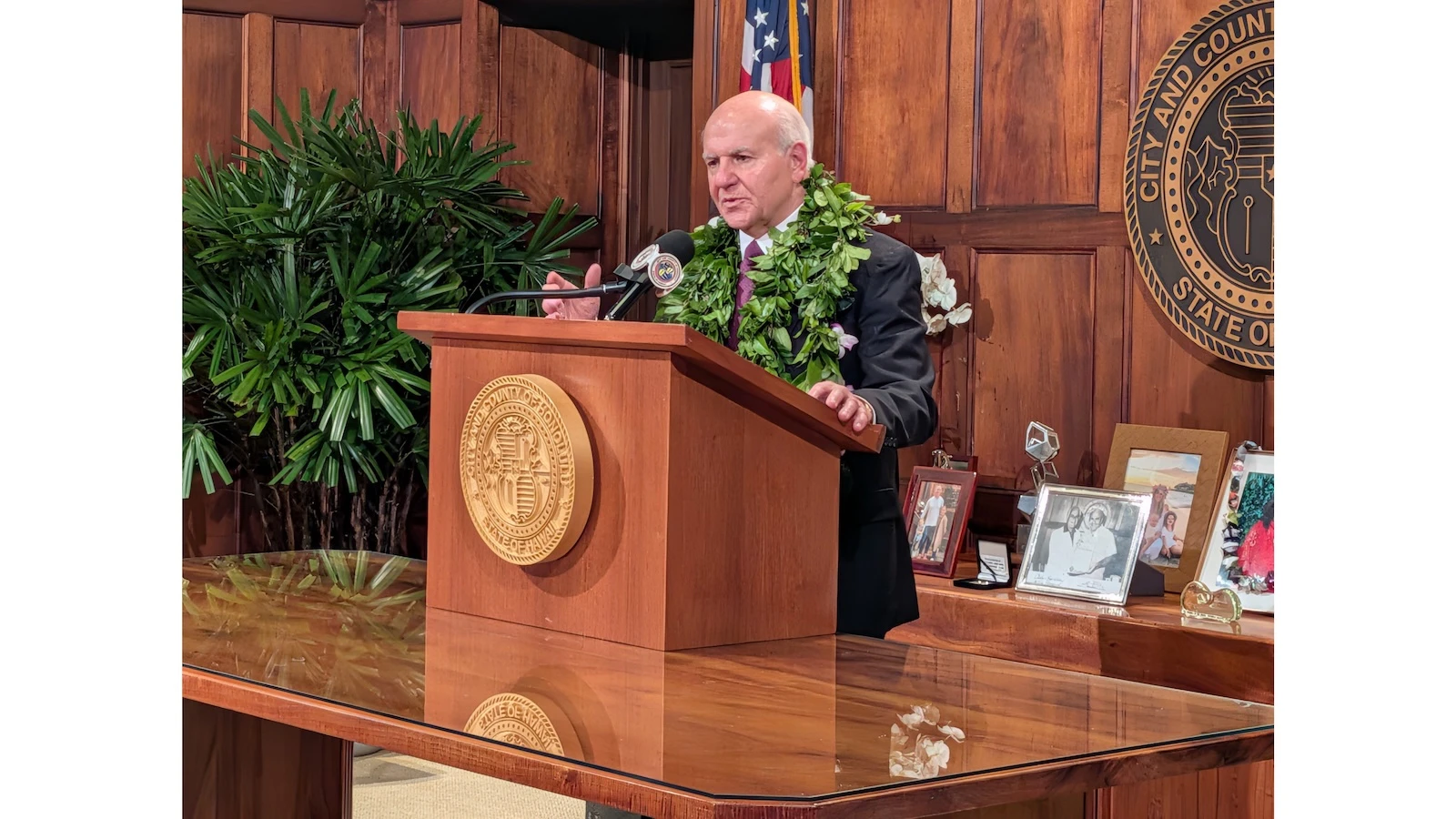
Honolulu Mayor Rick Blangiardi focused on a “common sense approach” during his sixth State of the City address on Wednesday.
Throughout his speech and a subsequent press conference, Blangiardi reiterated that his administration is determined to reduce government red tape that slows down projects and ultimately costs residents money.
“Systemic barriers within government, at all levels, added over time, slow our progress and drive up costs for our residents,” Blangiardi said during his speech at Mission Memorial Auditorium. “I want to focus on how we are restructuring the underlying systems that hold us back.”
Throughout his speech, Blangiardi emphasized several commitments to constituents, such as:
“We will not [raise property taxes] under my watch”
When Blangiardi spoke about his $5.08 billion budget proposal — $133 million less than last year’s budget — he introduced earlier this month, he said the city will need to find ways to stretch its resources further as federal funds become unavailable.
The mayor said nearly $900 million in federal funds, primarily tied to Covid relief, are no longer available to the city. At the same time, scheduled wage increases for city employees’ collective bargaining units are projected to exceed Honolulu’s economic growth over the next four years.
Despite this, Blangiardi promised he will not raise property taxes to make up the funding shortfall. Instead, he said the city will adopt AI tools throughout its departments so that employees can work more efficiently.
“We are focused on implementing AI that can handle repetitive assignments, manual data entry, and routine calls, so that our employees can focus on the work that requires a human touch,” Blangiardi said, adding that an AI system already handles about 40% of routine calls to the Department of Customer Services.
Blangiardi said the Honolulu Police Department is also investigating the possibility of using AI to help officers write reports faster.
This segued into another promise:
“There will be no AI-related job cuts here while I am mayor”
Blangiardi said the adoption of AI is not intended to reduce jobs, but reduce waste.
“When we cut waste, we work faster,” the mayor said. “And when we work faster, we lower costs — for everyone.”
Blangiardi repeatedly emphasized the need for modernization throughout the city’s departments. He highlighted the Department of Planning and Permitting’s rollout last year of HNL Build, the department’s new permitting software — which, he added, allowed DPP to clear “a record $3.3 billion worth of construction permits” last year.
“Modernization only works if the people using new systems feel comfortable doing so,” Blangiardi said. “Even if we install the most advanced software available on the best machines we can buy, we accomplish nothing if our employees don’t know how to use it … Every day one of our departments clings to an outdated process is another day families spend waiting.”
“I made a commitment — one I still believe in — to not locate O‘ahu’s next landfill on the Wai‘anae Coast”
Blangiardi spoke at length about the city’s need for a new landfill as the Waimānalo Gulch landfill approaches its capacity. He later told reporters at a press conference that his administration started the process of looking for potential sites years ago, but the Red Hill fuel spill changed everything.
After Red Hill, Blangiardi said, nobody would entertain the notion of a landfill located above an aquifer, which excluded most of the potential sites his administration identified.
“O‘ahu must have a landfill and we have no more stones to turn over,” Blangiardi said. “Right now, we are out of options except the one I reject: another landfill on the Wai‘anae Coast.”
Blangiardi urged state lawmakers to help by changing state laws to allow facilities to be built above aquifers. He later told reporters that people accept high rises and gas stations being built above aquifers because of collective faith in modern technology to protect the aquifer.
The mayor also said that, if he had his way, the landfill would be built in Wahiawā, a proposal that has drawn considerable controversy over the years.
Beyond his explicit commitments, Blangiardi also discussed various policy proposals to take effect throughout the near future, such as:
- More than 1,700 new housing units are in development within Honolulu’s urban core.
- The University of Hawai‘i Economic Research Organization is reviewing all of the city’s housing policies to ensure they are actually promoting and not hindering new housing development.
- The City will begin a small business loan program later this year to help local entrepreneurs.
- The City will make more offers to acquire more land surrounding Iwilei Center to develop a community master plan for 3,000 new housing units.
- As of Wednesday, the City has closed a purchase of property at Shark’s Cove on the North Shore for the development of an operations center for first responders.
- The City is developing a command center that can track the use and availability of homeless resources, including available shelter beds.
- The first guideway column for the next Skyline phase will be installed near Aloha Tower later this month.
The full text of Blangiardi’s speech can be read here.
For the latest news of Hawai‘i, sign up here for our free Daily Edition newsletter.