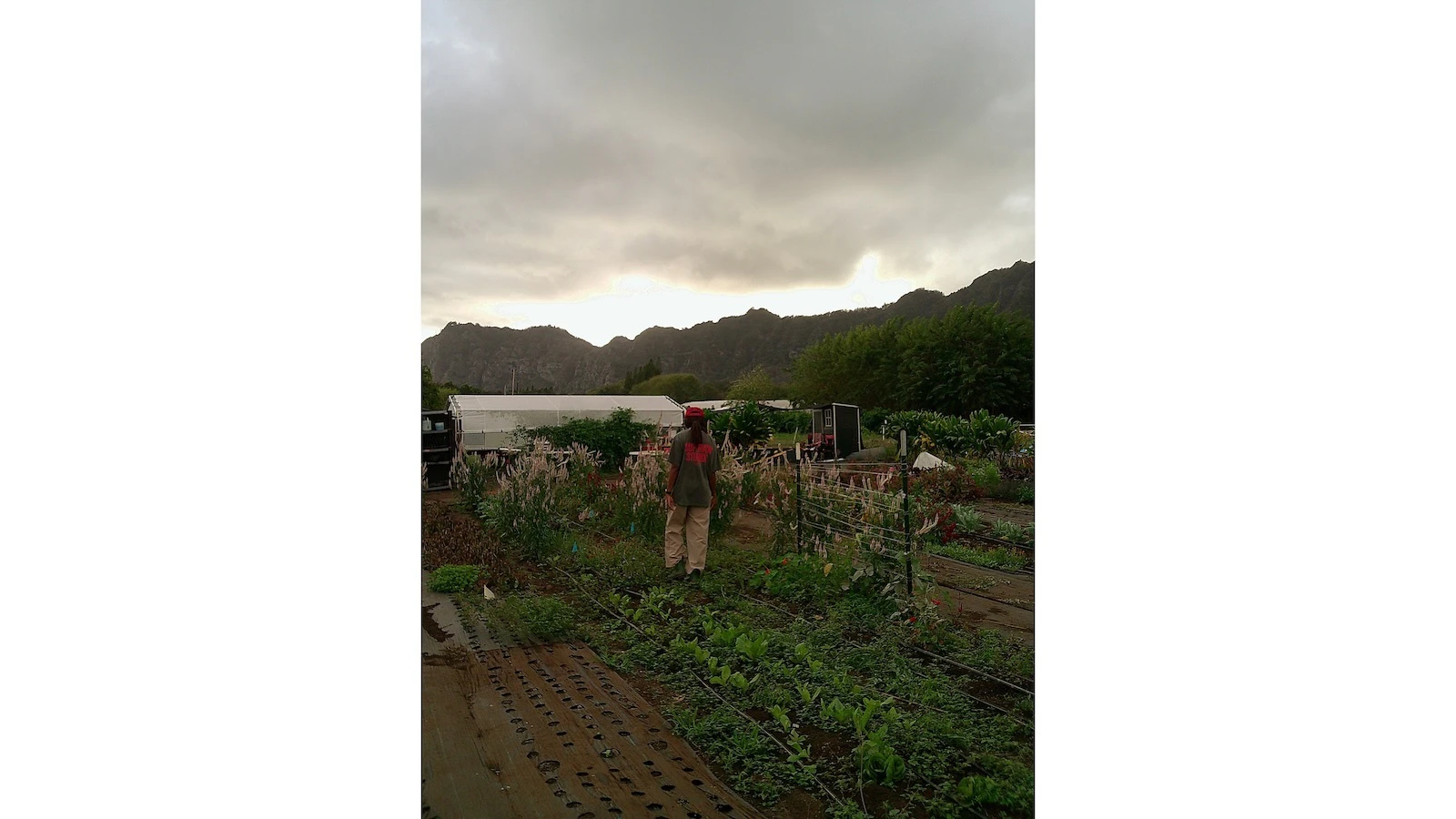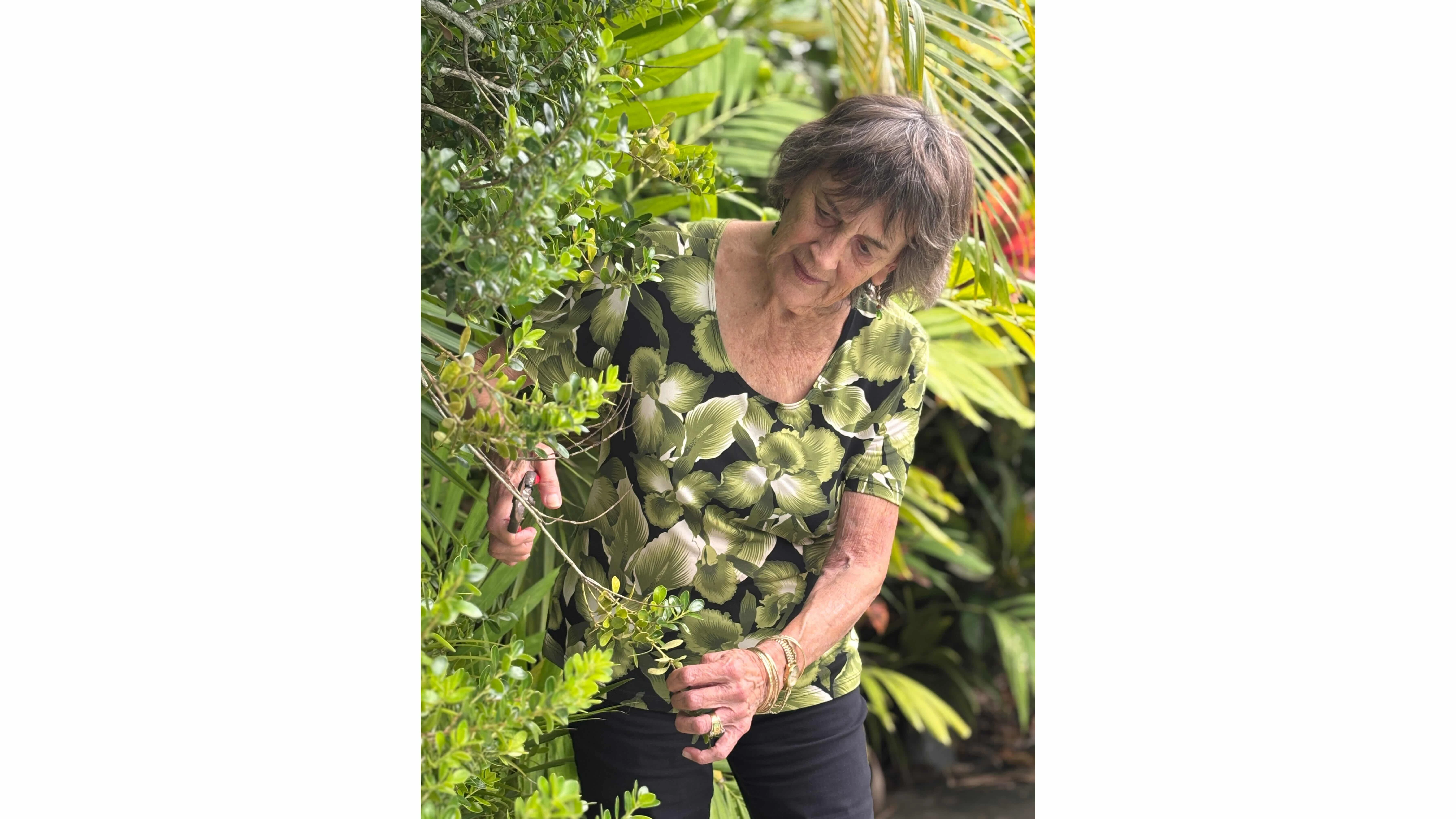
Diane Harding’s affinity for nature began long before she became president of The Outdoor Circle’s (TOC) board of directors and president of its Lani-Kailua Outdoor Circle branch (LKOC). She was born and raised in Kāneʻohe’s lush Mahinui Valley, with the One‘awa Hills rising in the back of her family’s home and a panoramic view of the ocean and Moku o Lo‘e, Coconut Island, in front of it.
“When my two brothers and I were growing up in the 1940s and 1950s, that area was isolated, very rural,” Harding said. “One of our neighbors had cows and horses. The family next door—I use ‘next door’ loosely, because we had to walk on a steep trail through woods and a gully to get to their house—had seven kids who were our playmates.”
Harding remembers building forts with them and her brothers in a dense grove of hau trees. Japanese plum trees provided ammunition for “battles.”
“The plums are the size of olives and mushy inside,” she said. “We threw them at each other as hard as we could, and we’d go home wearing clothes that were permanently stained purple.”
Guava was also abundant in the valley. “In the fall, we’d fill buckets with ripe fruit, then gather in our friends’ kitchen to make jam and jelly with their mom,” Harding said. “I feel blessed to have had a wonderful childhood in such an idyllic place.”
Harding graduated from Punahou, then MIT. With her newly minted bachelor’s degree in Applied Mathematics in hand, she embarked on what was to be a 40-year career as a computer software developer in the field of geophysics.
Every summer for 13 years, Harding, her husband and their two sons traveled from their home in the Boston area to visit her parents, who were still living in Mahinui Valley. Her dad, Harold Mechler, was the head of data processing for Castle & Cooke. Her mother, Julene, was an artist renowned for her exquisite ceramics and porcelain Hawaiian figurines.
In 1980, Harding’s husband floated the idea of moving to Hawai‘i. It wasn’t something she had considered, but the following year, she recalled deplaning in Honolulu and feeling that she was really home. Her subsequent work for various companies included sonar seafloor mapping; an anti-submarine warfare project; and conducting surveys for proposed undersea cable routes offshore Japan, Canada, Nova Scotia, the Caribbean and the Philippines.
Harding got involved with TOC in 2008, the year before she retired, through her younger brother, Steve, who was the organization’s volunteer landscape architect and third vice president on its board. “Frankly, I didn’t know much about The Outdoor Circle back then, but they asked me to join their board as assistant treasurer,” she said. “I was so impressed by their commitment and their mission, I immediately said, ‘Yes!’”
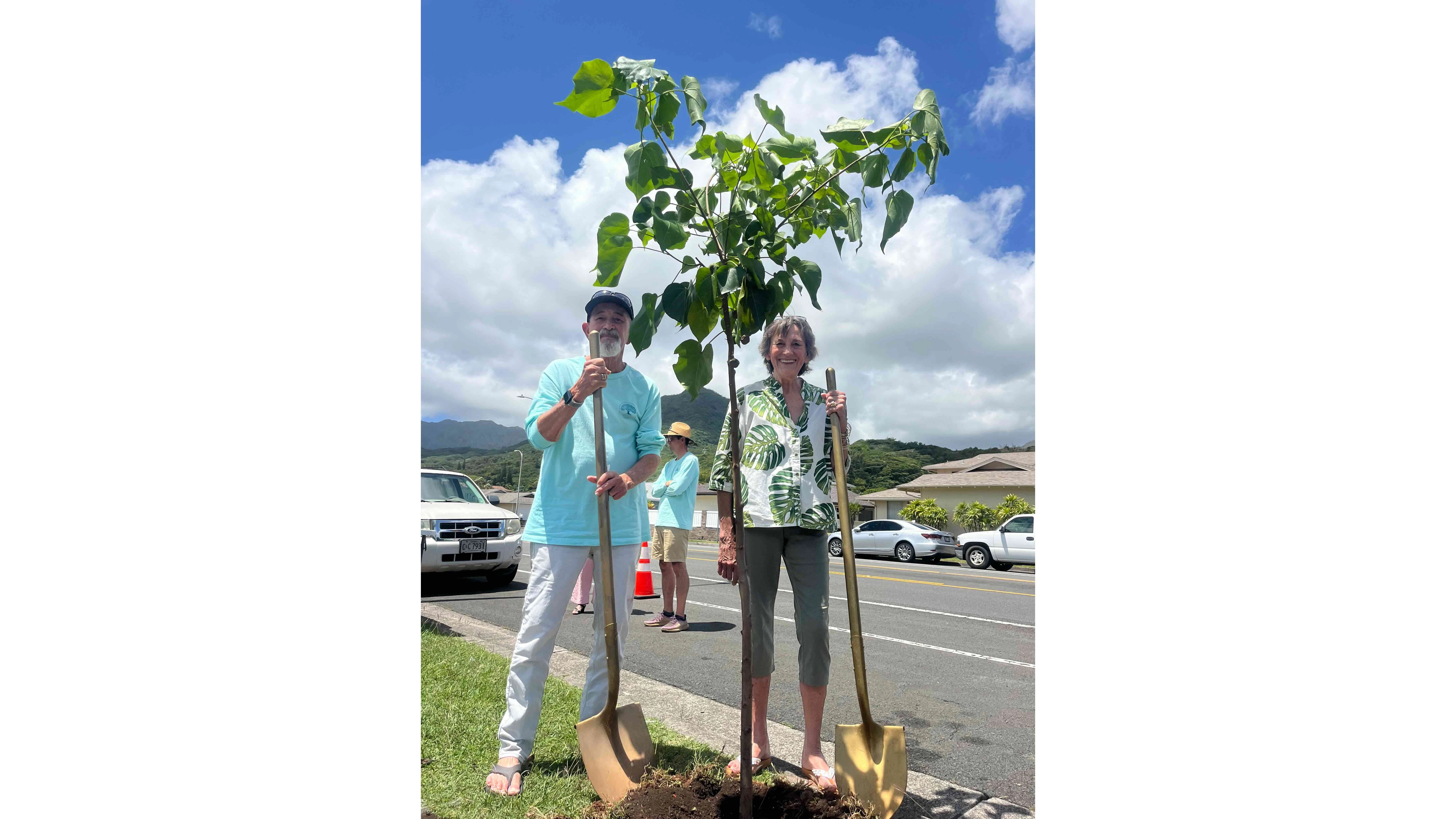
In the ensuing years, Harding readily took on more responsibilities. In 2009, she accepted the position of treasurer, and in 2013, she agreed to be the liaison for LKOC (her family had settled in Kailua). The following year, she became LKOC’s president, and in 2022 she began serving as the president of TOC’s board.
“I was retired by then, so I had the time to take on those responsibilities,” Harding said. “The more I learned about The Outdoor Circle, the more excited I got about it.”
Founded in 1912 as a 501(c)(3) nonprofit, TOC is dedicated “to keep Hawai‘i clean, green and beautiful by preserving, protecting and enhancing our environment.” Among many other accomplishments, it helped ban billboards in Hawai‘i, pushed for underground utility lines, and planted more than a million trees on urban streets and in public parks and gardens.
But its reach goes much further. TOC saved Queen Emma Summer Palace from demolition, established Hawai‘i’s first recycling plant and, in partnership with the Audubon Society and the Office of Hawaiian Affairs, preserved Waimea Valley as a historical and cultural site. It even published two books: “Majesty, The Exceptional Trees of Hawai‘i” in 1982 and a sequel in 1991.
Seven TOC branches statewide spearhead their own programs and projects. For example, to facilitate archaeological inspections, LKOC cleared the area surrounding Ulupō Heiau, which is on the national and Hawai‘i registers of historic places. The branch started a scholarship at Windward Community College to foster the next generation of environmental stewards.

Learning to Grow at the Women’s Community Correctional Center (WCCC) is an inspiring success story. Mentored by a handful of LKOC members, a select group of incarcerated women are growing herbs, beans, papaya, lettuce, breadfruit and sweet potato for use by WCCC. In addition, Foodland buys some of the program’s lettuce.
“The Outdoor Circle has such a rich history; our fingerprints are evident on so much of the Hawai‘i we see today,” Harding said. “I wanted that history to be put into easily accessible digital form for posterity, rather than be hidden in boxes under someone’s bed.”
To that end, in 2017 she started researching and organizing two comprehensive compilations of photos, correspondence, newspaper clippings and other documents to post on LKOC’s website. One shares little-known facts about TOC; the other summarizes LKOC’s major contributions to Kailua. She continues that work.
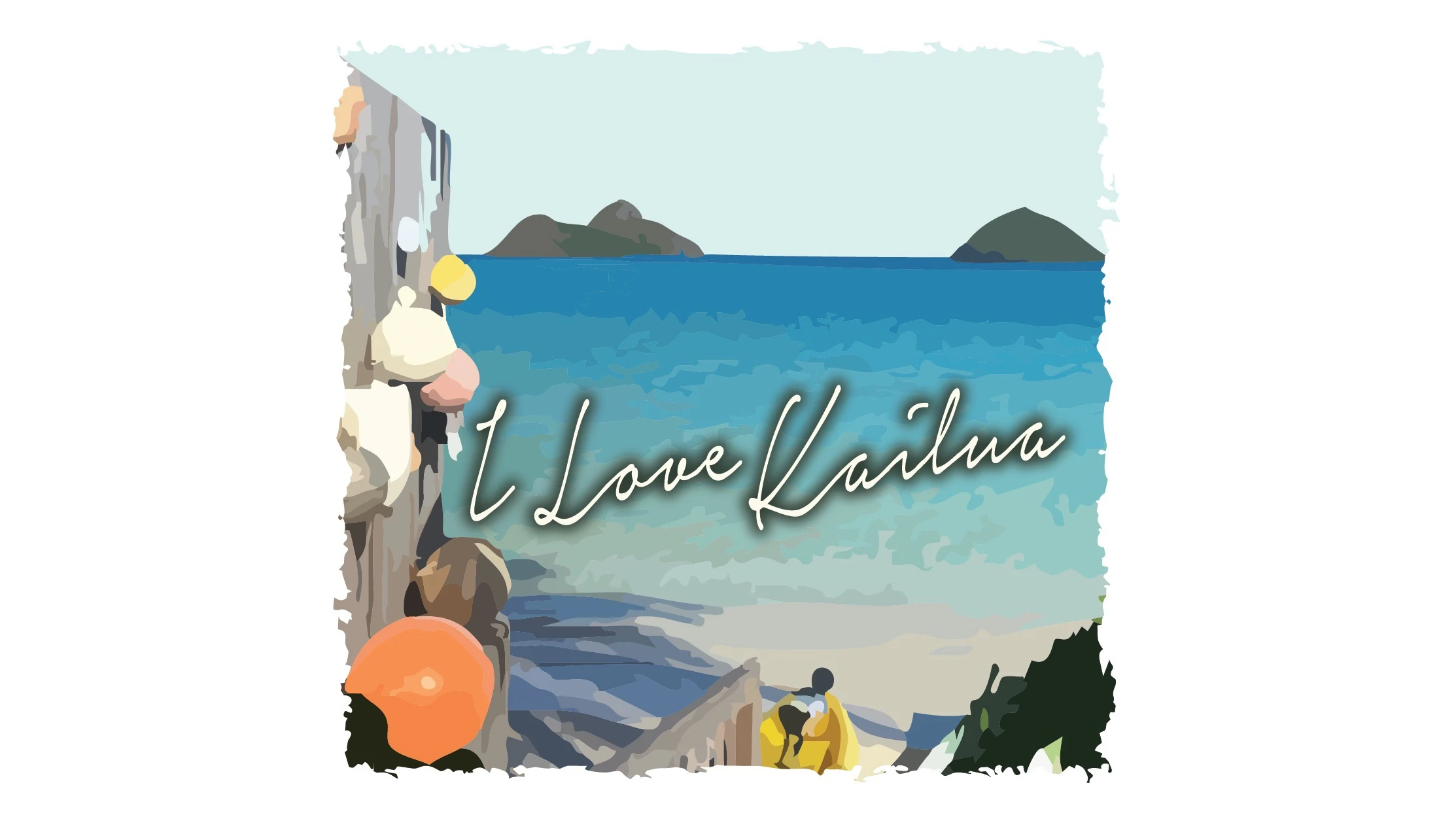
Since 2018, Harding has also chaired LKOC’s annual “I Love Kailua” Town Party (see sidebar), proceeds from which have funded the branch’s beautification projects over the past 30-plus years.
“It’s a lot of fun, of course, but beyond that, it’s a great educational opportunity,” Harding said. “Lani-Kailua will have a booth there, and we hope people will stop by, say hello and find out how they can participate. The Outdoor Circle is a watchdog; we advocate for responsible development. We attend legislative sessions and testify at hearings for zoning and land-use ordinances. Our outreach efforts improve the quality of life throughout Hawai‘i. We don’t just represent our members; rather, we are a voice for everyone in every community.”

For more information, visit https://www.lkoc.org/town-party.html. Want to get involved with TOC? Check out www.outdoorcircle.org.