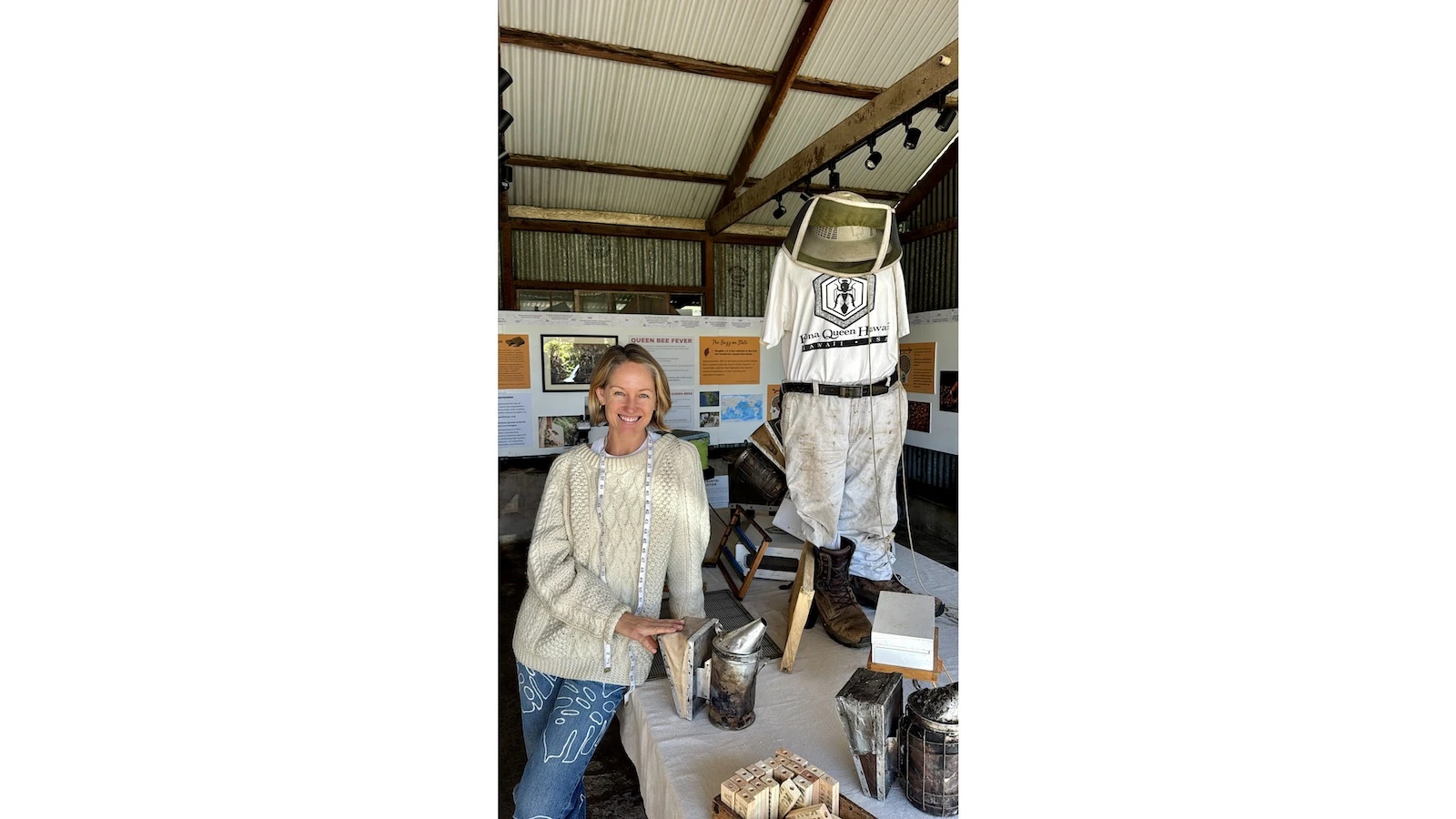
A multimedia exhibit on display in Waimea aims to celebrate the Big Island's beekeeping history.
You'll now find the second phase Hawai‘i Beekeeper Legacy Project at Anna Ranch Heritage Center, 65-1480 Kawaihae Road in Waimea, through May 30.
The exhibit was previously housed at the Kona Historical Society, where it welcomed more than 2,000 visitors and 250 students.
It has been "re-envisioned to highlight Waimea as the place where organized beekeeping in the Islands first took root alongside the ranching community," an announcement about the exhibit notes.
The project was created by Leandra Rouse, the daughter of Kona beekeepers who was raised on a queen bee farm in Kealakekua. Rouse says that the project originally started as a way to honor her father, retired beekeeper Gus Rouse, on his 75th birthday.
"There's a really neat archive at Kona Historical Society and he had mentioned to me they have all this great ag history, but nothing on bees," she told Aloha State Daily. "... I was going to just do a little timeline and write-up and submit it, but as soon as I got going, I realized this wasn't really about my dad, this was about beekeeping in general and also about agriculture in Hawai‘i and about biosecurity and how pests impact our land here. It became something bigger than me right off the bat."
Rouse then created an original 10-minute documentary in partnership with her friend Andrew Richard Hara, a videographer and photographer in Hilo.
"The documentary is really to showcase the beauty of beekeeping in Hawai‘i and put these hard-working farmers up on a pedestal because beekeeping is hard work," she says. "It is hardcore manual labor. I think my dad worked six days a week for 50 years, lifting heavy boxes out in the Kona sun, but it's also very noble and important work, particularly now."
The loss of honey bee hives have long been, and continue to be, a problem.
Preliminary results from the 2024-2025 U.S. Beekeeping Survey found that between April 1, 2024, an April 1, 2025, beekeepers in the United States lost an estimated 55.6% of their managed honey bee colonies. It's the highest loss rate reported since yearly losses were first tracked starting in 2010-2011, the findings notes.
Rouse notes that one in five hives on the Mainland and a majority of hives in Canada have a queen bee from Hawai‘i Island.
"So the Big Island is extremely important for helping these beekeepers who have lost their hives to repopulate," she says. "They're extremely important when it comes to national food security and it's just one of those operations that kind of is silently in the background."
According to Rouse, the Waimea exhibit includes an "in depth educational museum exhibit" with a variety of artifacts, and original and historic photos; a live observation hive; and a screening room showing the 10-minute documentary. She's also hosting a field trip program.
Rouse said in a follow-up this week that the Waimea exhibit has so far hosted 750 visitors and 175 students, with nearly 700 students booked over the course of the four-month exhibit.
The exhibit is free and open to the public from 9 a.m. to 3 p.m. Tuesday through Friday. Visit historyofkonabeekeeping.com for more information.
For the latest news of Hawai‘i, sign up here for our free Daily Edition newsletter.
Stephanie Salmons can be reached at stephanie@alohastatedaily.com.