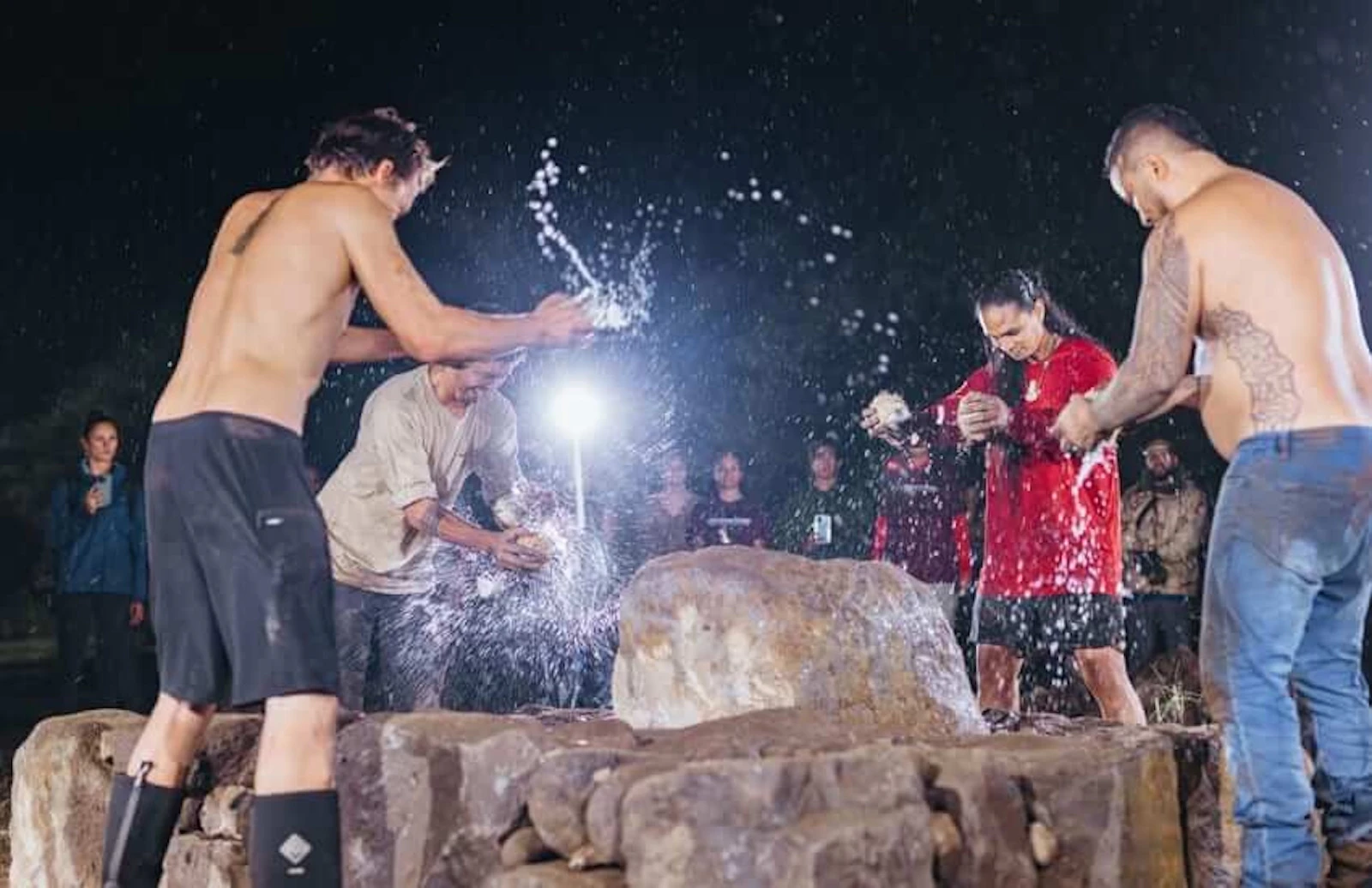
The echo of pahu drums under the darkened sky signaled to the 200 volunteers who stood waiting that it was time to begin their work: planting Maui’s first uluniu (coconut grove) in over 100 years. Cradled between grand sand dunes and the Kapoho Fishpond at the Waiheʻe Coastal Dunes and Wetlands Refuge, Uluniu o Kapuawailana was established the evening of Jan. 22.
“This uluniu will be dedicated to and honor the legacy of Liliʻuokalani, the last sovereign queen of Hawaiʻi,” said Kiaʻiokaʻuhane Collier, manager of Āina Stewardship for the Hawaiʻi Land Trust (HILT).
Following the overthrow of the Hawaiian Kingdom, the relationship between Kānaka and this important traditional resource was disrupted, leading to the loss of thriving coconut groves and the everyday use of niu in Hawaiʻi.
Thus, the uluniu was planted as a tribute to Liliʻuokalani’s commitment to aloha ʻāina, setting an intention for the wellbeing of the new coconut grove and, consequently, of the people who will be nourished by a practice and place rooted in Hawaiian culture for generations to come.
Participants and practitioners from across the pae ʻāina represented cross-sector participation to show what is possible when various partners come together: Niu Now, Community Coconut Program from DLNR’s Kaulunani Urban and Community Forestry Program; UH West Oʻahu; Hawaiʻi Land Trust; Ka Poholima Kāʻeo; Pōhaku Pelemaka; with hoʻoponopono practitioners, kūpuna, volunteers, and community members.
Together, they entered into mū ka waha, a sacred ritual of stilling voice to focus intention, planting in silence for the next three hours beneath the night sky to the steady beat of drumming and the chant, He Pule Niu, calling for the growth of coconut, culture, and community.
Exactly 133 coconut trees were planted that evening, “One tree for every year since the overthrow of the Hawaiian Kingdom,” said Collier. Planting the coconut grove marked an act of resilience and healing.
While the trees were being carefully tucked into the ground, a crew from Ka Pōholima Kāʻeo stacked stones to build and complete an ahu (shrine) to mark a promise, sealing the significance of the moment, and reinforcing commitment to aloha ʻāina.
Twenty-three coconut varieties were carefully selected from a coconut nursery that Niu Now, the Coconut Community Program, and HILT started in preparation for this uluniu nearly a year ago. Seedlings were harvested from across Maui, each chosen for its distinct qualities: those used in Makahiki ceremony; those resilient to high-sand soils; varieties prized for their long fibers or favored for productivity, or the flavor of their water, meat, or milk.
The coconut seedlings were mostly planted using the polymotu practice, a traditional uluniu model adapted with contemporary techniques, grouping three or more trees of the same variety to promote and maintain genetic diversity.
The evening selected for planting purposefully aligned with the favorable farming practice of the Kūkolu mahina phase, which means “to stand in threes.” Huli planted during these moon phases are believed to shoot up like coconut trees.
The idea for Uluniu o Kapuawailana emerged about two years ago when Collier crossed paths with Niu Now members Indrajit Gunasekara, Kekaula Hanohano and Jesse Mikasobe-Kealiinohomoku. Together, they envisioned a way to reconnect people with coconut as a cultural responsibility and a foundation of food sovereignty.
Collier is the primary caretaker of the Waiheʻe refuge and leader of Ka Pōholima Kāʻeo, the fishpond restoration group working with HILT toward a Hawaiian-led space filled with fish, food, and cultural resources concentrated in one location to sustain community wellbeing.
“The preparation work is a lot,” said Hanohano, a coconut practitioner, and one of the main caretakers of Maui’s newly established uluniu. “These plants thrive and we’ve seen a lot of success even in the harshest environments. So our intention is to just preserve those varieties of place.”
Uluniu o Kapuawailana was planned in concert with the two-day ʻAha Hoʻoponopono Honua gathering held at UH Maui College and various sites around the island, which emphasized the importance of reconnecting people to ʻāina as a path to healing. In the face of the looming threat of the invasive Coconut Rhinoceros Beetle – and the continued practice of trimming the coconuts off trees – replanting niu becomes an act of healing and reclamation.
“When we heal land, we heal ourselves. When we heal ourselves, we heal land. It’s a simultaneous thing,” said Manu Aluli Meyer, hoʻoponopono practitioner and co-founder of Niu Now.
When the last coconut tree was planted, a light drizzle began eventually giving way to a steady downpour, blessing the freshly planted coconut seedlings. Meyer shared: “Hahai no ka ua i ka ulu lāʻau. Plant a forest and the rains will come.” Share purpose with others and transform the world.
The evening closed with a hōʻike to honor Hanohano as a loea uluniu (coconut grove master practitioner).
“That title means I also need to constantly learn,” he said. He notes that without the traditional governance systems that once distributed care for Hawaiʻi’s lands, roles like his become vital to ensure “that people have kuleana to those spaces.”
As a loea uluniu on urbanized Oʻahu where most coconut trees are pruned, he admits he has no direct access nearby to gather coconuts. That reality fuels his dedication to establish more uluniu throughout Hawaiʻi and reconnect people with a once-abundant relationship with coconuts.
Uluniu o Kapuawailana follows the growing niu movement, building on successful models such as the uluniu at Kūkaniloko established five years ago, where more than 100 coconut trees – of 16 varieties – were planted in service of a shared vision: that everyone in Hawaiʻi will once again have access to coconuts.
This article is reprinted with permission from OHA's Ka Wai Ola newspaper: "The first coconut grove planted on Maui in over 100 years" by Annabelle Le Jeune, in its March 2026 issue, Vol. 43 No. 3. Read more at kawaiola.news.
For the latest news of Hawai‘i, sign up here for our free Daily Edition newsletter.