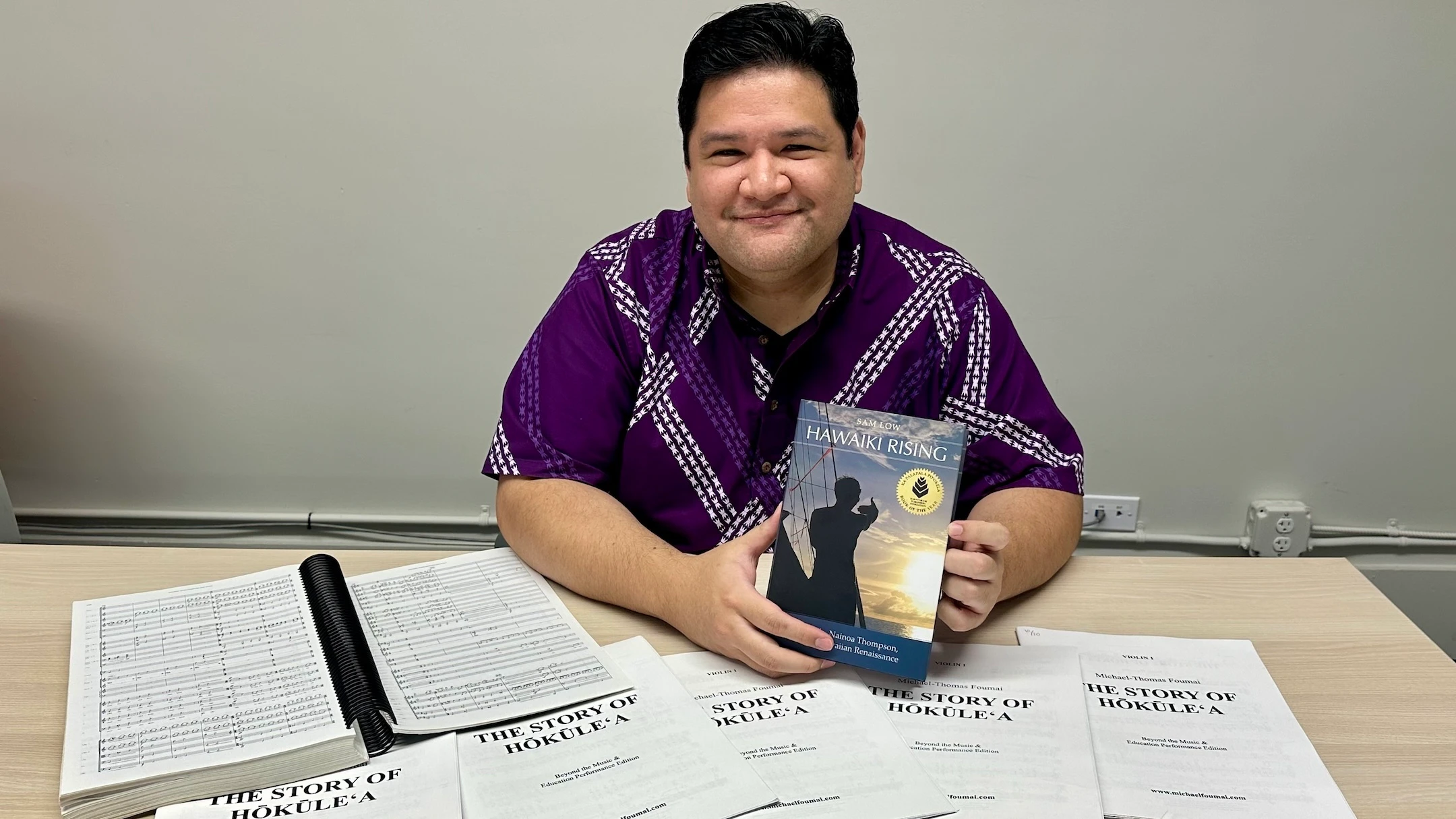
Musicians and composers never know who is listening. Michael-Thomas Foumai, the first composer in residence for the Hawaiʻi Symphony Orchestra, would know.
As a teenager, he composed a piece for the Hawaiʻi Youth Symphony. More than a decade later, Elizabeth Wong, who was in that audience, and is a supporter of the symphony and the Polynesian Voyaging Society, asked if he could write a piece about Hōkūleʻa, the double-hulled voyaging canoe that has inspired generations of navigators.
The work was commissioned by the Wallace, Elizabeth, and Isabella Wong Family Foundation. He and Wong met for coffee at Mānoa Marketplace. And the rest is history. The world premiere of “Raise Hawaiki” was performed by HSO at the Neal S. Blaisdell Concert Hall in 2019, but it was an abridged version of the piece.
On Sunday, April 19, the piece will be performed in its entirety for the first time and will feature the Oʻahu Choral Society and narration from actor Moses Goods. It includes illustrations of voyaging canoes by Herb Kāne, an artist, historian and founder of PVS, as well as photos from every expedition Hōkūleʻa has taken since her maiden voyage in 1976, Foumai said.
On Saturday, April 18, HSO will perform an adapted version of the piece as part of its Beyond the Music series, which is open to keiki and consists of a shorter, one-hour concert. Before the event, there is a chance for youth to take part in hands-on activities, such as exploring musical instruments at the Hawaiʻi Youth Symphony Instrument Zoo and tying knots with PVS navigators. The performances are in celebration of the 50th anniversary of Hōkūleʻa’s maiden voyage to Tahiti.
“Raise Hawaiki" is an arrangement that uses instruments to share the voices of the canoe, sea, clouds and stars, with a trumpet solo signifying the voyager, Foumai said. The composition also highlights the legacy of Eddie Aikau, the legendary waterman who was a crew member on Hōkūleʻa and disappeared at sea while in search of help after it capsized in an early voyage.
The work’s title, “Raise Hawaiki,” was inspired by Hawaiki, the mythical homeland of the Polynesian people, and a term used by navigators. After getting permission to write a symphony about Hōkūleʻa, Foumai picked up the book, “Hawaiki Rising,” by Sam Low.
“There's this phrase in nautical parlance that when you're on board a voyaging canoe and you're approaching land after a long journey, when you see land on the horizon, it appears as if you are pulling it from the sea,” he said. “There are many allusions to this in Hawaiian mythology. We have Maui pulling the Hawaiian Islands into existence. And so, sailors, voyagers, navigators would say ʻWe raised Oʻahu on this day’ or ‘We raised Tahiti,’ after a voyage.”
Foumai combined the words to get "Raise Hawaiki."
“That was a title that I thought the piece should take because it also meant the raising awareness of Hawaiian consciousness at this time,” Foumai said. “The language had all but been erased and the knowledge to do voyaging in the ancient tradition was nowhere to be found but in Micronesia. So, it was this raising of everything — of consciousness of Hawaiian pride, the raising of the language.”
The is not the first time HSO has used music to tell stories. Recently, the orchestra offered a free ocean-themed concert with animations, as well as hula and storytelling. HSO has also performed alongside the popular band Kapena, which is known for its Island music, and ‘ukulele virtuosos, such as Jake Shimabukuro and Taimane Gardner.
Before writing the piece, Foumai met with Nainoa Thompson, a master navigator and the CEO of PVS, to ask permission.
“This is really important for me because I'm not Hawaiian,” he said. “I'm Samoan. ... I know that this is such a meaningful and symbolic story for the Native Hawaiian people that I had to get permission to tell the story from Nainoa Thompson, himself. We proposed this idea of a symphony of Hōkūleʻa that would tell their whole story, all the way up into the Mālama Honua Voyage.”
Thompson shared that when they voyaged, they were looking toward the stars, which can be millions or billions of years old.
“In kind of an analogy, those are the ancestors,” Foumai said. “And that's kind of like music in some ways, because we build on that legacy, too, of the ancestors who have come [before]. We think of our classical music ancestors, like Beethoven, who have created all of these symphonic forms that we still use today. We just use it in a different way — to tell our story now.”
One of the lessons Foumai picked up in graduate school while attending the University of Michigan in Ann Arbor was to tell the stories of home, like this one.
“I feel like I had to go away to come back,” Foumai said. “A lot of that is an artist’s journey, to go out and explore the world, but by doing so you gain a deeper appreciation for where you are — for your identity, where you come from, for your home. You realize there are things that you cannot find anywhere else, and that you should, as an artist embrace them and tell that story.”
Upcoming events
Saturday, April 18
Beyond the Music: Hōkūleʻa
The family-friendly concert, which starts at 11 a.m., is one hour. HSO will perform excerpts from “Raise Hawaiki” at the Neal S. Blaisdell Concert Hall. Keiki and their families can arrive early to take part in hands-on activities, such as tying knots with the Polynesian Voyaging Society and exploring classical instruments through the Hawaiʻi Youth Symphony Instrument Zoo. Tickets start at $22.50 for keiki and $32.50 for adults.
Details.
Sunday, April 19
Hōkūleʻa 50
This event, which starts at 4 p.m., includes the complete choral symphony, “Raise Hawaiki,” which is being performed in its entirety for the first time and includes narration from Moses Goods, along with visual projections and historic photos at the Neal S. Blaisdell Concert Hall. A pre-concert talk starts at 3 p.m. Tickets start at $43.50. Details.
For the latest news of Hawai‘i, sign up here for our free Daily Edition newsletter.
Katie Helland can be reached at katie@alohastatedaily.com.