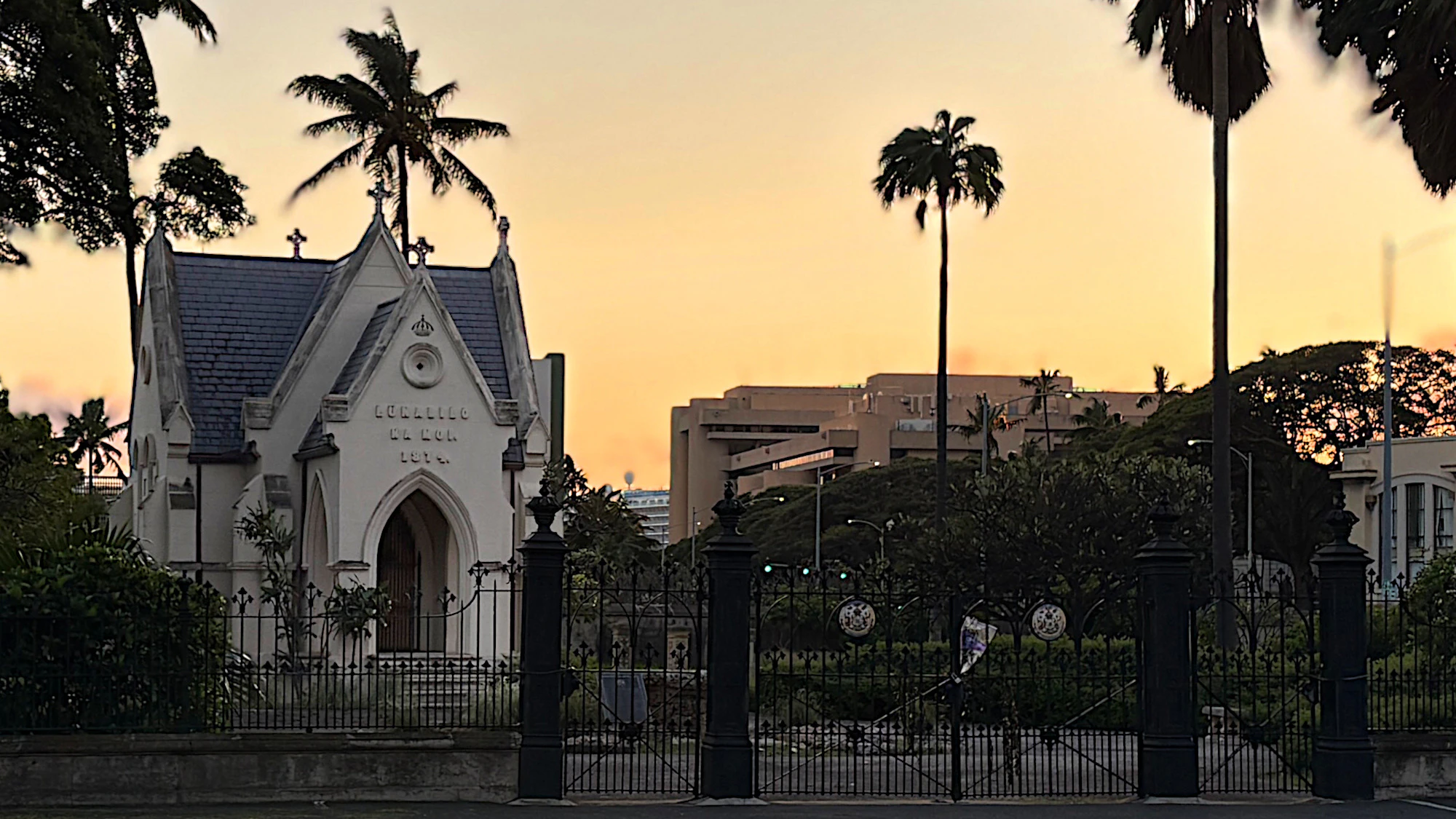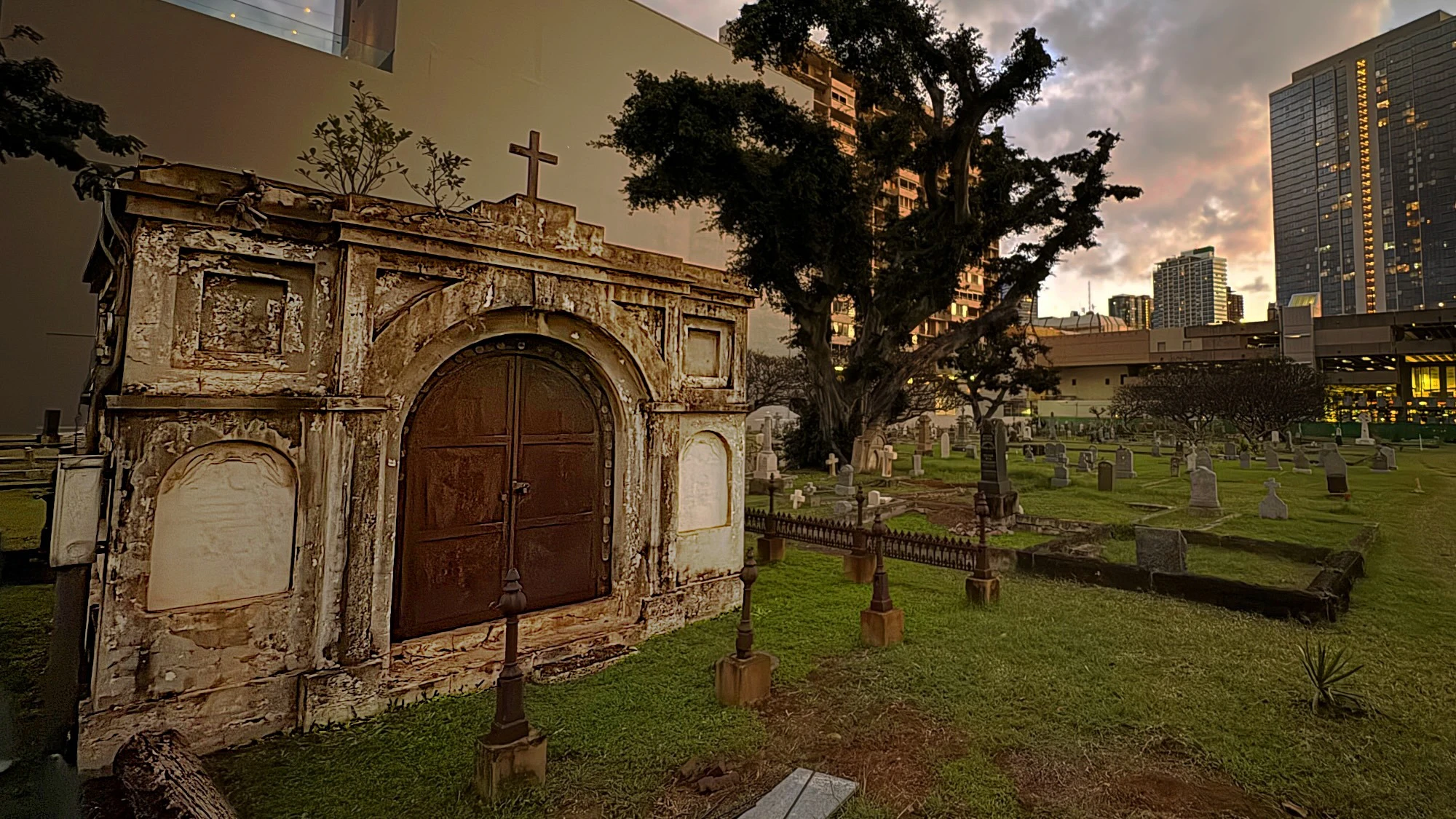
Around 1845, Governor Boki is said to have given the Catholic Church in Hawai‘i a plot of land outside Honolulu in an area called Kulaokahua. This parcel of land became a cemetery, open to members of the Catholic Church in Hawai‘i. More land was added through subsequent purchases in 1866 and 1912, creating what is now known as the Roman Catholic Church King Street Cemetery.
However, by the turn of the 20th century, overcrowding at the Catholic Cemetery was already a concern. As early as 1899, the Committee on Cemeteries recognized that the city’s growing population meant an increase in deaths, which required more land for burials.
In 1902, the Board of Health reported a dire situation at the Catholic Cemetery. The rear quarter of the grounds was stated to be unfit for use as the underground water level was just three and a half feet below the surface, and burials had been made at two and a half feet short of the required depth. The groundwater drained into the open ponds behind the cemetery, where the Hawaiian Electric buildings are now, which Hawaiians were still using for fish. The original ‘Ewa half of the cemetery was badly crowded, and officials believed any new graves dug would encounter previously buried coffins. The “new” Waikīkī portion was also mostly filled and had very little space left. In 1908, the Board of Health declared the lower part of the cemetery to be unsanitary due to the high underground water level. Burials were supposed to stop, but they only reportedly slowed down.
On the property was a small house where the sexton, or caretaker, lived. The sexton was responsible for maintaining the cemetery and digging graves. In 1928, agents raided the cemetery and arrested the sexton after finding an alcohol still inside the house. Further investigation found a family tomb that led about 30 feet underground, which housed 20 gallons of aged “oke” (okolehao) and 4 gallons of wine. The sexton entered a plea of guilty to violating the National Prohibition Act, telling the court he made the liquor for his own use.
“Ghosts don’t drink,” he told the judge, “But I do.”
In September of the same year, the Board of Health declared that no new burial permits would be issued for the King Street Catholic Cemetery. All future burials were to be directed to the newly established Diamond Head Memorial Park. Although the cemetery was closed, a few burials were added after 1930, including the wives of prominent figures who were already buried on the grounds.
However, not all the remains buried there remain. As Honolulu grew, space became scarce. During the widening of King Street in 1971, 39 burials were disinterred and relocated to other cemeteries on O‘ahu. In 1997, during the construction of the adjacent condominium, a legal notice in the newspaper announced that they had discovered unmarked burial sites containing human skeletal remains on their lands purchased from and located next to the King Street Catholic Cemetery. The State Historic Preservation Division requested that the descendants of families buried in that location contact them regarding the appropriate treatment of the unmarked remains.
Perhaps not every spirit follows where the bones were taken. In a place where names were lost and resting places disturbed, the past lingers, sometimes seen, sometimes heard.
People often park along King Street in front of the cemetery and wait for traffic to slow before jaywalking across to the hospital. One woman said that while waiting, she heard someone call her name. She looked around, didn’t see anybody, and turned back to watch for her chance to cross. But the sound came again, and she stepped back from the curb and turned around. She looked beyond the fence, and as she stepped forward, she realized someone was calling her name from inside the cemetery. But no one was there.
Another popular ghost story comes from Nanette Napoleon. She said she spoke to a woman who was tracing her family’s genealogy. The woman spent hours looking for her ancestor’s grave until, all of a sudden, an older Hawaiian woman with long gray hair and wearing a white mu‘umu‘u appeared. The Hawaiian woman asked the lady who she was looking for, then led her directly to the correct grave marker. But when the lady turned to thank the woman, she had already vanished. This cemetery is small and flat, and there weren’t any nearby places to hide.
My own experience is similar. My wife and I were exploring the cemetery a few years ago. We find it interesting to see familiar names or dates that might be significant to us. A few headstones have surprising details about the person’s death, announcing they died from an illness or in a car accident. After looking at a fallen headstone with the name Kamehameha engraved in an arch across the top, we made our way towards the tall iron cross in the center of the cemetery. A young priest, clean-shaven with short black hair, wearing a long cassock, was there. My wife commented on the heat and how stifling the man’s robes must be.
As we passed him, the man said hello and gave us a slight nod. We greeted the man, and barely a second later, my wife turned back to look at the priest, only to find that he’d somehow disappeared. We looked behind the cross, but he wasn’t hiding there. There are two large banyan trees, each about a hundred feet away from the iron cross, and we looked behind both. Most of the headstones aren’t large enough to hide a fully grown man, but we walked up and down the aisles anyway. The priest was nowhere to be seen.
We never did figure out where he went. He either moved incredibly fast, or we were just very slow to realize we’d met a ghost.