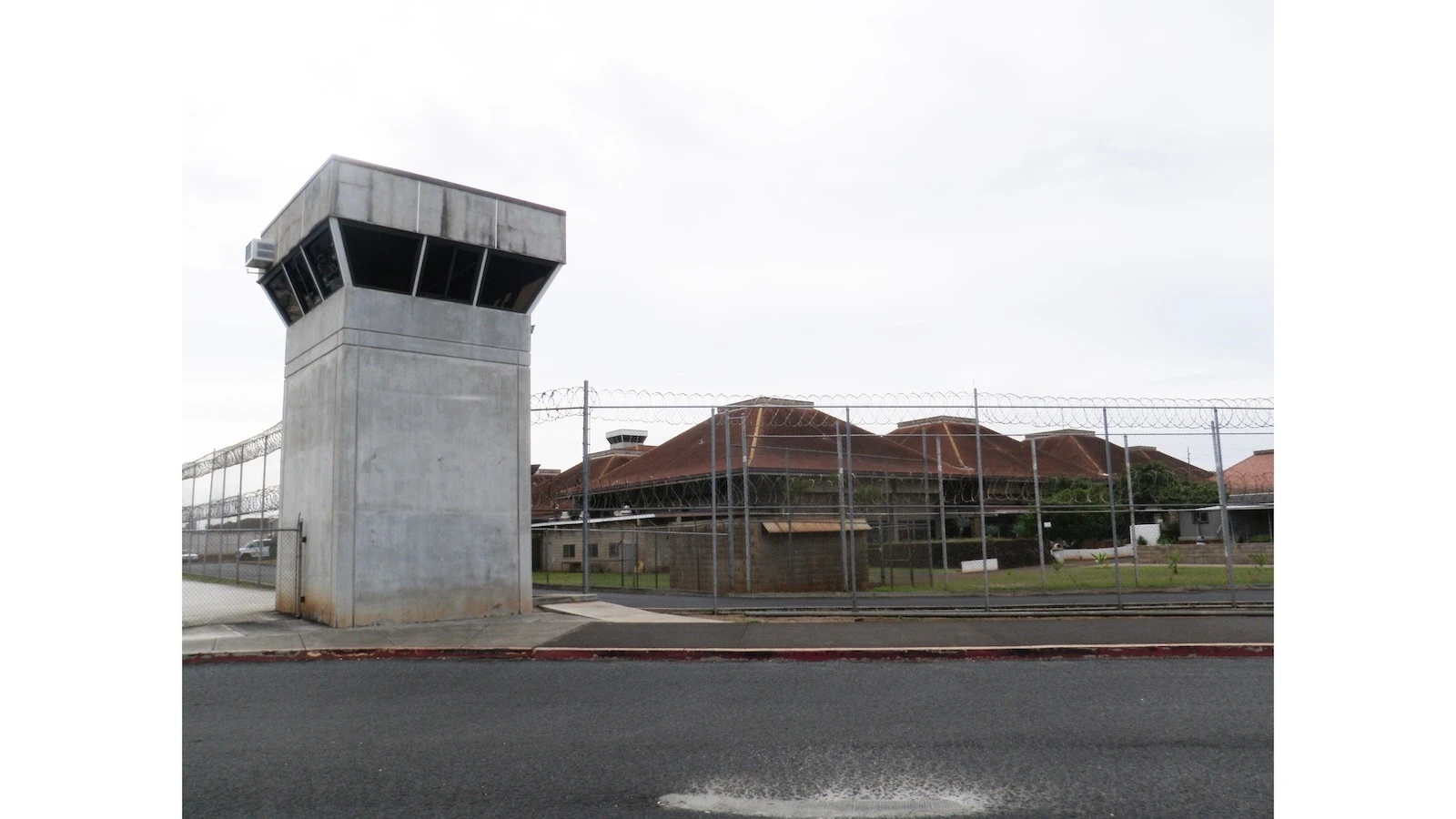
A proposal to return Hawai‘i felons to Hawai‘i prisons passed its last committee in the state Legislature Wednesday.
House Bill 1769 is a proposal that would set up an incremental process to gradually move felons incarcerated in private Mainland prisons to in-state correctional facilities beginning in 2027.
Under the terms of the proposal, between July 2027 and July 2028, the Department of Corrections and Rehabilitation would be required to transfer 5% of Hawai‘i inmates incarcerated in out-of-state private facilities back to the state. The following year, the department would need to transfer another 10%, and 15% in 2029.
By 2031, and each year thereafter, the department would be obligated to transfer 5% of those out-of-state prisoners back to Hawai‘i.
Hawai‘i entered into a contract with private prison operator CoreCivic in the 1990s to send inmates to CoreCivic facilities to alleviate overcrowding in state prisons. In a 2021 extension of the state’s contract with CoreCivic, the state paid the company more than $50 million to house 1,700 inmates, or $81.66 per head.
The measure notes “Hawai‘i's longstanding reliance on … the use of private, for-profit correctional facilities located outside the state has caused significant harm to incarcerated persons, their families and communities.”
The bill also cites a 2018 report by a state task force, which found that the state’s incarceration rate has increased by 403% from 1978 to 2016. Despite that, the bill states “mass incarceration has not improved public safety, imposes high fiscal and social costs and fails to address the underlying causes of criminal behavior.”
However, that task force report also notes that the state’s increasing incarceration rate has overtaxed the state’s jails. At the time the report was published, four Hawai‘i incarceration facilities — the Kaua‘i, Maui, O‘ahu and Hawai‘i community correctional centers — had populations well in excess of their operational capacities. Since then, the situation has worsened further.
Consequently, the Department of Corrections and Rehabilitation has opposed the measure as it is written. In testimony on the bill, department director Tommy Johnson wrote that the mandate within the bill equates to approximately 240 inmates to be returned by 2030, without any consideration for how to appropriately house them.
“DCR shares the concerns raised regarding housing inmates in facilities far from home, and would have returned the inmates long ago but for the lack of facilities in which to house, care for and treat them, “ Johnson wrote. “[The Hālawa Correctional Facility on O‘ahu] has a design capacity of 496 offenders. However, at present there are 817 convicted male felons housed at that facility … Currently there are 797 convicted male felons being housed at the Saguaro Correctional Center in Eloy, [Arizona].”
Johnson wrote that any effort to return 30% of Hawai‘i inmates held at Saguaro alone would require a new medium security prison, which he estimated would cost up to $900 million. He concluded that the bill should only pass in conjunction with a commitment to build a new prison or an expansion to the Hālawa Correctional Facility.
But the state Office of the Public Defender argued that the incremental returns will allow DCR to “responsibly expand in-state capacity,” a claim echoed by dozens of other testifiers in support of the measure.
The Senate Ways and Means Committee voted unanimously Wednesday to pass the measure with little discussion and no amendments. Having passed its last committee in either chamber, it must next pass third reading in the Senate.
For the latest news of Hawai‘i, sign up here for our free Daily Edition newsletter.