
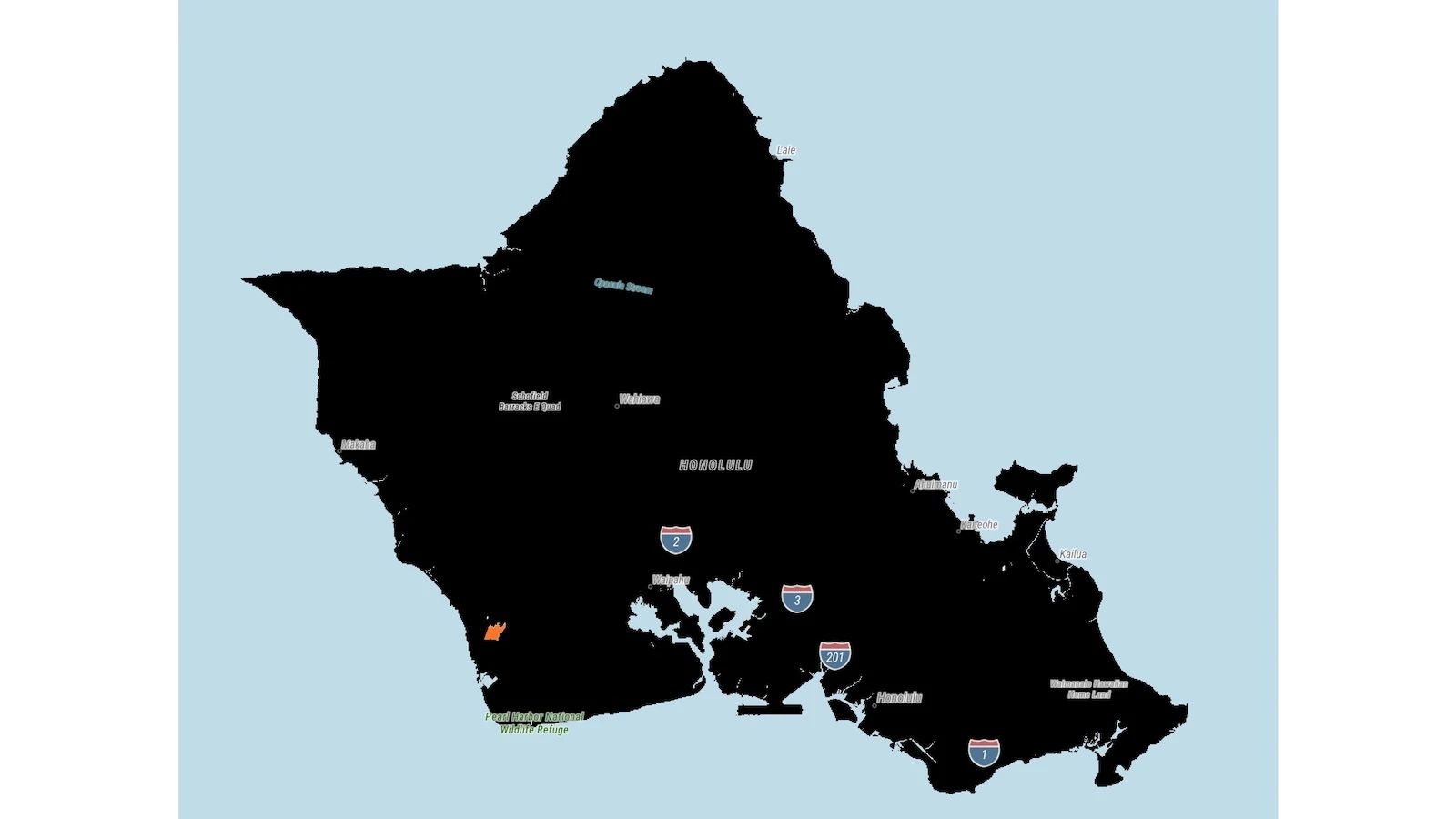
Land in Makakilo is the only place on O‘ahu where the city can build a new landfill.
For years, the City and County of Honolulu has been searching for potential sites on which to develop a landfill that would eventually take over for the Waimānalo Gulch Sanitary Landfill after it becomes unusable.
But, as the Department of Environmental Services will explain at a Makakilo-Kapolei-Honokai Hale neighborhood board meeting Wednesday, a web of overlapping environmental and zoning restrictions means that the City really has only one option left: within a 1,600-acre area in the Makaiwa Hills, west of Makakilo.
Roger Babcock Jr., director of the Department of Environmental Services, told Aloha State Daily that landfills cannot be built within 10,000 feet of any airport runway, within tsunami evacuation zones or on federal lands. A 2020 law also prohibits the building of a solid waste disposal facility within a half-mile of a school, hospital or residential area or on conservation district lands.
The department had previously identified a site northwest of Wahiawā as a potential location, but Act 255, passed last year, nixed that as well: now landfills cannot be built anywhere inland of the underground injection control line, a boundary that designates whether an aquifer is a protected source of drinking water or can be tapped for an underground injection well.
The department previously had set a deadline to identify a landfill site by the end of 2022, Babcock said, but when the Red Hill fuel leak was discovered in 2021, concerns about the landfill’s potential impact on the island’s water supply pushed that deadline back to the end of 2024.
Months later, Act 255 was passed, which excluded the vast majority of all land on the island, and, Babcock said, precluded the Wahiawā site and other potential locations the department had identified “after looking since the beginning of time.”
And so, Babcock said the department is beginning the long process to get the Makaiwa Hills site approved.
The Wednesday neighborhood board meeting is a necessary first step for preparing the Makaiwa Hills site for the landfill, Babcock explained. In order for the department to make a budget request for the project — the project costs an estimated $190 million, including an estimated $65 million for purchasing the land from current owner Makaiwa Hills LLC — the Honolulu City Council needs to pass a resolution to modify the city’s Public Infrastructure Map identifying major public projects throughout the island.
In order to modify the Public Infrastructure Map, the Department of Environmental Services needs to present the project to area residents.
“This [meeting] is not about choices,” Babcock said.
Meanwhile, another deadline is fast approaching.
The landfill at Waimānalo Gulch is set to close in mid-2028 when a special use permit expires. That permit will need to be extended, Babcock said: on the most optimistic timeline, a new landfill in the Makaiwa Hills could become operational in 2033, and the necessary permits to build it will take years to obtain.
But even if the Waimānalo Gulch permit is extended, there is still another ticking clock: at current waste production rates, the Waimānalo landfill is estimated to reach capacity by 2031, two years before the earliest possible opening of the new landfill.
“We’re still evaluating how to bridge that gap,” Babcock said.
At the same time, the Makaiwa Hills landfill has a presumed lifespan of about 20 years.
Babcock said that, given how long developing this landfill has taken, the city will need to start thinking about what comes next sooner rather than later.
“There’s a lot of assumptions about those 20 years,” Babcock said. “We’re assuming growth, we’re assuming that people will generate the same about of waste.”
Babcock said the Department of Environmental Services will continue to develop additional recycling programs in an effort to remove more items from the waste stream and extend the landfills’ operational life. He said the department has just launched a pilot program for recycling food waste in the same bins as compost, for example.
Other possible solutions include the potential to ship waste or ash from the H-POWER trash incinerator off-island, or to recycle H-POWER ash into materials such as asphalt. Babcock said other governments have begun mining their landfills to extract and recycle previously buried waste, freeing up additional space.
But Babcock also said “we could always get better recycling participation,” adding that the average O‘ahu resident generates more than one ton of waste per year that gets sent to H-POWER or the landfill. “We don’t have the luxury of a lot of space.”
The Makakilo-Kapolei-Honokai Hale Neighborhood board meeting will be held Wednesday at 7 p.m. at Kapolei Hale.
For the latest news of Hawai‘i, sign up here for our free Daily Edition newsletter.


