
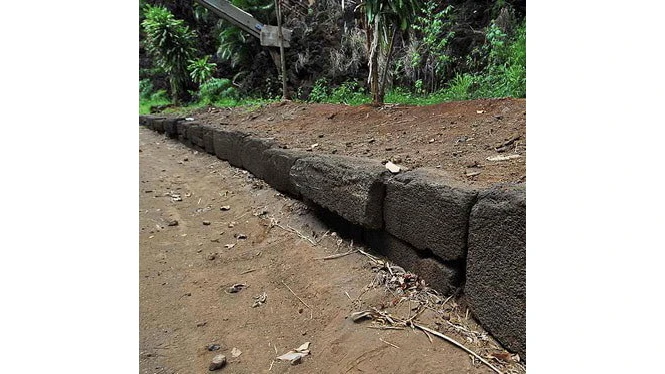
They were not peculiar beings with miraculous powers like the dwarves in European stories. They were, rather, an independent people. According to Katherine Luomala , the Menehune were a separate people who already arrived in Hawaiʻi before those ancestors who came from Tahiti (French Polynesia) and the Marquesas. They were stout, darker-skinned, and skilled in construction. In Kahiki (ancestral homeland), their birthplace, they were called Manahune and belonged to a subservient class. They were believed to be destitute of mana (spiritual power); and thus the name, Manahune.
In Hawaiʻi, the pronunciation changed and became Menehune, the people famed for their construction abilities. The ʻAlekoko fishpond at Niumalu is one of the feats of wonder of the Menehune. According to the famed storyteller of Kauaʻi, Fred Wichman, the name ʻAlekoko resulted from the inability of the aliʻi, ʻAlekoko and Kalālālehua, to observe the kapu (taboo) of the Menehune. Namely, the kapu forbidding anyone from witnessing their work.
Due to the ruckus caused by the construction of the fishpond walls, the aliʻi peeked and saw the Menehune working. As soon as that happened, the work ended completely. The chief of the Menehune ordered all to cease work, wash their hands in the fishpond, and return home. Their hands were bloody (koko) because the rocks were not smooth.
These were ragged-edged and bumpy stones from Wahiawa, Kauaʻi. The Menehune stood shoulder to shoulder from Wahiawa to Niumalu, about 25 miles, carrying the stones person by person in the dark of night. At Niumalu, the stones were chiseled by the workers to fit tightly together. It is a wondrous work that is known throughout Hawaiʻi.
The famous chief of the Menehune people was Ola. The amazing works of Ola are known to this day. Kīkī-a-Ola (Spouting of Ola) is the grand aqueduct at Waimea built of hewn rock. Hālau-a-Ola (The lodge of Ola) is the koa (acacia) forest of Ola. There, the koa trees were felled and then hewed into canoes. Queen Emma traveled through it on her trip to Kilohana, the lookout at the towering cliffs overlooking Hāʻena. While she was passing through Alakaʻi, she stepped upon Kīpapa-a-Ola (Pavement of Ola), a pathway made of hāpuʻu ferns laid side-by-side over the damp and soggy land of the swamp.
In the story of Hawaiʻiloa, as told by Kamakau, that ocean-faring chief named the first island he visited after himself and another, Māui, after his son. It was on these islands that he met some short and stout people who were descendants of Kalani Menehune. These were then descendants of Lua Nuʻu (a.k.a Kānehoalani, Hūmāmenehune) just like Hawaiʻiloa. According to Beckwith , Luanuʻu and Meʻehakulani (Meʻehiwa) were the parents of the Menehune.
Therefore, the Menehune people are distant relatives. They are a true race. They are, indeed, family.
This article is reprinted with permission from OHA's Ka Wai Ola newspaper: "The Menehune: A true race of people" by Kalani Akana, in its June 2022 issue, Vol. 39 No. 6. Read more at kawaiola.news.
For the latest news of Hawai‘i, sign up here for our free Daily Edition newsletter.


