Ron Montgomery’s introduction to aerodynamics came in the form of model airplanes that he made when he was a teen growing up in East Orange, New Jersey, near Newark.
“A rubber band was the planes’ ‘engine,’” Montgomery said. “It was attached to the propeller, which I turned to wind the rubber band real tight. I let the propeller go from a standing position. The rubber band provided enough propulsion for the plane to fly about 20 feet, six feet in the air. It was great fun. I did it again and again, using different planes, and the thrill never died.”
After graduating from high school in 1958, Montgomery enrolled in the Teterboro School of Aeronautics, 16 miles from East Orange. He graduated in 1961 and passed the Federal Aviation Administration test for an Airframe and Powerplant license, enabling him to perform repairs and maintenance on U.S. aircraft.
But Montgomery was eligible for the draft, which presented a challenge. “Employers were reluctant to hire men who might have to report for military duty at any time,” he said. “They didn’t want to deal with the possibility of high worker turnover and the expense of having to find and train replacements.”
So Montgomery joined the Navy and embarked on a 28-year career as an aircraft mechanic and air crewman. His first duty station was with a patrol squadron at Naval Air Station Barbers Point (this base was decommissioned and renamed Kalaeloa Airport/John Rodgers Field in 1999).
“When I landed at Hickam Air Force Base, it was 80 degrees,” Montgomery said. “Palm trees were swaying in the wind, and there were a couple of showers that left a rainbow in the sky. I got to Barbers Point, where I had a cold beer and saw beautiful beaches. I thought, ‘Wow, I’m never going back to Jersey!’”
Montgomery was based at Barbers Point from 1962 to 1966, but during that time, his squadron served six-month stints in Japan, Okinawa and the Philippines. In 1964, he spent another six months training as a flight engineer for the Lockheed P-3 Orion, a four-engine turboprop plane designed for anti-submarine and maritime surveillance.
Armed with flight engineer credentials, Montgomery participated in patrols and search-and-rescue operations off the coast of Vietnam aboard P-3s. “I loved it!” he said. “I was the mechanical guy on the plane. If anything went wrong with, for example, the engine, rudder, propellers, landing gear, hydraulic system, wing flaps, or cabin temperature and pressure, I was the one responsible for troubleshooting it.”
During his naval career, Montgomery also was stationed in Florida, Midway and Alaska. He returned to Hawai‘i in 1970, again assigned to Barbers Point. By then, he was married; he and his late wife, Teruko, had tied the knot in Tokyo the previous year, and their son, Richard, was born in 1971.

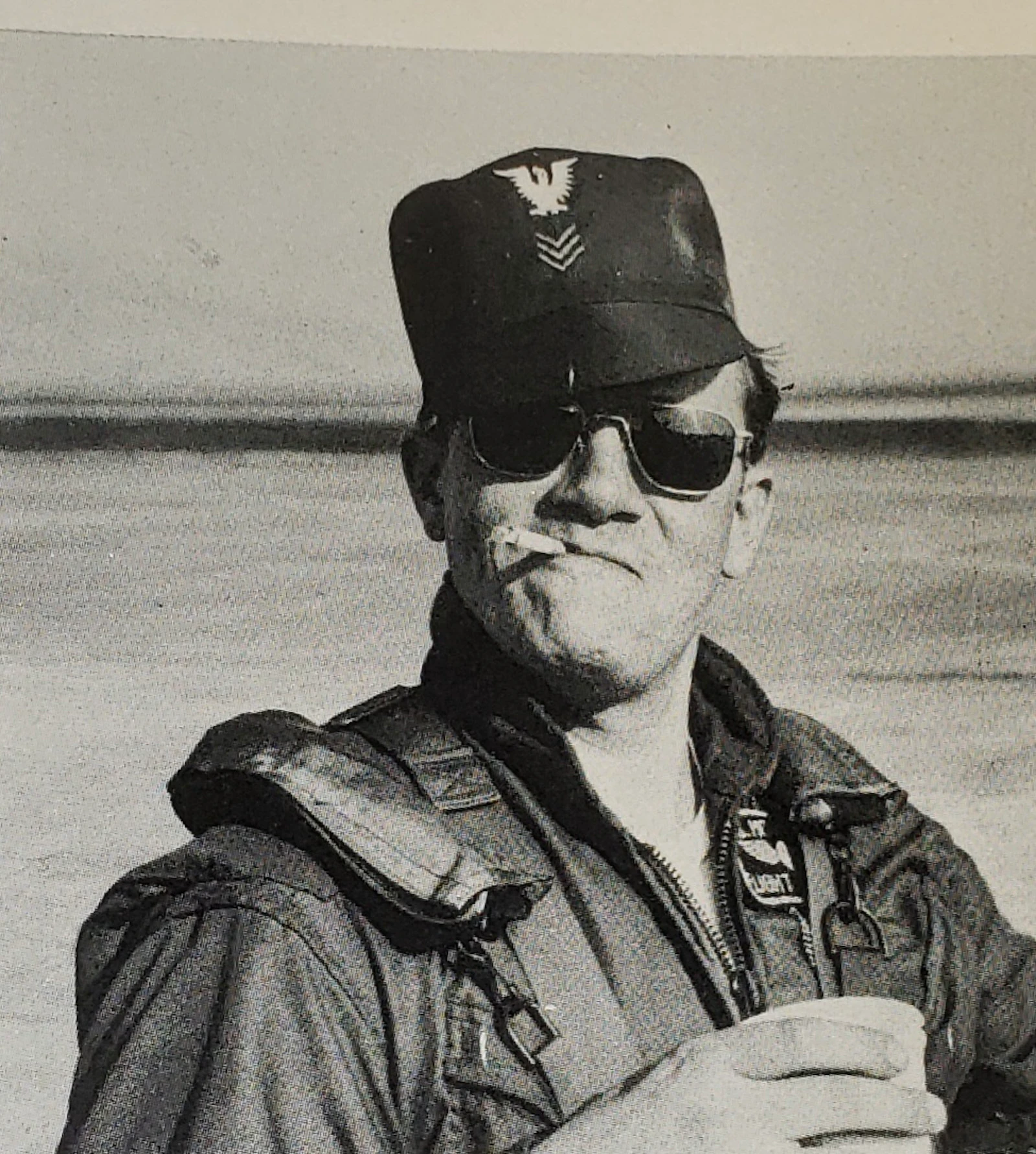
In 1978, Montgomery was offered a position as a flight engineer for a VIP P-3 that was used to transport high-ranking naval officers, government officials and other dignitaries. The combat and surveillance equipment on that plane had been removed; instead, it was furnished with amenities that included furniture, a galley, restrooms and passenger seating.
“That was a fantastic opportunity that I enjoyed my last 11 years in the Navy,” Montgomery said. “I flew with prominent people all over the world, including France, Australia, New Zealand, Indonesia, Thailand, Pakistan, Africa, the Aleutian Islands and the Soloman Islands.”
Montgomery retired from the Navy in August 1989, and two months later, he started a 25-year career with Hawaiian Airlines, most of that time in supervisory positions. He retired for the second time in 2014. Teruko had passed away five years earlier and Richard was working as a physician in San Diego, but Montgomery remained in Hawai‘i.
During a 2018 visit to O‘ahu, Richard and his family toured the Pearl Harbor Aviation Museum (PHAM) with Montgomery. There, they met the restoration shop manager, who, upon learning about Montgomery’s background, urged him to join PHAM’s team of volunteer aircraft restoration technicians.

Montgomery disassembles a stabilizer on the tail section of an SBD-5 Dauntless, a World War II-era dive bomber. (PHAM) 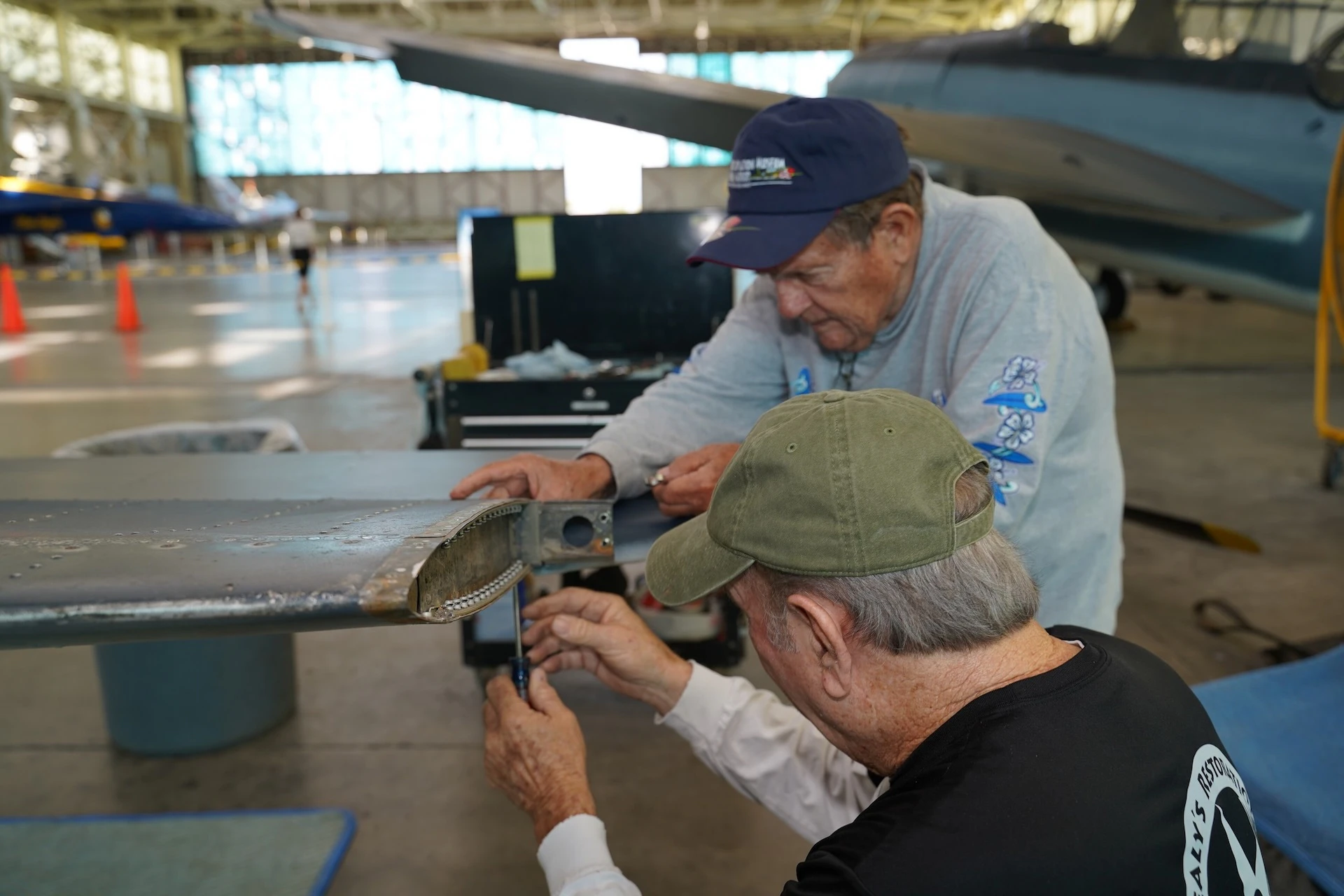
Montgomery (wearing blue cap) and Mark Erwin disassemble a stabilizer on the tail section of an SBD-5 Dauntless, a World War II-era dive bomber. (PHAM) 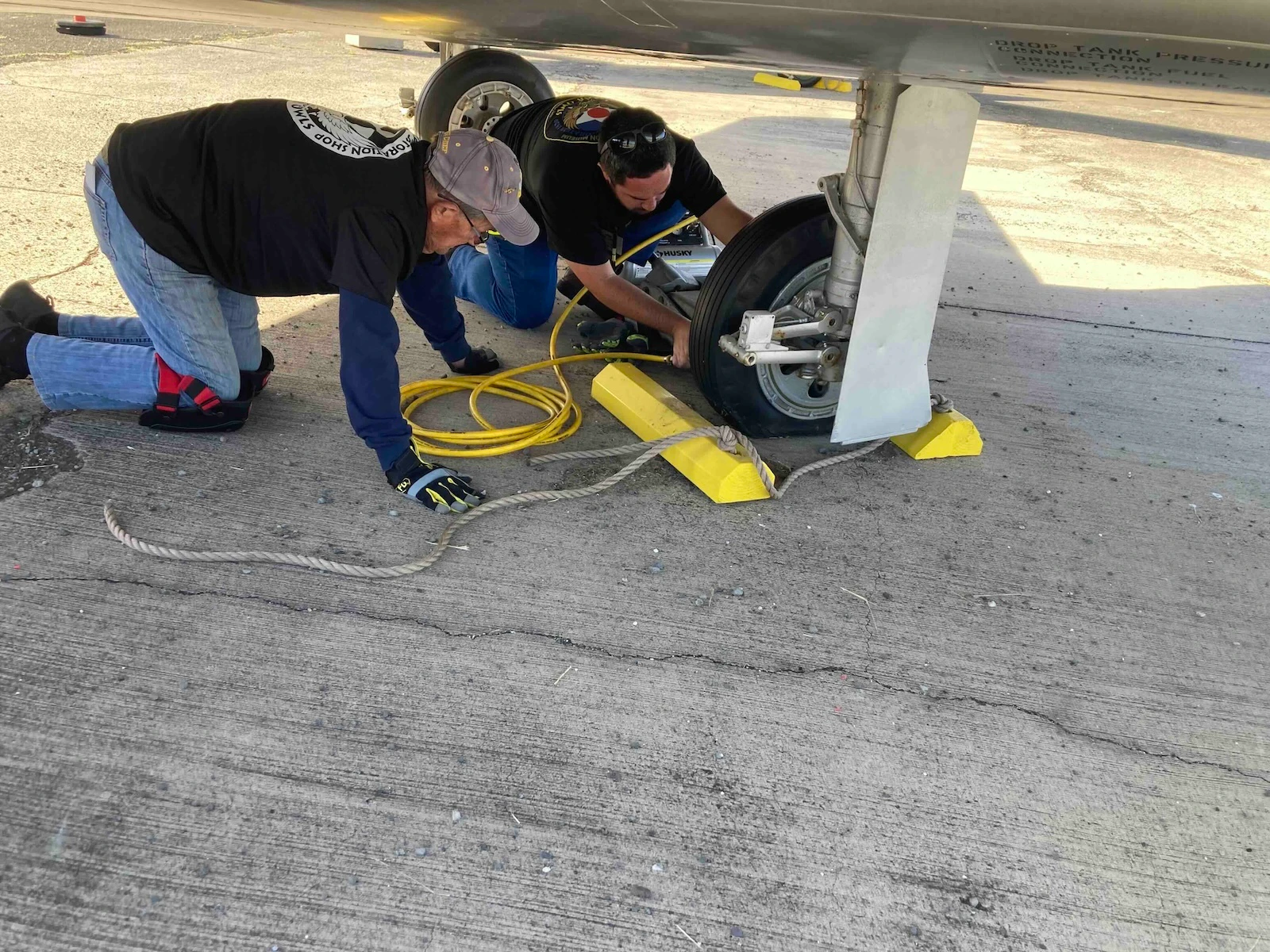
Montgomery (wearing gray cap) and Mike Tobin, PHAM’s restoration shop manager and exhibits fabricator, fill air in a tire of an F-86E Sabre jet, America's primary fighter plane during the Korean War. (PHAM)
“I’m there Tuesdays and Thursdays, from 7 a.m. to 2 p.m.,” Montgomery said. “We do corrosion control, sheet metal repair and painting for a variety of vintage planes, mostly World War II-era, that the museum has acquired. None of them have engines; we work on the exteriors, which often takes years to finish. Our camaraderie reminds me of my time in the Navy. If something needs to be done, everyone jumps in and does it.”
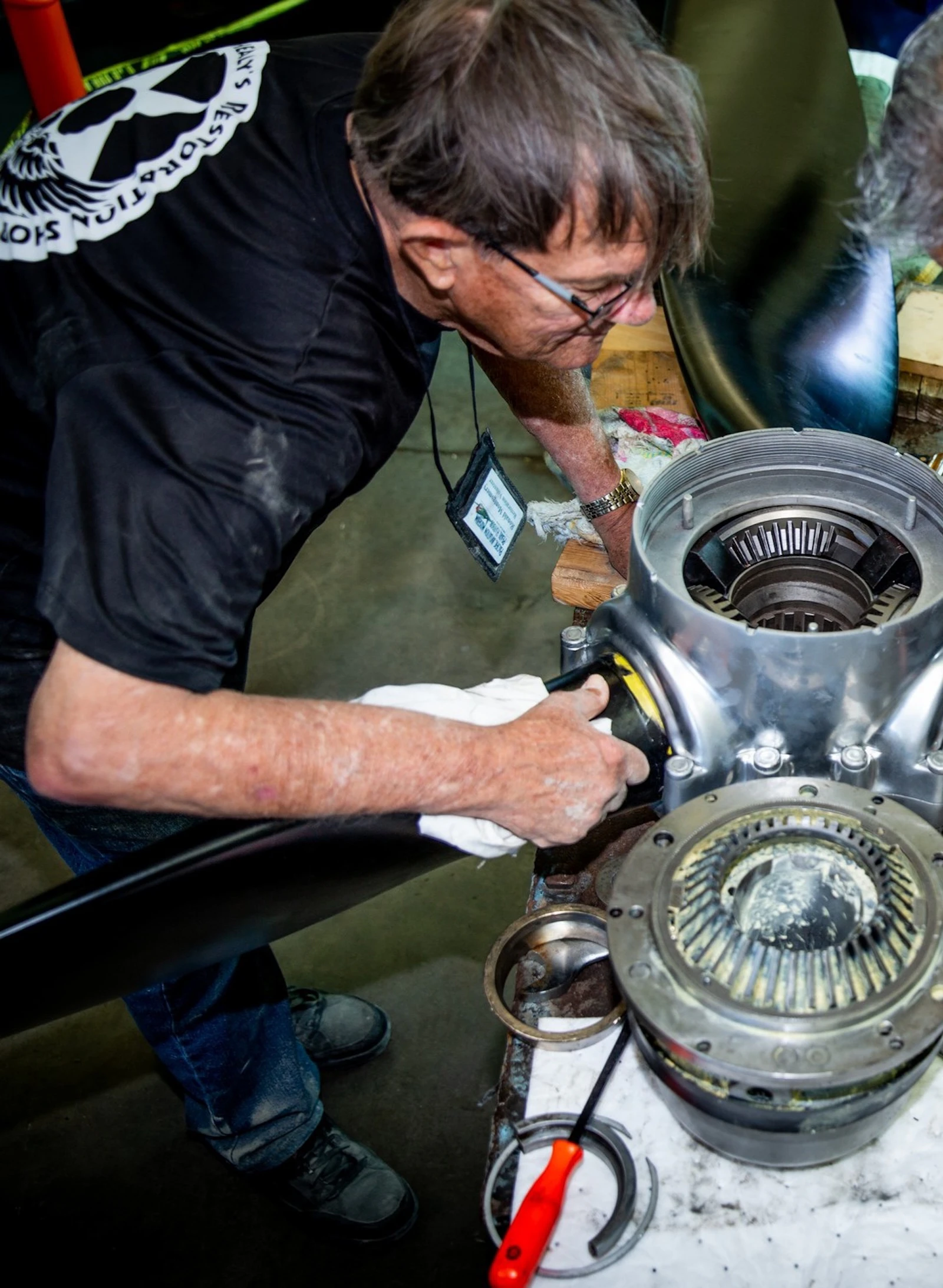
Montgomery works on the propeller hub assembly of a TBM Avenger, a World War II-era torpedo bomber. (PHAM) 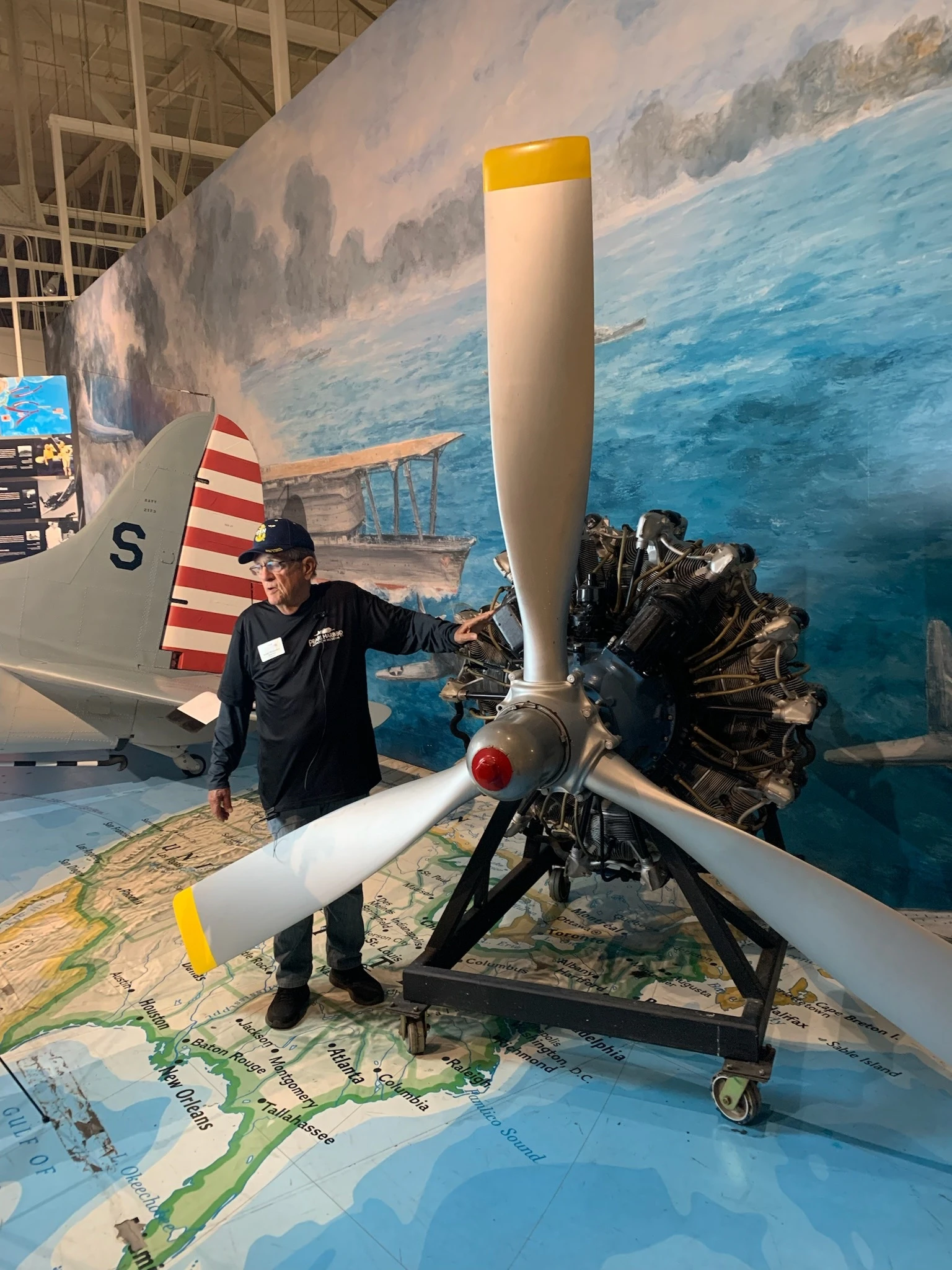
Montgomery displays a Pratt & Whitney R-2000 radial engine, which was developed in 1942 to power a variety of U.S. military aircraft. (PHAM)
In addition, Montgomery keeps busy with online Japanese language classes and volunteering as a counselor at the Retiree Activities Office at Joint Base Pearl Harbor-Hickam. He lives in the same modest three-bedroom house in ‘Ewa Beach that he and Teruko bought 56 years ago with two poi dogs, Milton and Coco, to keep him company. He does all the household chores and drives everywhere he needs to go in either his 2019 Nissan SUV or 1998 Ford Ranger.
“I’m living my best life, and many guys need a truck to do that,” Montgomery said. “Even one who’s 84 years old like me.”
PHAMily Fun Day
Monthly except January and December, the Pearl Harbor Aviation Museum hosts PHAMily Fun Day, a community event that usually includes talks, demonstrations, special exhibits and hands-on activities from 10 a.m. to 4 p.m. The theme of the May 23 event is Armed Forces Appreciation.
Admission is $10 at the door; $5 for kamaʻāina and military aged 4 and up if purchased online by 11:59 p.m. the day before; and free for PHAM members and keiki 3 and under. For more information, click here.
Author Cheryl Chee Tsutsumi can be reached at cct1402@gmail.com.
For the latest news of Hawai‘i, sign up here for our free Daily Edition newsletter.