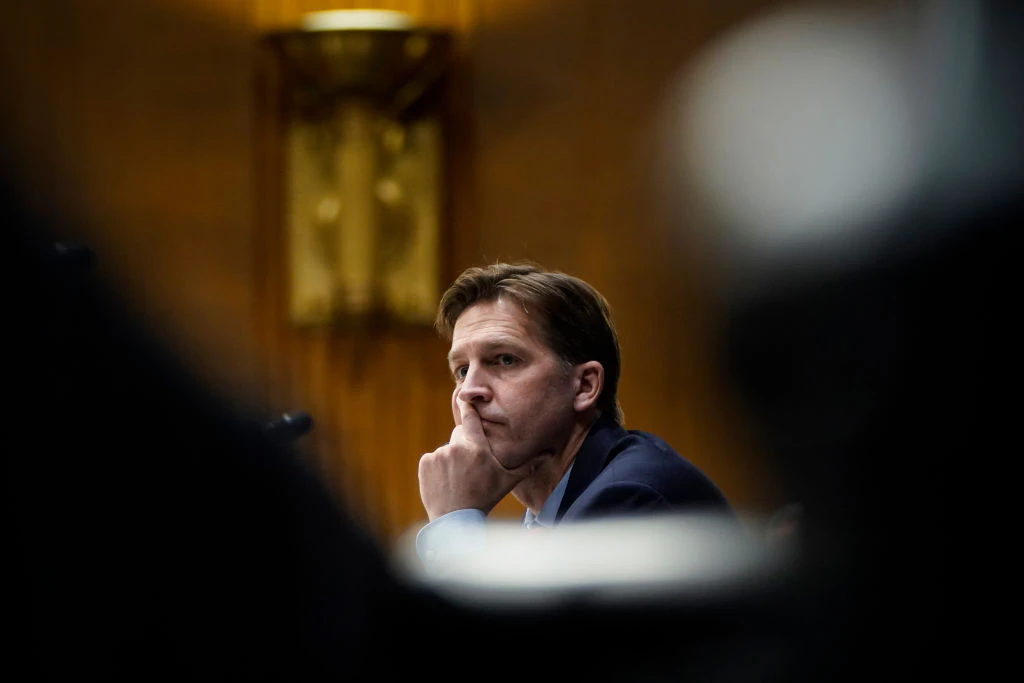
Ben Sasse is bleeding from the face.
He’s seated across from New York Times columnist Ross Douthat, mid-interview, and he pauses to note it. He’s dying of stage 4 pancreatic cancer. One side effect of the treatment is that his body can’t grow skin.
“Yeah, you look terrible,” says Douthat.
“Thank you,” says Sasse with a smile.
Since his diagnosis, Sasse has appeared on 60 Minutes, Focus on the Family, the Manhattan Institute stage, and a parade of podcasts. He uses the time to say what most politicians never dare to.
He talks about faith. He quotes R.C. Sproul. He discusses Tocqueville with the ease of someone who has actually read him.
Sasse is a two-term Republican Senator from Nebraska, a Harvard graduate, a Yale PhD in History. He voted to impeach Donald Trump and took the consequences. Though popular with voters in his home state, he left the Senate to serve as President of the University of Florida.
Now he spends his last days making one argument: American political life has gone badly wrong. Not because the wrong party is winning. Because the whole enterprise has lost its bearings.
Sasse starts with something most politicians would rather ignore: the pace of technological change. Previous economic transformations — industrialization, electrification — unfolded across generations. This one won’t. Robotics and automation will wipe out whole careers within a single working life.
Sasse sees a second shift: disembodied consciousness, the way screens let people leave their world. Families are breaking apart. Communities are dissolving. The local ties — churches, civic groups, the small-scale institutions Edmund Burke called “little platoons” — that help people absorb hard times are being stripped away. The formation of souls and citizens is at risk, and government is mostly ignoring it in favor of clickbait and rage.
He thinks our loves should be ordered, first to God, then to those nearest us, rippling outward from family to neighborhood to state to nation. Caring about a national political party more than your own community isn’t just confused. It’s a disorder of affection.
What’s true of the nation is true in Hawai'i. The legislature introduces three thousand bills a year. How many of those take the large challenges seriously? The demographic shifts, the cost pressures squeezing local families, the slow hemorrhage of young people off the Islands? The floor speeches and press releases gesture toward these problems, but the lawmaking doesn’t match the problem.
Sasse’s example suggests why. He can sit for an hour-long interview on dense political and theological matters because he has a clear philosophy — a disciplined way of working through problems. It also gives him the power to persuade, which is the precondition for coordinated action.
The founders studied rhetoric and philosophy with the same care they gave the law, because republican government runs on argument and clear speech. Most of Hawai‘i’s lawmakers couldn’t sustain an interview like Sasse’s, and the laws show it. There’s no clear direction. No will to rally the public. Few signs that anyone has thought hard about what government is for. What fills the vacuum is performance: press releases, floor speeches written for social media, outrage timed to the news cycle.
Sasse has a simple framework for what a coherent politics looks like. He describes four ways of valuing government, measured in cheers. No-cheer people — hardcore libertarians — don’t understand that government exists to secure liberty. Three-cheer people believe in a state that controls everything. Republicans, he says, are the one-cheer party. Democrats are the two-cheer party. Each has an extreme wing. Hawai‘i’s loudest voices are at the extremes.
What we lack are the one-cheer leaders: those who see government as necessary but flawed, able to secure order but not to deliver salvation.
Government should do a small number of important things well. It should get out of the way of the little platoons. It should never present itself as the path to utopia. Hawai‘i’s government casting itself as humanity’s last best hope has always been faintly comic.
Sasse’s sharpest line comes when he describes what voters already sense about the way their leaders talk.
They know it’s bullshit, he says — and they don’t want to be lied to. Why can’t politics do a small number of important, long-term things?
There is something clarifying about a man making that argument while bleeding from the face. He has no election to win, no caucus to protect, and by his own reckoning, weeks or months to live. What he’s chosen to do with his time is sit down and think hard about what government is and isn’t for, and what we’ve lost by confusing the two.
In watching Ben Sasse die, Hawai‘i might learn something about how to live.
Author Sterling Higa can be reached at hello@sterlinghiga.com.
For the latest news of Hawai‘i, sign up here for our free Daily Edition newsletter.