
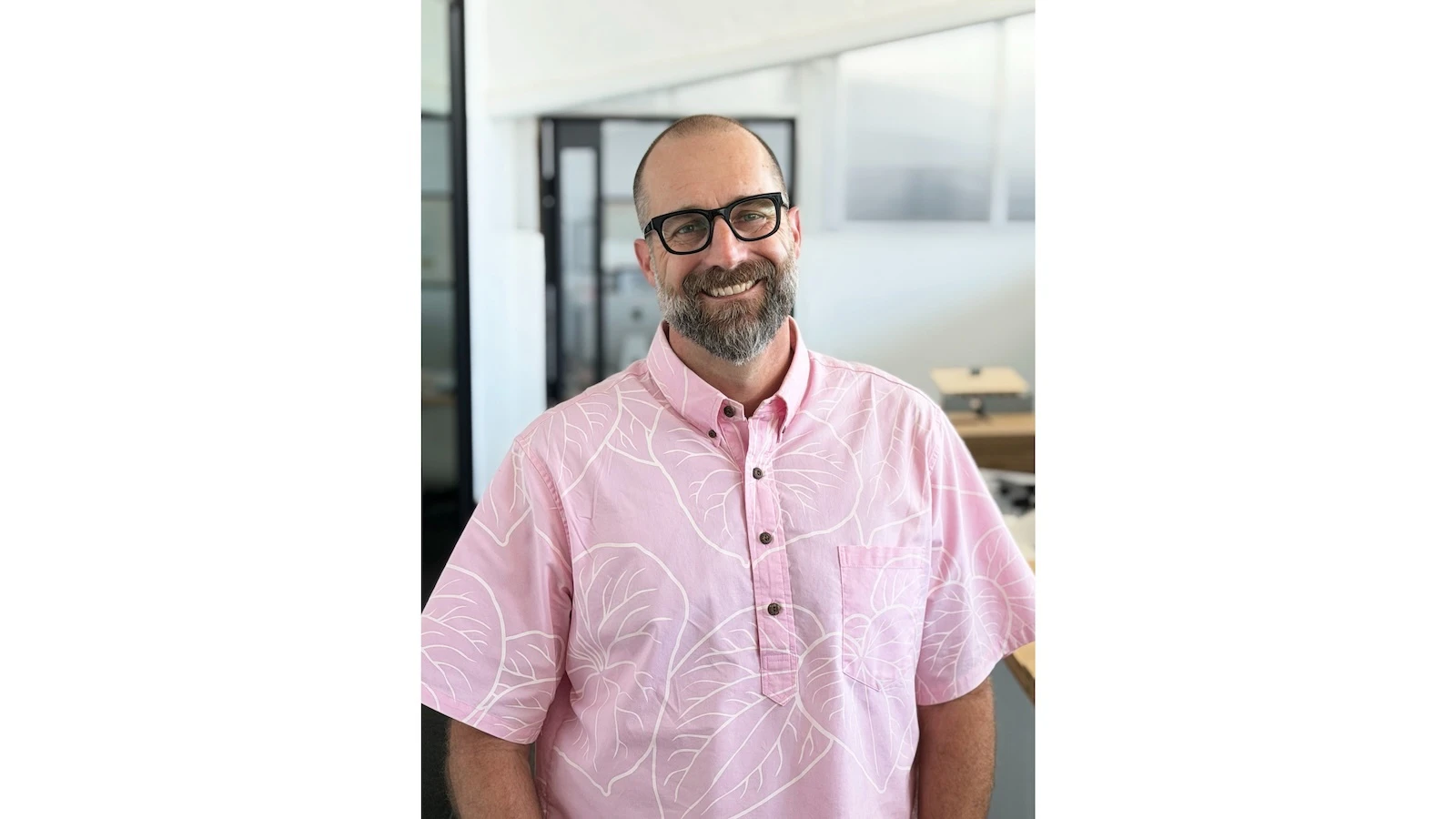
Maui architect David Sellers built his career on land — and by sea.
Originally from Texas, Sellers — who has worked on a commercial fishing boat in Alaska, studied architecture and worked in the Netherlands, and led operations on a remote atoll in the Pacific — has been living and working in the Islands for more than a decade. Now he's looking to step onto the national stage.
Sellers, the co-founder and principal architect of Hawai‘i Off-Grid, a Maui-based architecture and engineering firm, is a candidate for 2027 president-elect of the national American Institute of Architects, or AIA, board. That means if he's elected, he'll be president in 2028 and then past-president for one year but still on the national board, he recently told Aloha State Daily.
AIA is the largest design organization in the world with more than 101,000 members.
ASD caught up with Sellers to learn more about his history, work and why he's looking to become AIA president.
In the beginning
Sellers received his undergraduate degree from Texas A&M University. Pell grants allowed him to go to college, but Sellers, who grew up around auto mechanics, says he spent time working as a mechanic to help pay for school.
Following his first summer, though, Sellers, says he wasn't sure it was what he wanted to do.
Sellers learned about opportunities in Alaska from a friend he met when he first moved to College Station.
"He was like, 'You could go to Alaska and get a job and make a bunch of money in the summertime, and then maybe you wouldn't have to work during the rest of the school year,'" Sellers recently told Aloha State Daily. "I was like, 'Oh, that sounds fun.'"
Sellers bought his first commercial plane ticket on a credit card, flew to Anchorage, hitchhiked to Valdez and got a job at a cannery "because they had housing." From there, he says he was able to meet some people and land a job as a mechanic, or ship's engineer, on a commercial fishing boat.
"I ended up doing that for five years — every summer of my undergrad schooling — and was able to, some years, completely pay for my expenses above and beyond my student loans and didn't have to work as much."
Ultimately, Sellers says, he "really got into" and had a passion for architecture school. When talk turned to graduate studies, a mentor at Texas A&M recommended the Technical University Delft in the Netherlands.
"I ended up living in the Netherlands and ended up getting licensed after grad school and taking on my first professional architecture job there, and then I got a random opportunity to move to Hawai‘i," he told ASD. "... A friend of mine forwarded me this job posting and he's like, 'You're the only person I know that would fit this description.'"
Sellers says the job was looking for a boat captain, someone who knew mechanics and operated heavy equipment, was a certified scuba diver and had knowledge of aviation and runway construction projects. He ticked the boxes, did the interviews, made a visit and in 2011, he moved to Honolulu to work for the Nature Conservancy of Hawai‘i.
There, he led its Palmyra Atoll program; Palmyra is remote research station located about 1,000 miles south of Hawai‘i.
"That's how I got to Hawai‘i," Sellers says. "First thing that happened was they informed me that the timelines had advanced, so I needed to rebuild the runway."
To do that, he first had to survey the runway. And to do that, Sellers said he had to rent equipment to do so on O‘ahu — and a boat to sail the equipment to Palmyra and back.
He had the equipment, which was typically rented for a day, for 19. And when he returned, Sellers says the company owner told him that a civil engineer from Maui was angry he had taken the equipment for almost a month, but was excited when he learned where it was taken. The civil engineer left a business card for Sellers.
"I took the business card, put it in my pocket. He's now my partner in Hawai‘i Off Grid and he ended up helping me rebuild the runway down on Palmyra."
Eventually, Sellers says he needed a more stable work-life scenario, and in 2015, he co-founded Hawai‘i Off Grid Architecture & Engineering with architect Rick McGovern and civil engineer Jacob Freeman. You can find the full scope of its services here.
President-elect
When asked why he's seeking the president-elect role, Sellers says he's not one to say no to opportunities.
"There's a saying that lucky is when opportunity meets preparation, so I've just always been prepared for anything, if you will."
Sellers says in January he was asked by a few AIA board members if he would be interested in running for president and ultimately decided to do so.
"I feel very strongly about the things that we do," he says. "In 2020, Hawai‘i Off Grid made the commitment to only build new buildings that are net zero, and we've been able to stick to that for the most part. ... I'm very passionate about architecture. I believe that architects are uniquely positioned to be extremely relevant in the crises that are facing our society today."
That includes housing affordability and attainability, along with climate change.
"I firmly believe, and I have shown through our work that we've done at Hawai‘i Off Grid, that we can fix the housing crisis and at the same time combat the climate crisis. The way that we do that is we work with local and state governments to reduce the barriers to housing and then, as architects, we execute and we design and we get that housing built. The way that we do that is we design regenerative buildings that are net zero, or they make more energy than they consume, and we start to combat the climate crisis because 40% of the carbon that's being released into the atmosphere today is because of buildings. Architects have a unique responsibility historically to address that."
According to Sellers, the election is June 10 and results will be announced June 12.
Sellers says that anytime Hawai‘i has agency at a national level, "we can help guide and understand policy that can benefit us, whether that's policy alone or policy in the form of funding that can come to our communities, but we can also guide policy that affects our communities."
But it's not just what Hawai‘i can get by having a seat at the table, but what Hawai‘i can give, too.
"In Hawai‘i, we're at the tip of the spear when it comes to climate change, when it comes to affordability. ... As much as I think that it'll be beneficial to be close to the seat of power, to have the ability to network and bring resources back to Hawai‘i, I think the more important thing is that Hawai‘i can provide guidance and assistance and expertise and experience to the rest of the country."
If he's elected, and serves as president in 2028, Sellers says it'll be 50 years since AIA had a president from Hawai‘i. Elmer Botsai, a former dean of the University of Hawai‘i at Mānoa School of Architecture, served as AIA president in 1978.
Sellers previously served as president of AIA Maui and is currently a member of the AIA Hawai‘i State Council Board of Directors. He's also on the Habitat for Humanity Maui Board of Directors. You can read more about Sellers here.
Stephanie Salmons can be reached at stephanie@alohastatedaily.com.
For the latest news of Hawai‘i, sign up here for our free Daily Edition newsletter.


