
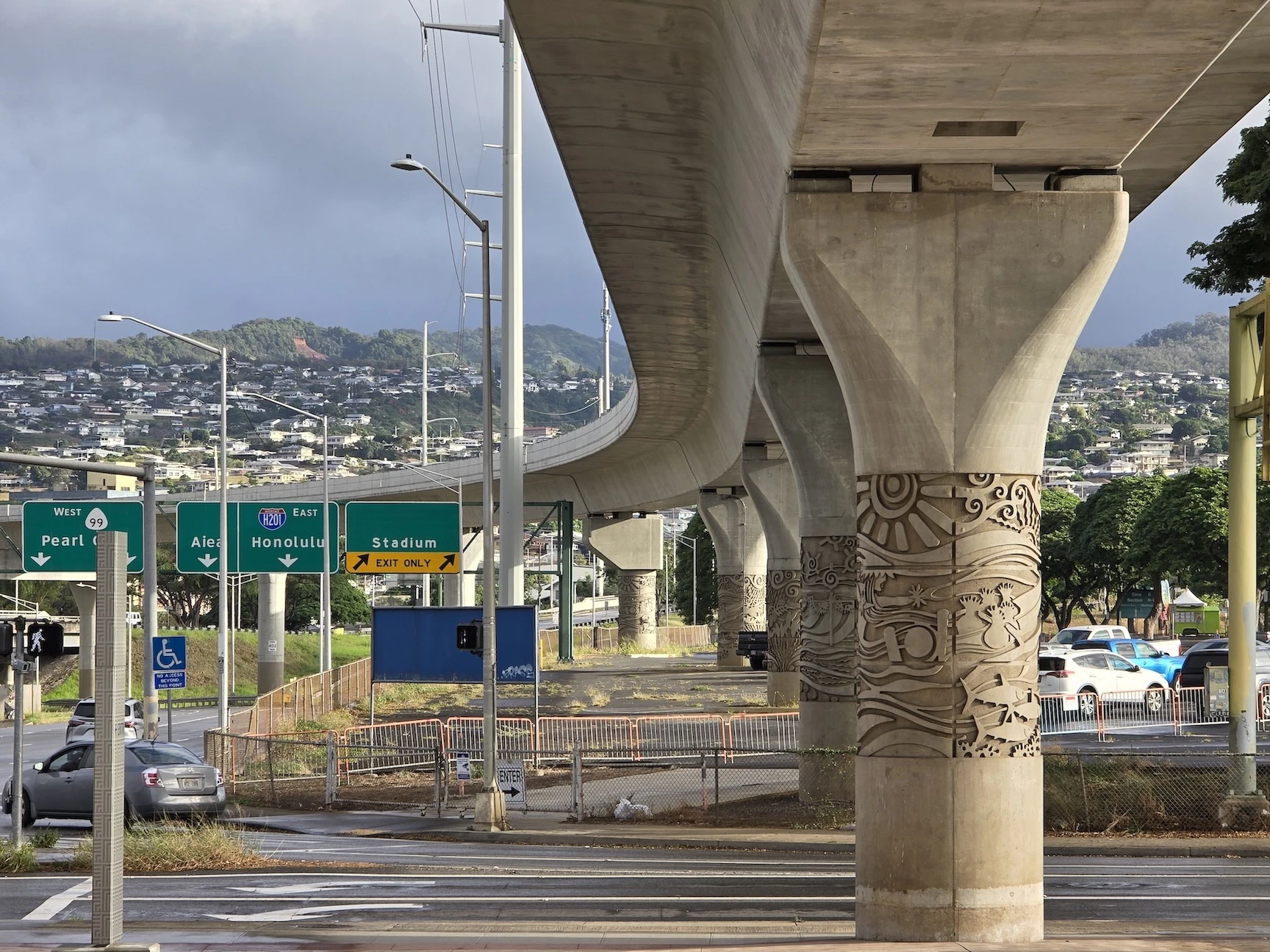
If you ask someone in Honolulu about public transportation, after some thought, they will wax nostalgic about how they grew up taking TheBus and shout out the route number they used to ride to and from home like a Zip code badge of belonging to their neighborhood. "Route 54! Upper Pearl City, not Lower!"
Maybe if you're lucky, they'll talk about Skyline and where it goes and doesn't go yet. But most will talk about how they drive everywhere now and what a chore it is to get around on this island to the places we go. This highlights a fundamental truth about transportation whether one rides or drives there: It is a critical public need, yet its ultimate success lies in how seamlessly it blends into the foreground and background of our lives.
Across Oʻahu, people spend far too much time worrying about how they will get from the dreaded Point A to Point B (and often to Point C, D, and beyond). They calculate traffic delays, swipe around the Waze app, stress over finding and paying for parking, and monitor social media for bad actors who can cause traffic delays by their inattention. Why do we spend so much brain space on how to get there instead of what we do when we arrive?
Transportation is a fundamental need, but it should never be a barrier to living our best lives. It should be a reliable baseline that simply works. When we design a transportation network, our goal isn't just moving vehicles of steel and rubber; it should be focused on moving people toward opportunity, community and vitality.
As we shape the future of Honolulu’s urban landscape, public transportation stands as the great connective tissue of our island. True connectivity is not just about linking geographical hubs; it is about binding our communities together. From our robust TheBus and Handi-Van systems to the expanding spine of Skyline and our integrated multimodal options like Biki bikeshare, we are creating a network where a rider can move effortlessly and reliably. When transit becomes seamless, it transforms how we plan our communities. It allows us to pivot away from sprawling concrete parking structures and shift toward transit-oriented urban spaces that prioritize walkable paths, affordable housing and public parks.
In Hawaiʻi, land is one of our most precious and finite resources. In Honolulu, we boasted a high-quality transit network implemented by our Aliʻi who had the foresight that a mobile community is a thriving one. For generations since then, however, the rise of the automobile throughout the nation dictated that spaces be built to accommodate cars first and human beings second. We are changing that paradigm, but it hasn't been easy.
By embedding reliable transit deeply into the fabric of Honolulu, we unlock the future and potential of our urban neighborhoods. We allow neighborhoods to densify responsibly around walkable and bikeable transit hubs, preserving our precious agricultural and conservation lands from development. Our streets can help transform gridlocked congested roadways of frustration into access points to and from vibrant community spaces where local businesses thrive, culture develops and opportunity abounds.
Ultimately, a modern, intuitive transit network unlocks equity and a level playing field for all. It means our kūpuna can travel independently as they live longer lives, our keiki can safely get a head start to and from school without relying on their parents to ferry them everywhere, and everyone can return home to their ʻohana sooner and with an expectation of safety. As we build out this future, we aren't just managing infrastructure; we are curating the daily experience of living on this island. We want to give you back your time and remove the friction from your day. Transportation shouldn't be the main event of your morning — it should simply be the invisible and seamless bridge that gets you to and from what matters most.
Jon Nouchi is set to lead a public discussion about human transit at AIA Hawai‘i's centennial quarterly book club series through “Human Transit: How clearer thinking about public transit can enrich our communities and our lives.” by Jarrett Walker. The free event runs from 10 a.m. to noon on Saturday, June 27, at UH West Oʻahu's Center for Creative Media (91-1001 Farrington Highway). Register here to reserve your seat.
For the latest news of Hawai‘i, sign up here for our free Daily Edition newsletter.


