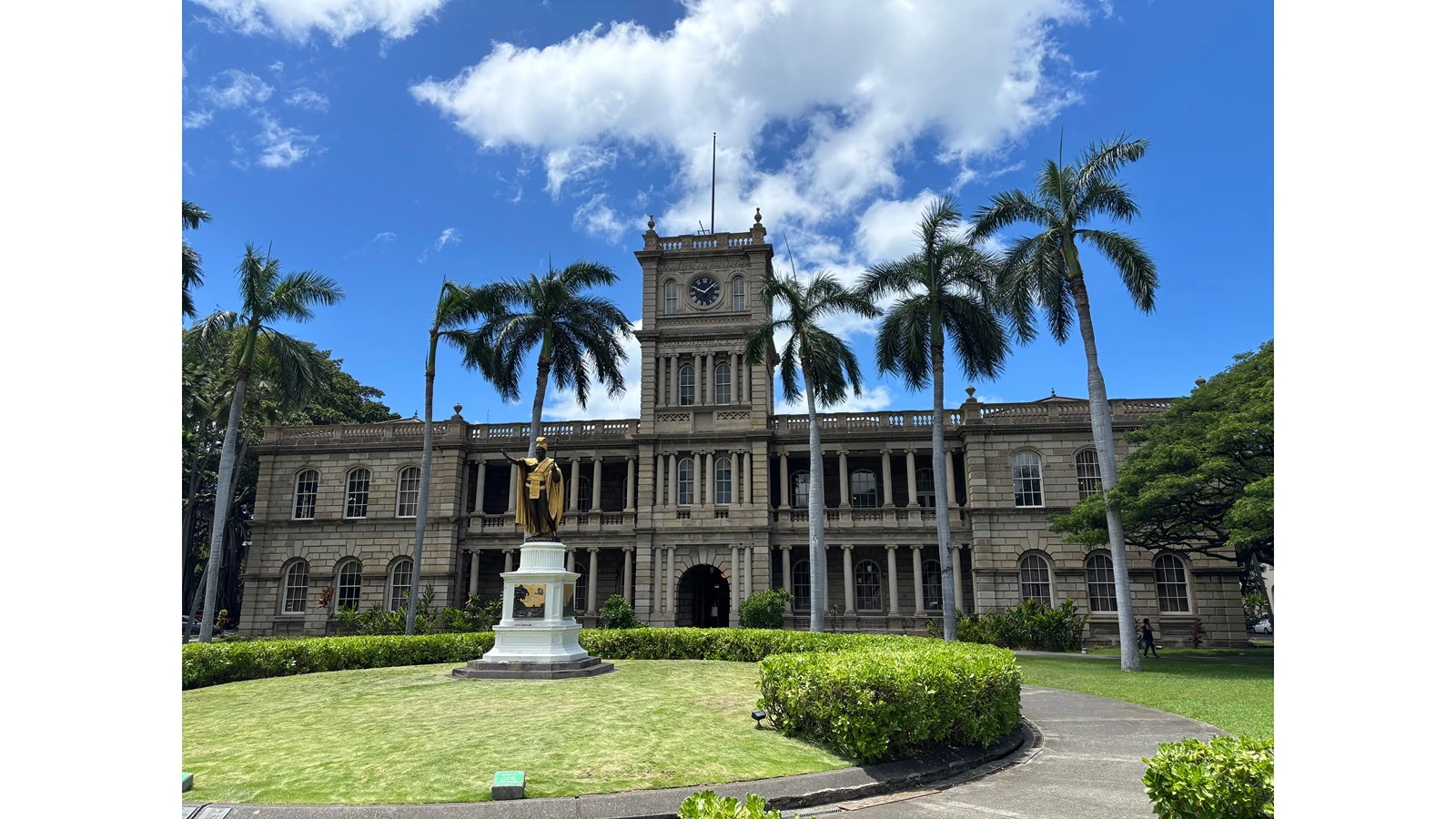
It’s 5 p.m. on a Wednesday in early July and the church bells are ringing out over Lahaina. The day may be ending, but it’s still hot and the sun is still shining brightly over the West Maui community.
It’s a different sight today than it was on Aug. 8, 2023, when wildfires driven by winds from a passing storm ravaged parts of the Valley Isle. While fires burned through several other areas of Maui, Lahaina saw the worst as an inferno destroyed much of the historic town and killed more than 100 people. It was one of the deadliest U.S. wildfires in more than a century.

Lahaina’s famed Front Street is no longer bustling in the way it was before the wildfires, but on this July day, nearly three years later, there are signs of new life on the quiet streets.
When I was here two years ago, just before the first anniversary of the fire, heaps of debris and piles of twisted metal remained in many areas. It was quieter then, almost silent, as I spoke with business owners who had lost everything. They sifted through the rubble and ruins and paused poignantly as they took in what was, seemingly reflecting on what had been.

On this day, though, it's different.
A small group has gathered in a parking lot off Front Street; signage there directs people to “Meet Here” for various tours leaving from the nearby Lahaina Small Boat Harbor. More signs direct pedestrians along a route to get there.

Some hazards may persist, the signs warn. Access at your own risk.
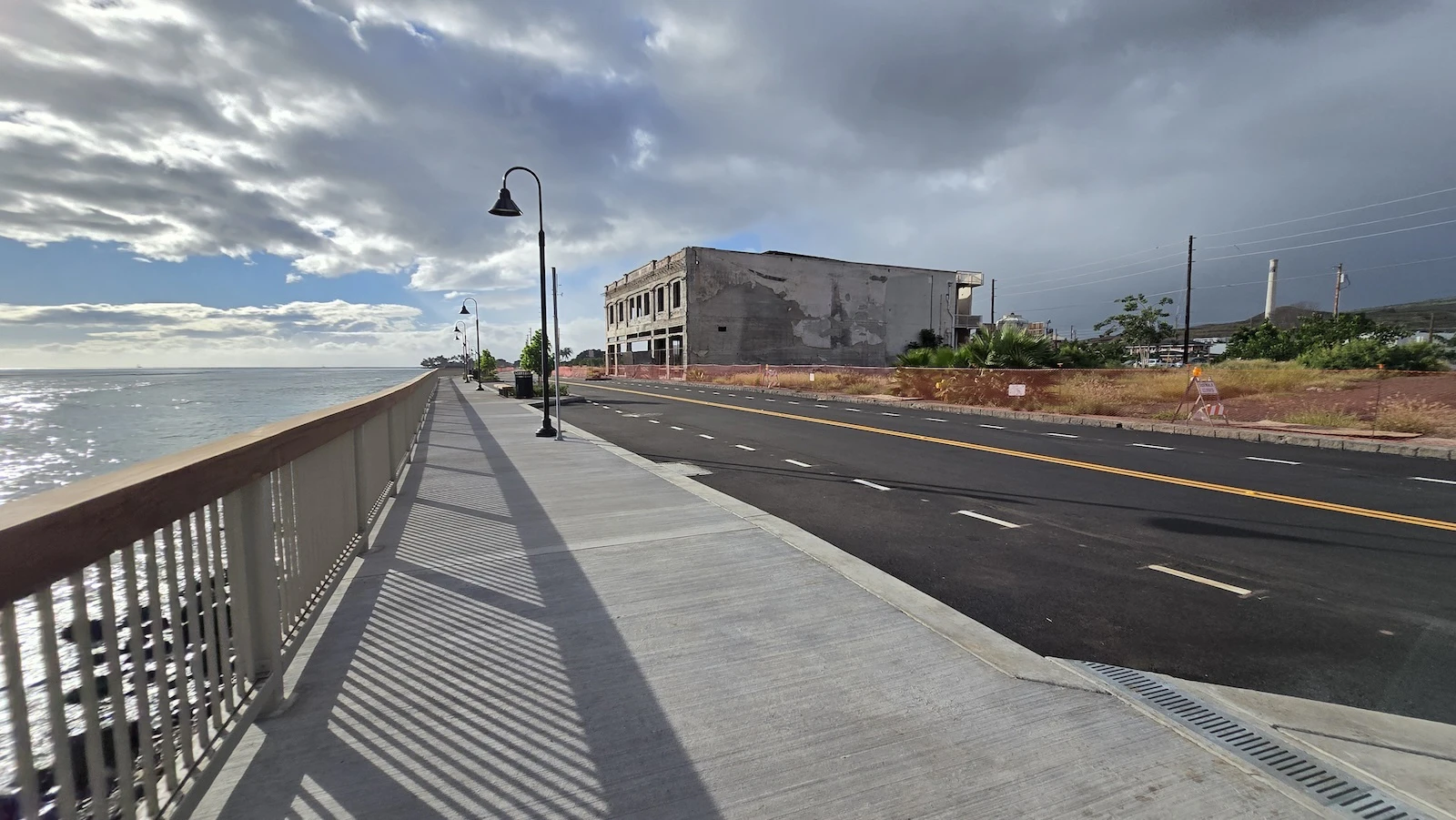
There’s plenty that’s still off limits on this day — roads closed, fencing up, warnings posted — but this afternoon, a few people, including this reporter, are trekking down the roadway, a portion of which was still closed to vehicles, on foot.
Visitors pause and take in the sight of the 153-year-old banyan tree, still looming large. The tree was damaged by the heat of the blaze and is still recovering from the fire, but wasn’t destroyed. It’s been fenced off, with no trespassing signs posted. Following an assessment this spring, arborists have decided that the tree will remain fenced off for another two years, but you can still admire from the sidewalk. (Read more the tree here.)
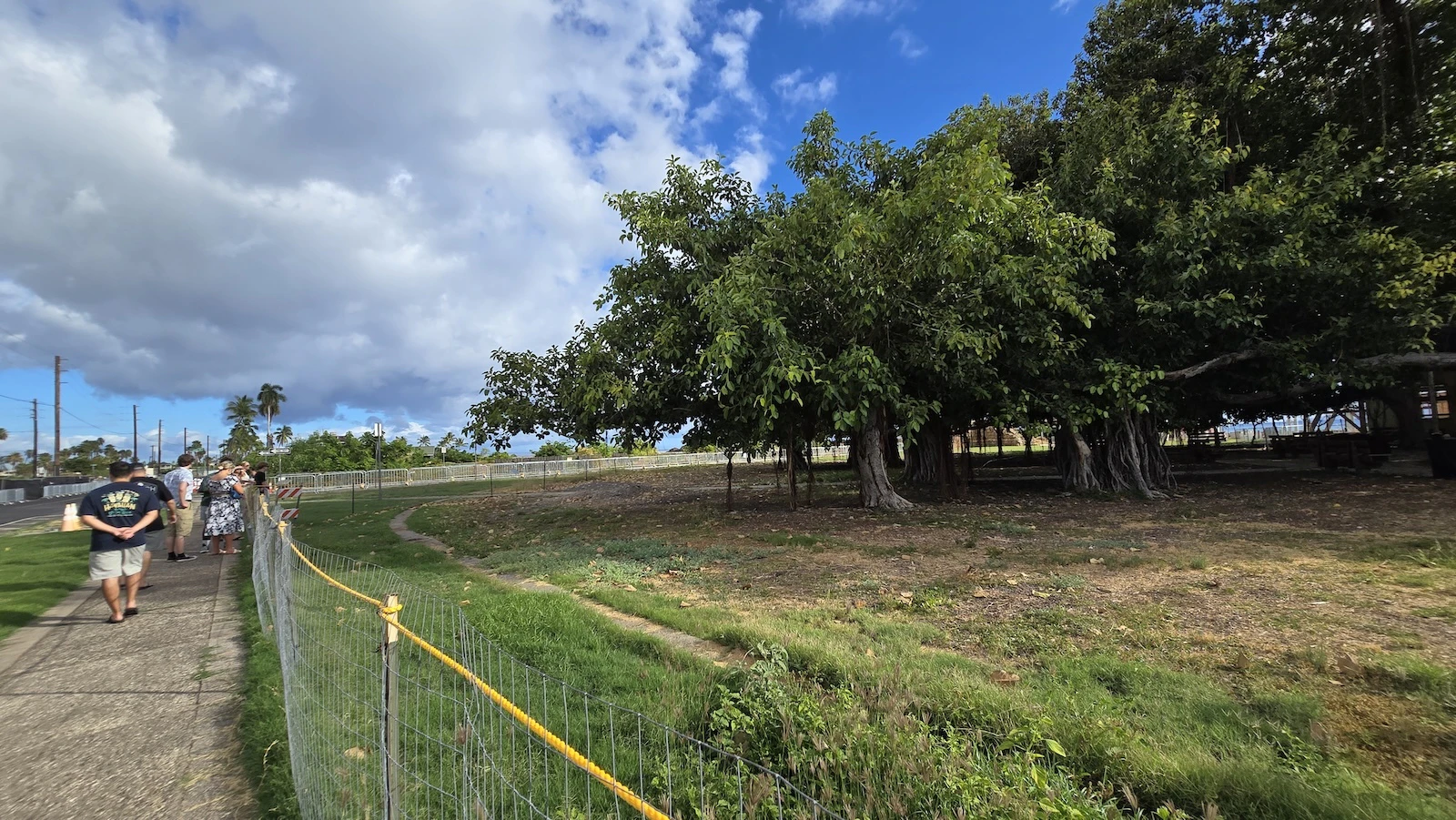
A man walks one way down the road, his dog on a leash. Walking in the other direction is a man with a surfboard under his arm. A short time later, a young boy bikes down the empty street, with his family following close behind. He rings the bell on his bicycle.
Some visitors on the sidewalk lament the loss.
Look at those buildings, they say. It’s all gone, they say.
And that’s true, but it isn’t.

So where’s Lahaina today, three years later? It’s still there. Recovery is still underway and what the community will ultimately look like is yet to be seen, but work is progressing, more slowly for some than others, but it is progressing.
Aloha State Daily sat down with county leaders last month to find out where things stand three years after the fires.
Rebuilding residential
When talking about the fires, Maui County Mayor Richard Bissen, who is seeking reelection this year, first offers up some context, and starts by recounting a community meeting in September 2023, the month following the fires.
“I recall this vividly. The question was put to us: When do you think we will be able to get a building permit?” he told ASD during a sit-down interview in July. “And this man, he was not angry. He was very matter of fact. He said, ‘We just need to know how to plan.’”
Bissen told the man that based on what was known from other communities like Paradise, California, which was devastated by deadly wildfires in 2018, and others, it would take at least two to three years to get a building permit.
But in November 2024, a little more than a year after the fires, Bissen said the first two rebuilt homes were moved into — one in Lahaina and one in Kula.
“So, not only did it not take two or three years to get a building permit, it didn’t take two or three years to move back into a rebuilt home,” Bissen says.
As of Aug. 5 of this year, 577 homes have been completed, including 264 single-family units and 313 multi-family units, according to data on the county's recovery dashboard.
There are 667 homes with issued permits, including 583 single-family units and 84 multi-family units, which means permits have been issued allowing construction to begin. Another 597 homes — 176 single-family units and 421 multi-family units — have permits processing, which means applications for permits have been submitted.
A total of 400 homes, including single-family and multi-family units, are under construction.
"I just needed to put that in perspective because it’s hard to say if you’re ahead or you’re behind without comparing it to something,” Bissen explained. “There’s so many reasons why that happened in terms of debris clearing and in terms of building, but I think for us, a big reason it happened … is we told our community so they would know in advance that our focus was going to be returning people to their homes, especially owner-occupied homes, because there are people who own second and third homes out there too, of course, [but] that has been our focus and we’re well on our way.”

Housing in Lahaina was a challenge even before the fire, but according to the Lahaina Long-term Recovery Plan, 2,207 structures were damaged or destroyed in the Lahaina fire, of which 1,898, or 86%, were residential. The residential structures that were damaged or destroyed made up about 45% of Lahaina's residential housing.
"The challenge of finding replacement housing units for residents who lost their homes is exacerbated by the average household size in Lahaina (3.53 people) being significantly higher than than the average in the county (2.96 people), state (2.92 people) and the United States (2.57)," the report reads. "The scarcity of rental housing amidst competition with short-term rentals presents an affordability challenge for displaced residents, increasing the pressure on the housing supply availability and high cost of living, compounded by the fire, have resulted in 45% of fire-impacted respondents to say they are considering leaving the county and moving elsewhere."
Across the August 2023 wildfires in Lahaina and Upcountry Maui, 2,145 dwellings were destroyed, according to information provided by the county, citing county real property assessment data.
Commercial activity and infrastructure
The county also has been focusing on the commercial rebuilding concurrently, but the challenges are different, Bissen says.
“But now that infrastructure has been restored — we’re talking about water, wastewater, power, roads — that’s all infrastructure that commercial needs,” he told ASD. “You can put up a building, but you still need to bring water to the building, have wastewater go away from the building, get roads [so] people can get to the buildings, parking. There are things that are needed for our commercial business and I’m really proud of where we’re at on that, as well.”
Maui County spokesperson Laksmi Abraham told ASD in a follow-up email that overall, infrastructure restoration was one of the "first and most critical phases of Lahaina's recovery."
"Before homes and businesses could be rebuilt, the community needed safe drinking water, functioning sewer service, reliable roads, electrical service and other essential utilities," she said, noting that many of the projects required coordination among the county, state, utility providers, the U.S. Environmental Protection Agency, the Federal Emergency Management Agency and the U.S. Army Corps of Engineers.
In March, the county's Ho‘okumu Hou program, which encompasses all the recovery programs funded by $1.6 billion in federal Community Development Block Grant Disaster Recovery funds appropriated for the 2023 wildfires, announced conditional funding allocations that will help restore 519 affordable housing units and fund 22 critical infrastructure and mitigation projects.
Some of those infrastructure projects include major corridor improvements, including phase 1C of the Honoapi‘ilani Highway realignment, or Lahaina Bypass extension; street extensions and connector roads; repairs to damaged roads and sidewalks; upgrades to recycled water systems; sewer system expansion and upsizing, replacement of critical wastewater pump stations, emergency power for essential water facilities, and reconstruction of public-serving facilities in West Maui, that announcement noted.
This summer alone, though, there's been a flurry of movement recently in Lahaina’s commercial sector.
An interim marketplace and community gathering spot in development by Hawaiian Council — with support from its Kākoʻo Maui Fund and the Hawaiʻi Community Foundation — will be the first project to bring storefronts back to Front Street, Maui County said in a July 2 announcement of its launch.
Called ‘Ulu o Lele, the marketplace will be located at the former Outlets of Maui site and offer a temporary home for local businesses, nonprofits, cultural practitioners, farmers and community programming while permanent commercial redevelopment progresses, the announcement noted.
According to the county, Hawaiian Council, formerly known as the Council for Native Hawaiian Advancement, has secured a two-year lease for approximately three acres at the site and is leading the planning, development and implementation of the project, itself designed as an 18- to 24-month recovery initiative.
The project will use modular retail spaces and supporting infrastructure to "quickly activate the site and create new opportunities for local businesses and organizations," the announcement says. Meanwhile, the marketplace is expected to hold approximately 25 to 50 local vendors and help sustain about 90 jobs.
Meanwhile, Kimo’s Restaurant, a popular waterfront eatery lost in the fire, has also announced its intent to return to Front Street.
Parent company T S Restaurants will partner with business leaders Kent Untermann and Mousa Hassan who are restoring the Chan Wa Building, which is where you’ll find the restaurant in the future.
Overall, five Front Street commercial permits were issued as of mid-July and two more commercial projects were nearing permits, according to information provided by Maui County. More than a dozen commercial properties were in planning consultation at that time.
"Permitting and approvals in the Lahaina Historic districts have been one of the most heavily regulated processes in the state, involving national, state and local rules. Besides being one of the most storied places in Hawaiʻi and the Islands’ first capital, it was the only historic district in the state with buildings constructed out over the water," the county noted in its July 2 announcement.
Risks ahead
But there are risks.
Some business owners may be hesitant to be the first business to return and reopen in Lahaina Town without other draws, but Abraham told ASD in July that’s why the upcoming ‘Ulu o Lele Marketplace is so critical, “because it paves the way and provides foot traffic and accountability, that there will be people down there when they do open their doors.”
Bissen noted, too, the dynamics between landowners and tenants in Lahaina’s commercial areas.
“Some of the landlords are their own tenants — they work in the building that they own. Many of them are landlords who lease their space to other businesses, which means it takes two people to really make that work,” he explained. “If the tenant wants to come back, but nobody builds the place, then they’re waiting. If the landlord rebuilds and no tenant wants to rent their space, then why did they rebuild?
“But if you own your own building and restaurant or retail, then you know you’re coming back. It’s very different from residential. ... Not enough people are factoring that in because not only do they have to risk financially, but also the time and effort and energy it takes to rebuild. I think that was part of the hesitation, but now that groups are coming back, I think people will see that momentum and see that synergy that’s starting to happen.”
But businesses could have moved forward with rebuilding at any time.
“I think it was a ‘Let’s wait and see’ in their mind how this is really going to go,” Maui County Office of Recovery Administrator John Smith told ASD during the same interview in July. “They knew that we were concurrently working to pave the way for them in terms of how permits go through, how infrastructure was going to be ready, because building a commercial building has a different standard than a residential [building] and we’re holding current building code standards ... . All of that stuff in a very old town has to be considered.
“When you have all these really old buildings and you’re going to rebuild, one, you’re going to rebuild to meet what the community wants — and that’s where we developed design guidelines. Commercial wanted to see how that was going to turn out. That’s all done now, so there’s a very, very clear path to go fast with commercial guidelines — but you also have to build to current building code and sometimes that means you need to upgrade your own infrastructure on your property, depending on the age of the structure.”
All that’s being weighed concurrently with the residential rebuild, harbor opening and streets coming back online, Smith says.
“In a major disaster, where an entire town is lost, commercial is naturally the lagging factor until there’s people to be there for business,” he told ASD.
As part of the broader Rebuild Lahaina Plan, commercial design guidelines approved by the Maui County Cultural Resource Commission in May “aim to support the Lahaina community’s rebuilding efforts and assist in meeting community needs, incorporating climate resilience and sustainability, and honoring the cultural and historical significance of Lahaina,” the Maui Recovers website notes. “These guidelines build on existing regulatory and policy documents and are grounded in historic Lahaina building styles and community feedback.”
The Rebuild Lahaina Plan itself covers about 120 acres and focuses on the core of Lahaina.
Smith said, too, that the county has engaged with all owners in the commercial area at this point.
“We’ve seen their plans. We’re working with them on their plans. We understand their timelines, when they’re coming back, how they’re coming back and in the interim things like the new marketplace that’s coming will be a significant help until reconstruction can occur,” he says.
Smith also told ASD in July that operations at Lahaina Small Boat Harbor are integral to Lahaina’s commercial activity. And while it’s actively operating now, the repair work isn’t finished.
The state Department of Land and Natural Resources Division of Boating and Ocean Recreation resumed limited commercial boat operations at the harbor in December 2025 — the first time since the wildfires. According to June updates from DOBOR, among the work already completed or underway, construction on a $5 million dredging project began June 1 and is anticipated to be finished by December.
Moving into a commercial area is different than moving into a home, Smith says.
“These commercial owners need to know that they’re going to have enough traffic down there.”
Timeline to rebuild
How long will it take to rebuild Lahaina?
That depends on who you ask.
“When you say that, if somebody’s home is already built and up in Lahaina, have we rebuilt Lahaina?” Bissen says. “Do we have to wait until we build the very last one to say we’ve rebuilt Lahaina? I think we’re in phases. We’re in stages. I think that’s how you rebuild any [community]. I don’t think we’re unique in that sense. I think that you can visibly see the tangible results that have happened if you saw the before and after — and I mean right after the fire to where it is now.”
Smith mentioned the 519 additional affordable housing units the county has helped fund, which are expected to be completed between 2029 and 2031.
“We can see over the next few years that every time one of those comes online, it’ll be another phase is done, another phase is done,” he told ASD. “I think it’s a very, very reductionist view … to just say ‘When’s it going to be done?’ For the 236 that have already moved into their homes, Lahaina’s back. The other [residents] that are in a temporary situation, they’re still there. … Lahaina’s still there, it’s just at what stage is it? And the answer to that is granular per neighborhood, per site, per unit.”
Smith says that more than 80% of all properties have a plan to “come back completely."
"I think we’ll get back to beyond 100% because we’re also talking about building new houses in new areas. Some of those multi-family [properties] are coming back more dense on purpose because they realized that they weren’t really utilizing the property efficiently.”
How would the county’s leaders rate the recovery efforts so far?
“I can only really answer it based on what other communities that have gone through similar things are telling us,” Smith says. “We know that we're doing, I would say, well. Easily, we’re doing well. I would say we are in some ways setting a new standard for recovery, and this is not just here. Maybe globally, we’re setting a new standard.”
For his part, Bissen says, “If you ask somebody who’s in their home right now … they’ll say ‘It’s great. We’re home quicker than we thought,' and if you have somebody waiting, you’ll always be able to find somebody who will say, ‘No, this is going way too long. It’s taking so long,’ and it’s true to them. It is absolutely true. I wouldn’t disagree with them.”
One ‘Ohana Fund
Gov. Josh Green on Thursday announced that the One ‘Ohana Fund, formally known as the Maui Wildfires Compensation Program, has offered the full $175 million available through the program to families who lost loved ones and individuals who suffered serious physical injuries in the fires.
An Aug. 6 announcement from the governor's office noted that as of Aug. 4, the program has offered compensation for 162 eligible claims across two phases, including 102 death claims and 60 serious physical injury claims. More than $155.7 million has been delivered to date.
According to the governor's office, the fund was made possible through $175 million in contributions from Hawaiian Electric Co., the state, Kamehameha Schools, Maui County, Charter/Spectrum, Hawaiian Telcom and West Maui Land Co. This funding is separate from the $4 billion-plus global wildfire settlement still in litigation proceedings, the announcement noted.
The program was announced on Nov. 8, 2023, two months after the fires, "to provide a prompt, accessible and Hawaiʻi-centered alternative for compensating eligible death and serious physical injury claims," the announcement says.
Eligible death claims receive $1.5 million, while serious physical injury awards are determined by the severity of the injury and may total up to $1.5 million, the state says.
To prevent future tragedies, Maui has been expanding the Maui Emergency Management Agency under new leadership; ASD reports on the details of that here.
Stephanie Salmons can be reached at stephanie@alohastatedaily.com.
For the latest news of Hawai‘i, sign up here for our free Daily Edition newsletter.