
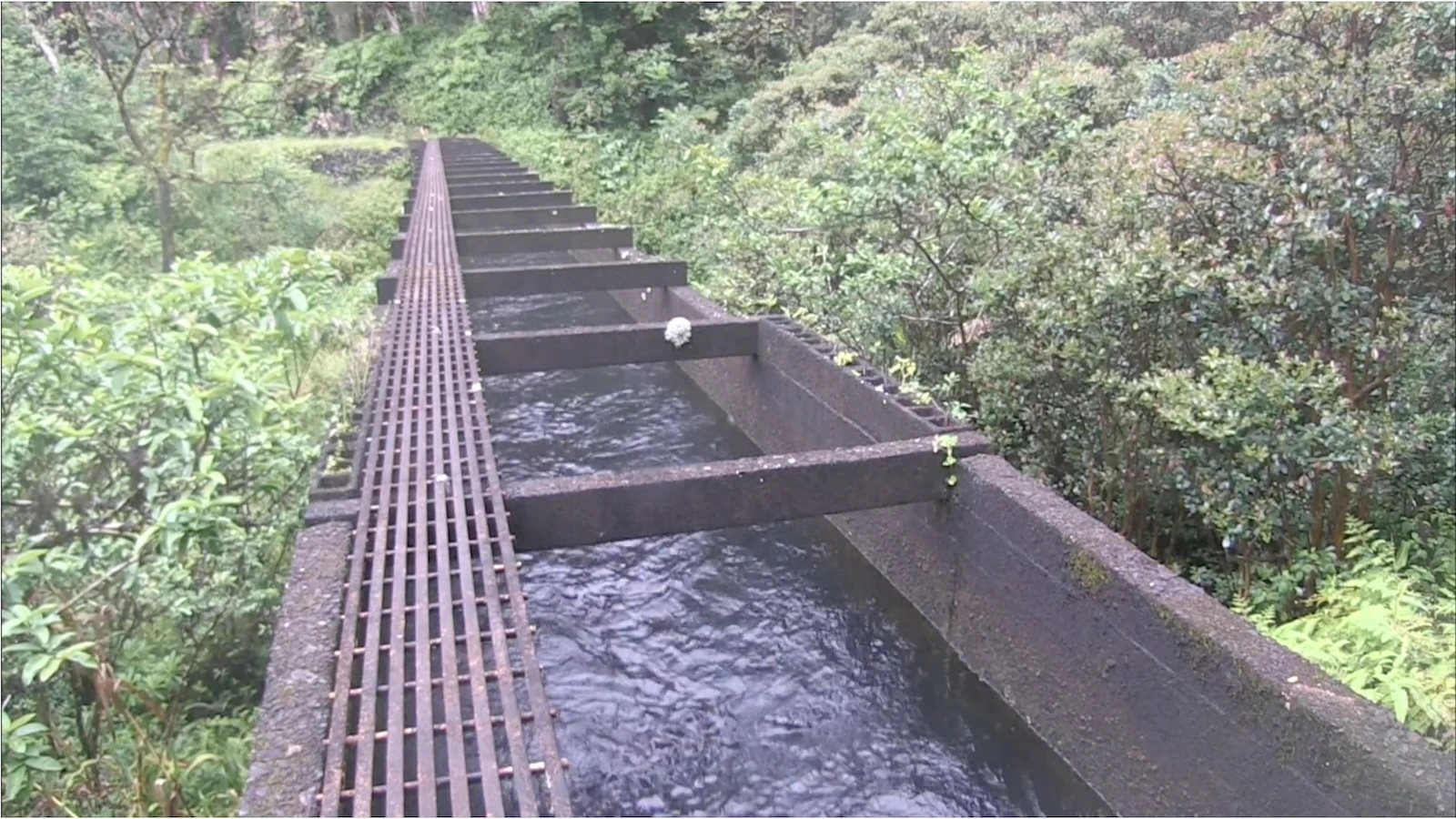
A battle over water rights in East Maui boiled over Friday as the Board of Land and Natural Resources considered a proposal to auction off water rights for 30 years.
The East Maui Irrigation System delivers as much as 450 million gallons of water per day throughout thousands of acres of agricultural land in East Maui. The operation of the irrigation system is contingent upon a contract between the state and agricultural company Mahi Pono LLC, which, as of 2025, owns and operates 100% of the system.
On Friday, the BLNR considered a pair of possible futures for the EMI. On one hand, Maui County requested in April to have state-owned land and a daily average of 6.5 million gallons of surface water within the EMI to be set aside to the county’s control and management “for domestic, municipal and agriculture purposes.”
On the other hand, the BLNR could also sell via public auction a 30-year license to divert up to nearly 87 million gallons EMI waters daily.
For scores of Maui residents who testified on Friday, the choice was obvious. Testifiers spoke for more than eight hours urging the BLNR to either reject the public auction — in which Mahi Pono would be the only serious bidder — or postpone their decision.
Attendees warned against placing more of Maui’s natural resources under the control of private entities.
“Mahi Pono can purchase the water it legitimately needs for agriculture from a publicly managed system just like the rest of us small farmers here on Maui,” wrote farmer Eddy Garcia. “We already have to compete with them taking all of our sales. It does not need to control the source for the next 30 years.”
Others raised concerns about Mahi Pono’s corporate ownership: the business is a subsidiary of PSP Investments, a Canadian pension fund with substantial water holdings in Australia. Several testifiers argued that a foreign company’s chief fiduciary duty is to its shareholders, not the people of Maui.
“They are not farmers,” said testifier Tamara Lester. “They’ve squeezed out a lot of family farms and sell the water back to the people it should belong to.”
Still others pointed out that, in 2022, Maui residents voted to amend the county charter and establish the Department of the East Maui Water Authority, which came online in 2024 and is tasked with the stewardship of East Maui waters and acquiring water systems directly. Surrendering those water systems to a private entity instead would seem to contradict that charter amendment, many said.
Nonetheless, there were some voices in support of the auction. Scott Enright, former chair of the Department of Agriculture, wrote that the alternative to a 30-year water license would be repeated one-year revocable permits, which he opined would be “fundamentally mismatched” to the decades-long transition from the plantation era to more diversified agriculture.
After hours upon hours of impassioned opposition, the board voted unanimously to reject both options. Maui board member Jay Carpio introduced a motion to deny both the auction and the set-aside of land to Maui County.
Included in that motion was a request for any further discussions on the matter to be held on Maui.
A contested case on the matter, requested by environmental group Sierra Club last December is still pending, after the state Environmental Court ruled in July that Sierra Club has standing to challenge the renewal of a revocable permit allowing Mahi Pono to divert water from the EMI.
For the latest news of Hawai‘i, sign up here for our free Daily Edition newsletter.


