
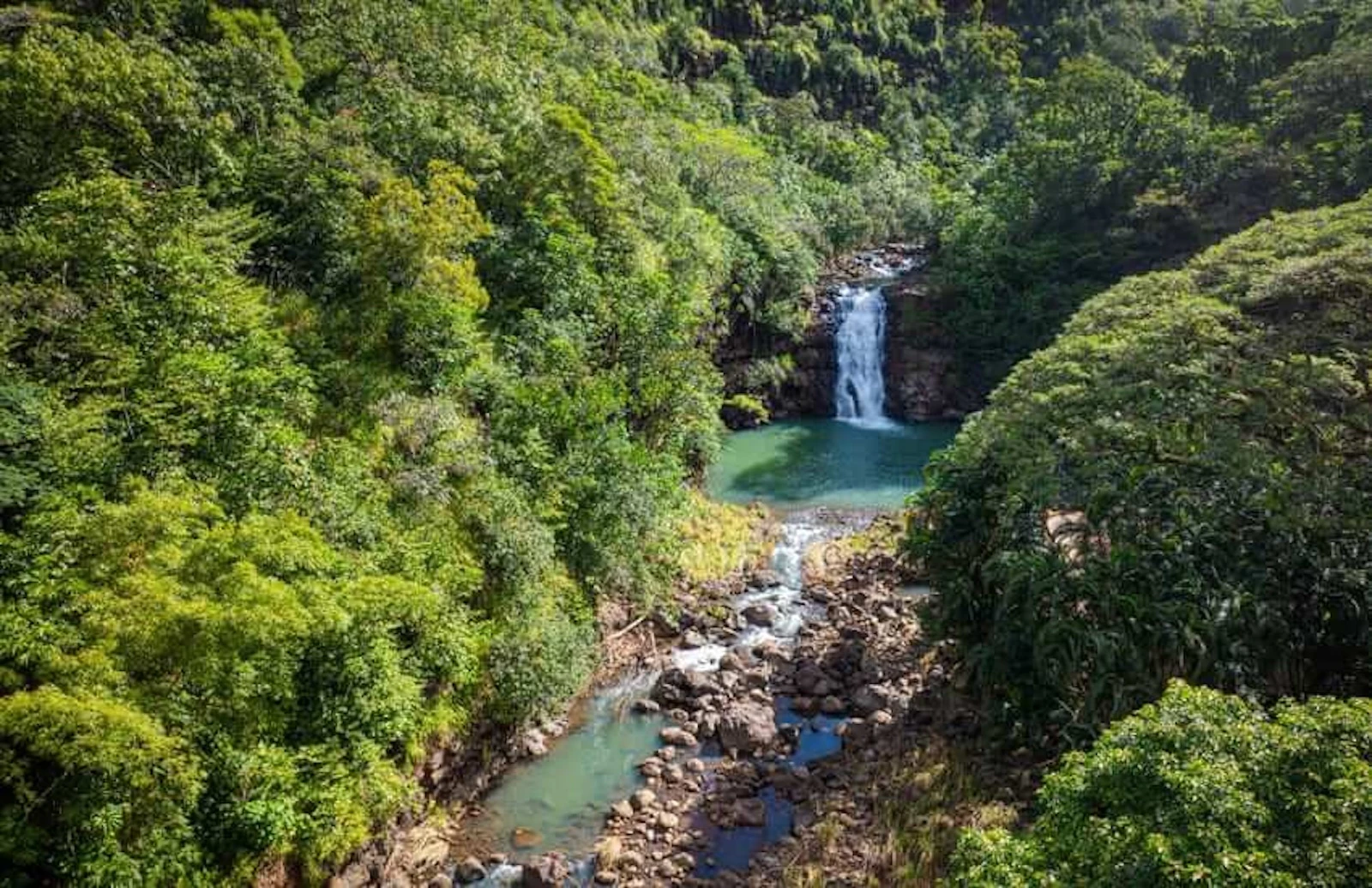
Culturally, historically, and spiritually Waimea, Oʻahu, is a Native Hawaiian cultural treasure of the highest possible order.
During the 11th century the ahupuaʻa of Waimea was set aside for the kahuna nui (high priests). Known for over 700 years as the “Valley of Priests,” Waimea includes three major heiau (temples) and scores of archaeological sites within the valley and along its perimeter including the formidable Puʻu o Mahuka Heiau located atop Keanaloa, Waimea’s northern ridge.
For centuries the ʻāina momona of Waimea supported a population of at least 600 people. Kalo terraces built centuries ago still shape the valley floor and foothills. It is one of the last intact ahupuaʻa remaining on the island of Oʻahu, and generations of kūpuna sleep there undisturbed, secure in the valley’s embrace.
Ever a storied and sacred place, today Waimea is mostly known for her unspoiled beauty and famous 45-foot perennial waterfall that plunges into a 30-foot-deep natural pool. But Waimea is so much more. Over the last two decades, Waimea Valley has become a contemporary puʻuhonua, a place where all are now welcomed to visit.
Few people know, or remember, that this wahi kapu (sacred place) was nearly lost to development.
From Hewahewa to OHA
The last kahuna nui to steward the valley was Hewahewa, high priest to both Kamehameha I and II, who died there in 1837. Following Hewahewa’s death, stewardship of Waimea passed to his granddaughter, Paʻalua.
In the mid 19th century, Waimea supported a population of hundreds. But after a series of devastating floods between 1884-1898 destroyed homes and crops, many residents were driven from the valley.
During the same period, Paʻalua foreclosed on Waimea, unable to pay the land tax. Before the century ended, Hawaiian title to Waimea Valley was lost.
The valley changed hands several times until Castle & Cooke purchased Waimea in 1929 and leased it to cattle ranchers. In 1941, the U.S. military took over the valley for training until the end of World War II.
In 1973, Waimea was purchased from Castle & Cooke by Hawaiʻi-based Bishop Corporation (not to be confused with Bishop Estate) to establish Waimea Falls Park as a botanical garden and entertainment venue. Ownership of the valley was later transferred to Associates Four, a partnership comprised of the same shareholders of Bishop Corporation. Associates Four operated Waimea Falls Park for 25 years, but in the 1990s, due to declining revenue, a decision was made to sell Waimea to avoid bankruptcy.
New York investor and theme park developer Christian Wolffer swept in and purchased Waimea in 1996. He envisioned turning the storied valley into an “adventure park” but his project failed and in 2001 he placed the valley in bankruptcy protection.
Around the same time, an increasingly concerned North Shore community began organizing to oppose further development in Waimea.
After the bankruptcy filing, the City & County of Honolulu initiated condemnation proceedings, taking possession of Waimea in 2002 and leasing the valley to the National Audubon Society to operate an ecological and cultural visitor center.
In 2005, to resolve the condemnation issue, Wolffer proposed a plan to subdivide Waimea and build a commercial attractions park near the front of the valley and luxury homes in the back. Hoping to avoid a lawsuit, the city council gave the plan its preliminary approval.
But when news of this became public it triggered vocal and widespread community protests, including a march on City Hall. Community opposition to the development was so compelling that when the council met to vote on the plan on Dec. 7, 2005, they unanimously rejected it.
A month later, after discussions with city officials, the Office of Hawaiian Affairs (OHA) Board of Trustees authorized the purchase of Waimea Valley.
In August 2006, under the terms of a court settlement with Wolffer, the joint purchase of Waimea by OHA, the City & County of Honolulu, the state Department of Land and Natural Resources, the National Audubon Society, and the U.S. Army was finalized.
Title to Waimea went to OHA to ensure the preservation of the valley in perpetuity.
Hi‘ipaka established to steward Waimea
In addition to 1,875-acre Waimea Valley, in 2006 OHA also acquired 25,856-acre Wao Kele o Puna on Hawaiʻi Island. Both acquisitions were made to protect these lands from development. Suddenly, OHA was a major landowner with a new kuleana for land stewardship.
In November 2006, OHA established a Land Management department and contracted the Hawaiʻi Audubon Society to temporarily manage the valley.
In 2007, OHA formed Hiʻilei Aloha LLC (limited liability company) a nonprofit legally separate from the agency to manage its community assets. Then in 2008, OHA formed Waimea Valley Hiʻipaka LLC (Hiʻipaka) as a nonprofit subsidiary of Hiʻilei Aloha specifically to manage the valley. Upon its formation, title to Waimea was transferred from OHA to Hiʻipaka.
Despite some initial uncertainty, a visit to the valley brought Pezzulo clarity; he knew Waimea was where he was meant to be.
The kuleana for Hiʻipaka was multi-faceted: preserve the cultural and natural resources of the valley while simultaneously building a self-sustaining business operation to support those efforts. It was no small task. “When I started, this place was losing about $1 million a year,” Pezzulo recalled.
“That first year the focus was on organizing — getting everybody on the same page and making sure everybody had input into developing a good strategic plan. One of the main things was watching our spending,” he added.
They also optimized their social media presence, supercharged their branding and marketing, reorganized, made some staffing changes, and then made sure that the people who visited the valley had a really good experience.
“We actually ended up making some money that first year. It wasn’t very much, but since then we’ve generated revenue to sustain our conservation efforts.”
Over the past 14 years, Hiʻipaka has not only generated revenue sufficient to support its stewardship of the ahupuaʻa and meet its payroll, it has also been able build financial reserves to prepare for emergencies.
“We now have about $11 million in an investment fund that is there for emergencies because anything can happen in the valley, like floods and rockslides,” Pezzulo said. He is proud that even when Waimea Valley was closed during the pandemic they were able to continue providing medical insurance coverage for all employees.
Hiʻipaka currently employs 86 people to support its cultural and conservation kuleana. Another 100+ staff are subcontracted to provide a range of guest services and operational support.
“We contracted out the food service — that’s 50 people. We have a lūʻau — 50 more people. We have a lifeguard service, that’s 10 staff. We contracted out the gift shop and they have 10 staff. So well over 200 families now rely on Waimea,” Pezzulo said.
He notes that balancing cultural preservation and conservation efforts with the commercial aspects of Waimea Valley can be challenging and he’s had to say “no” to many people pitching activities for the valley that simply aren’t appropriate.
“It’s about the impact on this valley rather than profit or revenue. It’s looking at everything we do and making sure it supports our mission to preserve and perpetuate the human, cultural and natural resources of Waimea Valley for future generations,” Pezzulo said.
“When I started, the visitor count was about 400 people a day. Now it’s about 1,300. That’s our average. During the summer it’s usually around 2,000 per day, which is about the max we want in here.”
Stewardship informed by research
The educational and conservation programs core to fulfilling Hiʻipaka’s kuleana are supported by ongoing research. Pezzulo and his team uniformly point to the decades of historical, cultural and archaeological work conducted by Waimea historian Rudy Leikaimana Mitchell beginning in the mid 1970s until his passing in 2008.
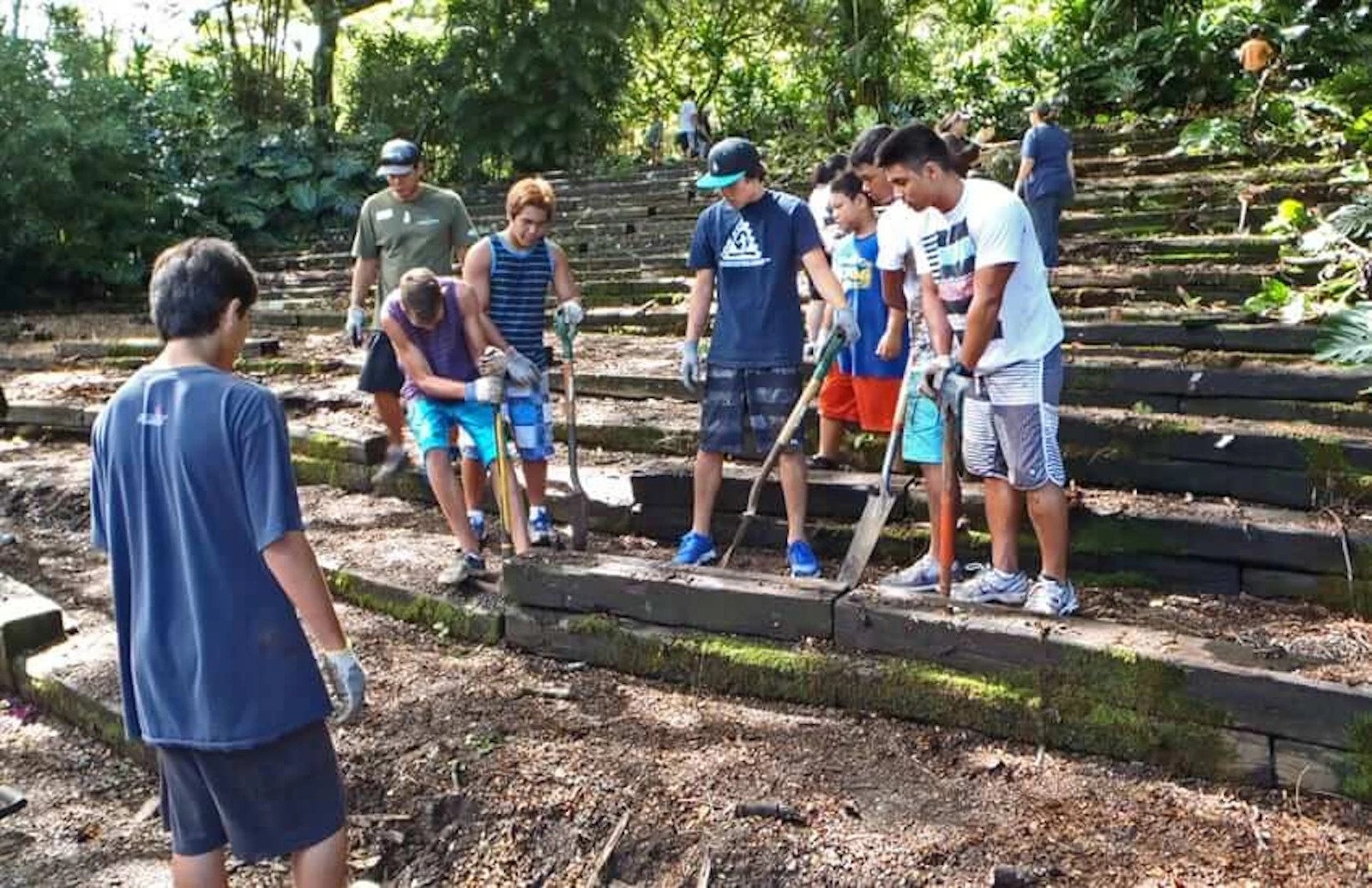
So profound was Mitchell’s impact in Waimea that Hiʻipaka dedicated its outdoor amphitheater to honor his memory. Located toward the back of the valley the amphitheater is where Hiʻipaka hosts its weekly Ka ʻAha Hula i Waimea (the gathering of hula at Waimea) featuring hālau from around Oʻahu.
“Uncle Rudy Mitchell was an amateur archaeologist who uncovered a lot of the cultural sites and developed a lot of the cultural programming here at Waimea,” Pezzulo shared.
Building on the work that Mitchell began is Hiʻipaka Research Director Dr. Alana Kanahele. She and her team are responsible for researching and documenting the valley’s cultural, historical, botanical, and archaeological ‘ike. Their work supports multiple departments including Cultural Programs, Botanical Conservation, Education & Training, and Marketing & Communications.
Although she now lives in Honolulu and commutes to Waimea each day, Kanahele grew up in Waialua and her pilina to the valley is lifelong. “My parents were married here 47 years ago right at the upper meadow,” she smiled. “This place has always been really important to my family.”
In addition to supporting the programming efforts of other Hiʻipaka departments, Kanahele and her team also collaborate with outside researchers and write for academic publications.
“We’re bringing researchers into the valley from BYU-Lāʻie and UH Mānoa for a number of different studies. It’s been a really exciting time,” Kanahele said. “We have a herbarium and library here on site, so we are bringing the community in to use these resources.”
Noting that Waimea is steeped in moʻolelo Kanahele points out that, “We have three different major heiau: Puʻu o Mahuka which is up above us on Keanaloa; Kahōkūwelowelo which is a navigational heiau; and Kūpopolo.”
Other important, but smaller, cultural sites in the valley include Hale o Lono Heiau which is still used by cultural practitioners; Kuʻula Shrine dedicated to the fishing god, Kuʻula; and Hale Iwi believed to be a burial temple for an individual of high-rank.
“Waimea is a very special place,” Kanahele added. “We think of it as a puʻuhonua, a place of healing, a place of refuge, a place for high priests. This has always been a place for education.”
Educational programs for everyone
Hiʻipaka offers a range of cultural educational programs, including school-based experiences that bring about 6,000 haumāna from 135 Oʻahu schools to the valley each year.
Literally building on this momentum, Hiʻipaka has just completed a new traditional hale under the direction of master builder Kumu Francis Palani Sinenci near the entrance to the valley.
The hale is sited on a 4-acre parcel, Puʻukua, and was built to support a new K-12 educational program that Hiʻipaka is developing. The area will be planted with native trees like koa, an agroforest with food-producing trees like ʻulu, and a lei garden.
Purchased in 2016, Puʻukua was the last remaining privately-owned parcel on the valley floor and Hiʻipaka’s first land acquisition using money from its Legacy Fund.
In addition to offering a variety of school programs, Hiʻipaka also offers family-focused programs suitable for any age, a program designed for kūpuna, and another for teachers. They also have a resident cultural artisan program that brings in practitioners from the community to teach on topics like launiu and lauhala weaving, kapa making, and ʻukulele.
Hiʻipaka Cultural Programs Manager Kaʻumealani Diamond has worked in the valley for 17 years. She began working at Waimea after OHA reopened the valley and likes to say, “I sleep in Mililani, but I live in Waimea.”
A natural born storyteller, Diamond is passionate about sharing Waimea’s history along with its cultural and spiritual importance but finds it difficult at times to protect the sanctity of this wahi kapu while welcoming visitors who may not comprehend the valley’s significance.
“That is why education is really important to help them understand where they are,” she said. “I’m a true believer that you cannot fault people for what they don’t know. But once they do, it becomes their kuleana to behave and carry themselves in a way [that is appropriate] in a sacred valley.”
To manage the ongoing challenge of being culturally authentic in a commercial setting, Diamond believes it’s important for the Cultural Programs team to truly understand Waimea Valley. “I mean, take your shoes off. Walk in these places. Sit in these places. And listen. We are in service to this place. I know she will feed us, but we give first. That’s how it works,” she said.
“I am just trying to hold space here for all of the kūpuna. It’s not about us. It’s about all those who came before us and what footprint are we leaving for those who will follow.”
Building pilina through sharing
For Hiʻipaka Cultural Programs Coordinator Kimo Jenkins, working at Waimea in the late 1970s was life changing. Born and raised on the North Shore, he was about 19 when took a job at Waimea as a tour guide and met Rudy Mitchell, the valley’s celebrated historian.
“Uncle Rudy took me under his wing, trained me, and forced me to be a man,” Jenkins laughed.
“I owe a debt of gratitude that can never be repaid. I worked in the valley with him. Did a lot of archaeological work. Ran the chainsaw. I did what Rudy instructed me to do and looking back it was the best time of my life. When we discovered something, Rudy would say we didn’t discover anything; that the valley had allowed us to see what it is.
“I had my cultural rebirth during that time. He took me to Kahoʻolawe. Made me read David Malo and John Papa Ii and then tested me. I was getting educated and working at the same time.”
Jenkins worked with Mitchell for three years before leaving and starting his own company. Decades later, he was semi-retired when he happened to come to Waimea for a luncheon. “I walked around and the valley tapped me on the shoulder and said, ‘come home,’” he smiled.
When he returned to Waimea in 2022, Jenkins said it took a while to figure out what his kuleana should be. Observing that so many visitors made a beeline for the waterfall without “seeing” rest of the valley, he came up with a plan to encourage people to slow down.
“They were missing the opportunity to engage with us, to see the kauhale (group of houses) and our other sites, so we instituted Kaʻapuni o Waimea, a walking circuit through the valley,” Jenkins said.
Kaʻapuni o Waimea encourages visitors to learn and engage with Hiʻipaka’s Cultural Programs staff at interpretive sites throughout the valley. Seated in the hālau waʻa (canoe house) that is part of the kauhale site, Jenkins explained that when people stop by, he talks about wayfinding, canoe building, and Hawaiian values.
“Nothing scripted. It’s just talking story with guests and answering the questions they have. Some people will stay with us for a couple minutes, some people will stay for half a day. The engagement is equally important.”
Jenkins adds, “Waimea is like a chameleon. It can be different to different people. The valley will guide them if they’re willing to listen; if you’re willing to listen to the valley you go to special places.”
Guests who complete the Kaʻapuni circuit are called “hoʻokipa ambassadors” and receive a special pin. “We share Hawaiian values with them — kuleana, pono, mālama — they’re taking the values we teach them back to wherever they are from around the world,” he said.
“I think the valley wants to be loved. Respected. Held. I tell people all the time, learn the names of the ridges. Learn the names of the streams. Speak the names and connect with them and that’s when the valley comes alive. It’s a moving, living, breathing organism and it needs to be cared for. And we’re the kiaʻi.”
From the valley floor to its ridgeline
Hiʻipaka’s Botanical Conservation department has kuleana for managing, maintaining and restoring Waimea’s remaining native forests, endangered species habitats, and botanical gardens, while also cultivating and cataloging the valley’s extensive botanical collections. They are responsible for all 1,875 acres – from the valley floor to its ridgeline.
The botanical gardens were established in the early 1970s after Bishop Corporation acquired the valley. Today, they feature over 50 plant collections across 60 themed gardens, showcasing thousands of plant species from tropical and subtropical regions around the world. The garden is home to about 280 threatened or endangered species.
Hiʻipaka Botanical Manager Josie Hoh has worked in Waimea Valley longer than most. Originally from Malaysia, she attended college in California, completed an internship in plant conservation at Waimea in 1990, was hired in 1991, and has been caring for Waimea’s botanical resources ever since.
“Hiʻipaka is such a blessing for Waimea Valley. Our mission is nonprofit which is very ideal for conservation, botanical projects and growth,” she said.
Responsible for managing Hiʻipaka’s botanical gardens and nurseries, Hoh describes the gardens as living museums. “They hold about 4,000 different types of plants. It’s cataloged and there is a number for each plant, and everything is logged in our National Resources Data Solutions database. We have a data collection specialist who does the cataloging.”
Catalog entries include information about where the plant was obtained, where it is originally from, why it needs to be in the nursery, and its required propagation methods. Hoh said that thousands of plants go through their nursery because Hiʻipaka has become a hub for plant propagation.
“Nonprofits that have conservation projects have come to us and asked for our help to grow, for example, coastal native plants for a restoration project on the North Shore,” she said.
Hoh notes that the non-native plants in Hiʻipaka’s botanical gardens were grandfathered in and are included for educational purposes, “so people don’t have to travel to different countries to see a certain endangered plant. They can just come to Waimea.”
She said they often get inquiries from researchers looking for plant specimens for medical or DNA studies. “Our inventory is included in the Botanical Garden Congress International website. It’s really wonderful that Hiʻipaka can help.”
The department’s conservation team is led by Conservation Manager Parker Powell. They work in the ma uka regions of the valley, monitoring native plants, removing invasive species, weeding, collecting seeds, and taking volunteer groups up to their restoration site.
Hoh’s team cultivates both native and non-native plants. “The majority of the native plants are planted up in our restoration site which is up at Kalāheʻe Ridge. We also have four native Hawaiian gardens down here in the valley for educational purposes. But up there, it’s real restoration of the ʻāina and the forest.”
Hiʻipaka currently has five ma uka restoration sites with 100 acres of forest fenced in. To date, about 100,000 native species have been outplanted.
Preparing for the next decade
As OHA and Hiʻipaka celebrate 20 years of stewardship in Waimea Valley, the milestone is also notable for the transitions that it will bring; Pezzulo has announced his retirement at the end of 2026 and a search is now underway for his successor.
Reflecting on the changes ahead, Pezzulo is optimistic and unwavering in his aloha for the community and his hope that more kamaʻāina will come visit Waimea. “The community is so important. They’re the ones that got the city council to change their mind and make sure that the valley is preserved in perpetuity,” he exclaimed.
“So we really want to make sure that our community knows that this treasure is here for them. We offer a lot of free days for kamaʻāina. We have annual passes that are heavily discounted. Our admission is heavily discounted. We have Keiki Wednesday when children are free. Lots of ʻohana days, activities and summer concerts.”
Hiʻipaka is also looking forward to facility upgrades including expansions of both the gift shop and pavilion, and renovation of their resource center thanks to a nearly $4 million economic development grant.
Another key element of Hiʻipaka’s transition into this next season will be the completion of their new educational program at the 4-acre Puʻukua site. Through the site’s volunteer work days, ‘ohana who participate will have the opportunity to care for dedicated garden spaces, allowing them to build an ongoing relationship with the land.
Over the last few years, Pezzulo has also focused on staff development and training. All Hiʻipaka managers have completed a management certificate program, while staff identified as emerging leaders participate in leadership training. Hiʻipaka also has a college tuition assistance program.
“And to make sure our staff are really knowledgeable about Waimea Valley, every month we do an ʻike training, alternating botanical and cultural, so they know — and can share — the valley’s cultural significance and beauty with our visitors,” Pezzulo said.
“Young people are a really, really important part of this transition. We have a lot of bright young staff right now — and a lot of staff who we know at some point will be moving on and retiring like myself — we need to make sure they’re prepared to take over.”
This article is reprinted with permission from OHA's Ka Wai Ola newspaper: "Waimea Valley: A Cultural Treasure of the Highest Order," by Puanani Fernandez-Akamine in its August 2026 issue, Vol. 43 No. 8. Read more at kawaiola.news.
For the latest news of Hawai‘i, sign up here for our free Daily Edition newsletter.


