
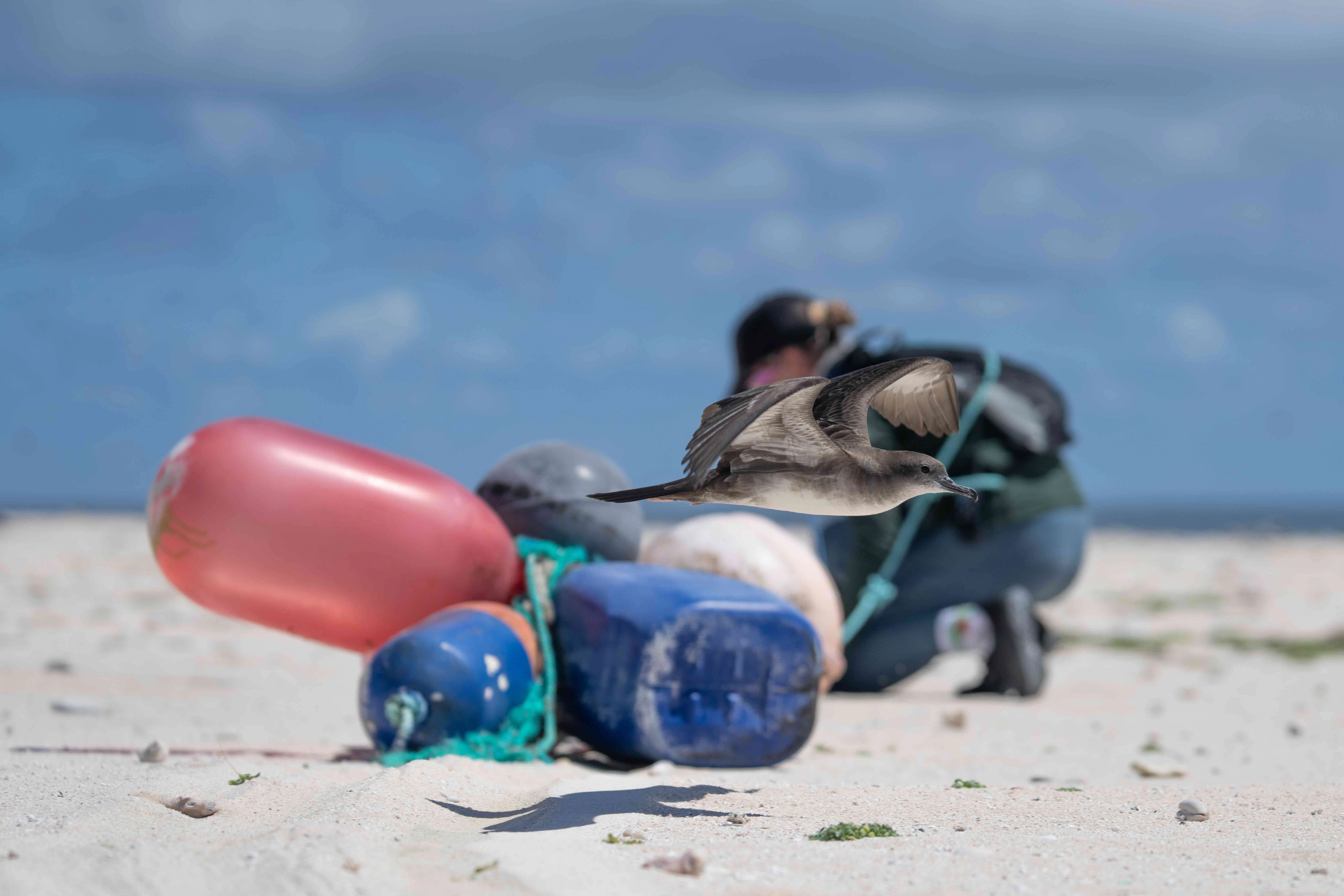
Papahānaumokuākea is one of the most extraordinary places on our planet. Stretching across the remote Northwestern Hawaiian Islands, its coral reefs, islands, and surrounding waters provide critical habitat for millions of seabirds, endangered Hawaiian monk seals, threatened sea turtles, and countless other species.
It is also a place where the impacts of marine debris are impossible to ignore.
At the Papahānaumokuākea Marine Debris Project (PMDP), our mission is simple: to protect the wildlife and preserve the habitats of Papahānaumokuākea from the threats of marine debris. Founded in 2019, PMDP conducted its first cleanup expedition in 2020. Since then, our teams have removed more than 1.3 million pounds of marine debris across 15 cleanup missions and 366 days in the field.
PMDP’s work continues a decades-long legacy of large-scale marine debris removal in Papahānaumokuākea. Since 1996, collective efforts by NOAA, partner agencies, nonprofit organizations, and others have removed more than two million pounds of derelict fishing gear, plastics, and other debris from these remote reefs and shorelines. Today, PMDP is carrying that work forward with support from the NOAA Marine Debris Program through the National Fish and Wildlife Foundation (NFWF), private donors, and small grant foundations. Beginning in Fiscal Year 2022, the NOAA Marine Debris Program provided $5.8 million to NFWF to support this five-year effort, matched by $6 million from philanthropists Marc and Lynne Benioff as part of their commitment to improving and safeguarding ocean health. Together, this represents nearly $12 million invested from Fiscal Year 2022 through Fiscal Year 2026 to help protect Papahānaumokuākea from the impacts of marine debris.
The scale of the challenge is enormous. Current estimates indicate that approximately 115,000 pounds of derelict fishing nets, or “ghost nets,” accumulate on the coral reefs of Papahānaumokuākea every year. The amount accumulating on shorelines has not been formally quantified, but PMDP’s field data suggest it could be another 85,000 pounds annually. Combined, we estimate that roughly 200,000 pounds of marine debris may accumulate across this remote ecosystem every year.
Marine debris is a problem throughout Hawaiʻi, but experiencing it in Papahānaumokuākea is different. Here, you see wildlife interacting with debris almost every day. Animals become entangled in fishing nets. Seabirds and other wildlife mistake plastics for food. Enormous nets become entangled on coral reefs, where waves and currents drag them across living coral, damaging critical habitat.
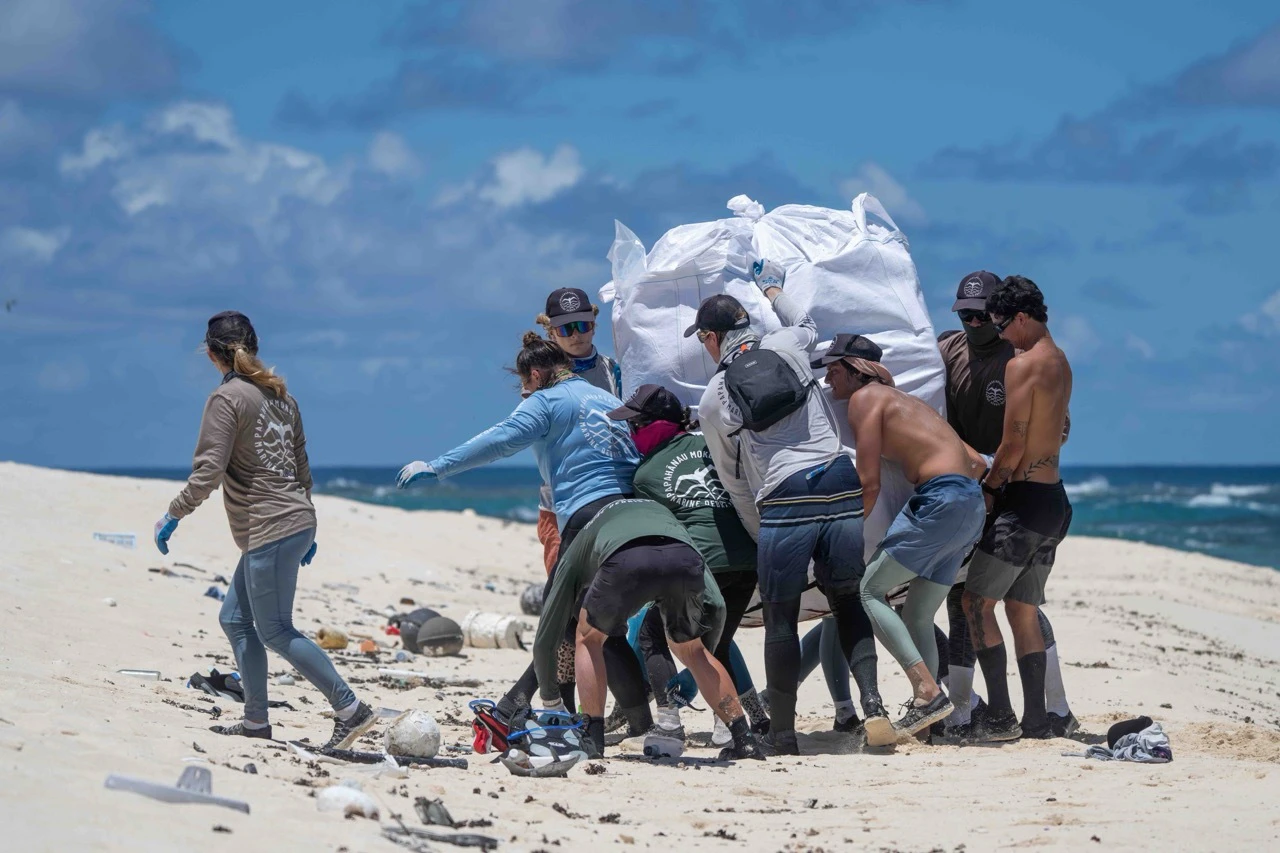
Some of these nets are almost unimaginable in size. The largest ghost net ever removed in Papahānaumokuākea weighed more than 23,000 pounds and overfilled an entire 20-foot shipping container. It took a team of 16 freedivers four operational days to cut the net into pieces small enough to lift manually, load into inflatable boats, and transport back to our ship for the journey to Honolulu.
That scale is why PMDP is continually working to improve how we do this work. Across more than 5,000 square miles of shallow coral reef habitat, we are testing better methods for detecting ghost nets, developing custom cutting tools, and fabricating a shallow-draft extraction platform. We hope these innovations will dramatically improve the efficiency and safety of removing massive nets from reefs.
From August 7-28, 2026, our 16-person team spent 22 days aboard the M/V Imua conducting our second cleanup mission of the year. Over just nine operational cleanup days, our team removed 48,680 pounds of marine debris from Lalo (French Frigate Shoals), Kamokuokamohoaliʻi (Maro Reef), Kamole (Laysan Island), and Kapou (Lisianski Island).
The expedition, however, did not go according to plan. Hurricane Lala forced us to suspend operations for four days and transit hundreds of miles away from the storm. Before leaving Kamole, our team had removed more than 13,000 pounds of marine debris from its shorelines. One week later, after Hurricane Lala passed directly over the island, we returned.
As we approached Kamole, the impacts were immediately visible. Vegetation had been heavily damaged, the landscape had changed, and there were clear signs of the winds, waves, and storm surge that had swept across this small, low-lying island. But we also saw hope.
During our assessment, we observed all four endangered species we were looking for: Laysan ducks, Laysan finches, Nihoa Millerbird, and Hawaiian monk seals. The island had taken a tremendous hit, but seeing these animals surviving in the aftermath of the storm was an incredible reminder of the resilience of wildlife, islands, and nature itself.
Our team is now preparing to set sail on September 14 for our third and final cleanup expedition of the year. This mission will take us even farther northwest to the reefs and shorelines of Manawai (Pearl and Hermes Atoll), Kuaihelani (Midway Atoll), and Hōlanikū (Kure Atoll). Like every expedition, our goal is straightforward: remove as much marine debris as we safely can while continuing to learn, improve our methods, and better protect these extraordinary places.
To accomplish this work, PMDP assembles a seasonal field team of specialized freedivers and small-boat operators. Field technicians are employed for approximately five months, beginning with two months of intensive preparation that includes medical, small-boat operator, freediving, and specialized marine debris survey and removal training. That preparation is followed by two month-long expeditions to Papahānaumokuākea and concludes with project demobilization at the end of the season.
It is physically demanding work in one of the most remote marine environments on Earth. It requires long days, heavy lifting, strong ocean skills, teamwork, adaptability, and a willingness to spend weeks away from home. But it also provides the rare opportunity to make a direct and measurable difference for a place that few people will ever experience firsthand.
Our next recruitment period will open in January 2027 for seasonal employment from approximately June through October 2027. We are always looking for hardworking people who care deeply about Hawaiʻi, our ocean, and protecting these extraordinary places for future generations.
There is still an enormous amount of work ahead. Marine debris will continue to arrive on the reefs and shorelines of Papahānaumokuākea, and we know we cannot stop it all at the source. But we can do something about what is already there.
Papahānaumokuākea has shown us how resilient nature can be. Our job is to give it the best chance we can.
To learn more about the Papahānaumokuākea Marine Debris Project, visit www.pmdphawaii.org, subscribe to our quarterly newsletter for project updates and employment opportunities, and follow us on social media at @pmdphawaii.
For the latest news of Hawai‘i, sign up here for our free Daily Edition newsletter.


