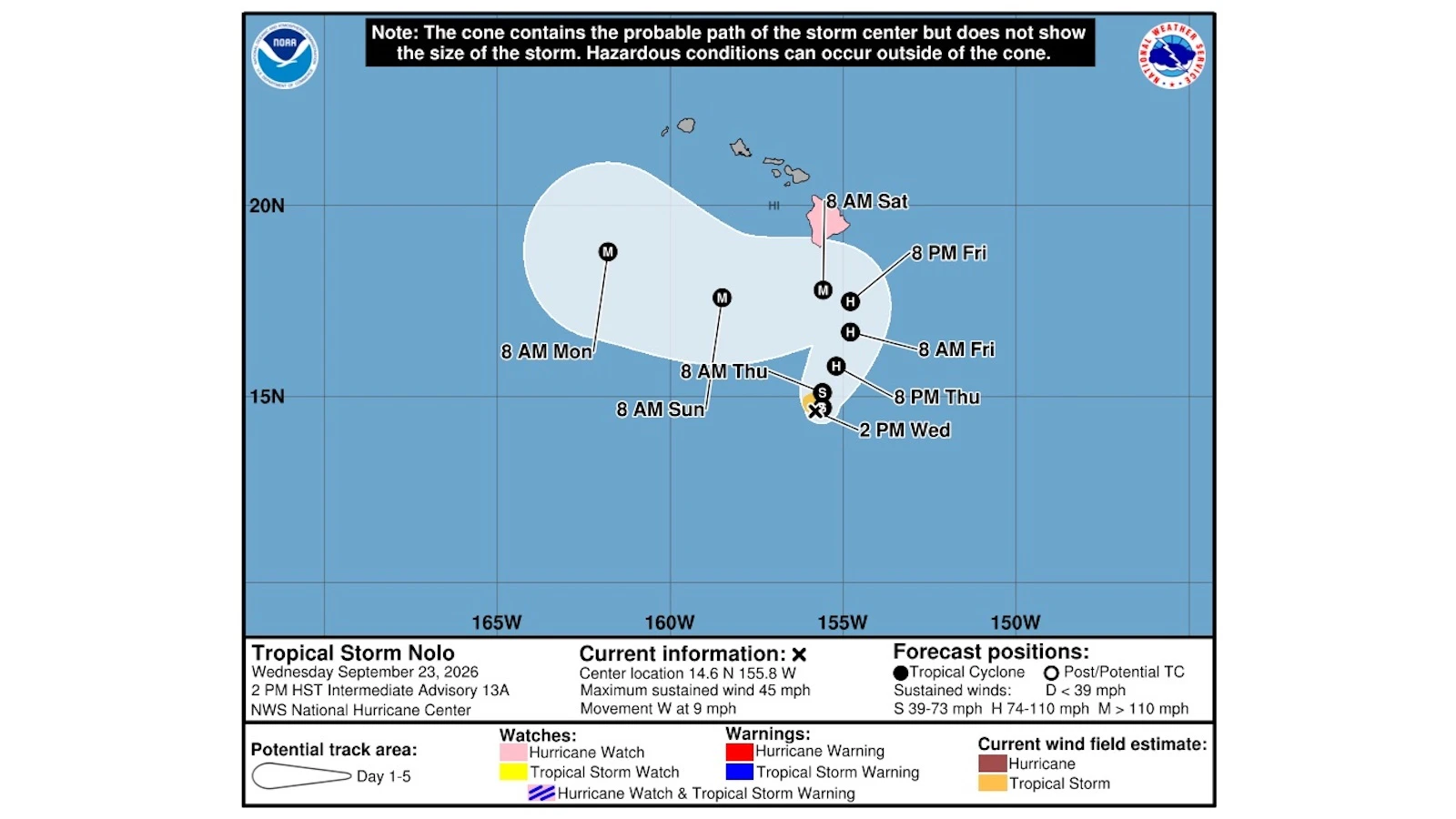
Recovering from the several disasters to strike Hawai’i this year will cost $1 billion and counting, Gov. Josh Green announced Wednesday.
So far, four major disasters have impacted the state this year: the Kona Low storms in March, the May earthquake on Hawai’i Island, Hurricane Lala in August and Hurricane Lowell in September.
And although the impending Hurricane Nolo will likely increase the damage toll still higher, those four disasters have caused an estimated $686 million in infrastructure damage throughout the state.
The Kona Lows were the most significant impactor to the state, with the storms connected to at least $44 million in damage to public infrastructure, $191 million in costs to Department of Transportation infrastructure — $136 million for state highways and another $55 million for airports — and 463 homes impacted statewide, including 17 destroyed and another 210 sustaining major damage.
Hurricane Lowell, meanwhile, is estimated to run the state another $112 million. Preliminary damage estimates place the total public infrastructure damage to about $100 million — $93 million of which is on Kaua’i — along with another $6 million in DOT highway costs and another $3 million to repair a sinkhole at Kaumālapa’u Harbor on Lāna’i.
The impacts of Hurricane Lala are estimated to cost about $108 million, including $67 million in infrastructure damage statewide and another $28 million in DOT highway and airport costs. The storm also inflicted an estimated $12.5 million damage across 38 public schools; Green said that, between the Kona Lows and Lala, Konawaena High School and Nā’ālehu Elementary School “are going to have to be rebuilt.”
Finally, the Magnitude 6.0 earthquake destroyed 18 homes on Hawai’i Island, seriously damaged 92 more, and caused about $1.5 million in highway costs.
Green said that, between the four disasters, more than $600,000 in housing assistance has been awarded statewide, with another $433,000 awarded for assistance with other needs. More than $1 million in individual assistance programs has been approved so far.
While the state Legislature was able to approve $50 million to the Department of Education for Kona Low repairs before the end of the legislative session, the department still needs another $117 million to fully recover from those storms on top of another $36 million for Lala and Lowell repairs.
Green said that, naturally, the state will request substantial funds from the state Legislature next year, and will fight “tooth and nail” to get whatever federal assistance is possible to supplement the state’s recovery. He said Department of Homeland Security Secretary Markwayne Mullin has signaled willingness to assist with the state’s recovery.
Other sources of funds will include insurance payouts on various facilities, appropriations from the state Rainy Day Fund, and revenue from the state’s Green Fee, which Green said generates about $100 million per year.
“How do you deal with these kind of disasters? We’ve saved,” Green said. “We now have just over $1.6 billion in the Rainy Day Fund … It has rained.
“We will take hundreds of millions of dollars from the Rainy Day Fund,” Green continued. “Whatever we don’t have in support from the federal government and the dollars we’ve already gotten, we’ll be able to cover these disasters … We need support, we will get it, and we will embark on an era of a hardened infrastructure.”
For not only will the state need some $686 million to recover from disaster damages, but it will need an additional $319 million, at least, for several proposed projects to improve the state’s resilience to future disasters.
Some of these projects range from the prosaic — installing additional generators to the state’s airports, which would cost an estimated $9 million — to the monumental. Green acknowledged that the most significant project on the horizon is a $20 million study to determine the potential location of a second major deep-water port in Hawai’i, to ensure the state’s supply chain isn’t severed if Honolulu Harbor is severely impacted by a storm.
Green said he believes Hawai’i Island would be the most appropriate location for such a new harbor: Hilo is the second-largest population center in the state, and the island is far enough away from O’ahu that it is unlikely that a single event could disable both harbors. He suggested that Hilo itself could host a harbor, or that the Kawaihae Harbor on the Leeward Side could be expanded.
The largest resilience project proposed Wednesday is a $175 million project to harden the Honolulu Harbor against future major hurricanes.
Other resilience projects include an $80 million project to modernize the state’s Emergency Operations Center, which is currently located in a bunker in Diamond Head. Green said the existing EOC is old and could potentially be relocated to Wahiawā or Mānoa.
However, Green noted that some of these projects, such as the new harbor, could be contingent on the state’s relationship with the U.S. Armed Forces, which could be a valuable asset in getting major infrastructure projects built — but is also in the process of attempting to renew state land leases that are controversial among many residents.
“We want them to work with us,” Green said. “We want them to work with us, and working with us means a longer lease, even if we have to do a longer lease … a fair lease, that takes care of our needs, that honors the Hawaiian culture, but also gives us significant resources to things like a better harbor, a newer harbor.”
For the latest news of Hawai‘i, sign up here for our free Daily Edition newsletter.