

A film about an NFL defensive lineman turned Juilliard-trained opera singer will take the big screen for its Hawaiʻi premiere on Monday, followed by screenings on Thursday, Oct. 29, and Sunday, Nov. 15, as part the Hawaiʻi International Film Festival.
Ta’u Pupu’a, who portrays his younger self in his first acting role in the 10-minute film, “The Platform,” was born in Tonga and drafted to the Cleveland Browns before an injury cut short his football dreams. He then did what most football players do not do … and pursued a career as an opera singer.
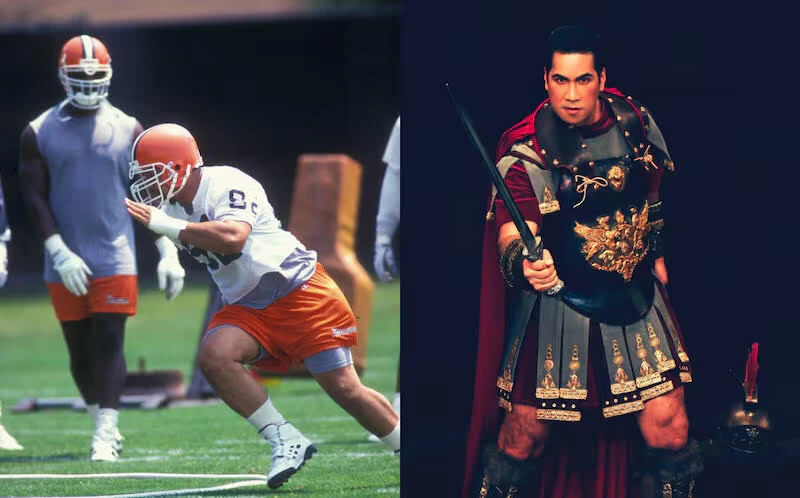
Directed by Mark Harris, who was raised in Hawaiʻi and Los Angeles, the film recently won Best Drama at the LA Shorts International Film Festival and has been nominated for HIFF’s Best Short Film Award.
“This movie is for all ages, all genders; it’s for everyone,” Pupu’a told Aloha State Daily. “It's a story about never giving up. It’s a story of trusting your talents, your faith — and courage.”

The idea for “The Platform” came about after Harris’ mother, Lee Casegrillo, read about the opera singer giving a concert in Hawaiʻi in a local newspaper. She mailed the story to her son, who was living in Los Angeles.
“And he saw it and was like, 'This is incredible. This should be made into a movie,'” Pupu’a said.
Harris and the film’s cowriter, Monica Foley, flew out to New York to meet Pupu’a and pitch the idea.
This week, Oʻahu residents will have the chance to hear Pupu’a, who is in town for the film festival, perform live at 6 p.m. on Tuesday, Oct. 27, at the Hideout at The Laylow Waikīkī, Autograph Collection.
Pupu’a is one of nine kids and has a sister who lives on Oʻahu, and cousins and extended family who call Oʻahu, Maui and Hawaiʻi Island home.
“I’m very excited to come out there and share this with them,” he said.

He remembers when one of his brothers took a course on classical music at The University of Utah. Soon, he was hearing the soaring voices of opera singers such as Luciano Pavarotti and Dame Kiri Te Kanawa, which started to plant the seed for a love of classical music.
“He would come home and play a lot of Mozart and Handel and Bach,” Pupu’a said. “I just didn't understand that kind of music, so I used to scream at him,ʻTurn it off. Play some R&B, play some hip hop or something,’ and then I would go to play football.”
When Pupu’a suffered a football career-ending injury, he returned to his parents’ house in Salt Lake City and moved into the basement. He was depressed because the sport had been his life since he was 10 years old.
He went to church and was singing when people turned around to tell him he should do something with his voice.
“I decided to pack my one suitcase — and a backpack full of faith and courage — and move to New York because if you want to be an opera singer, or a Broadway singer, you would come to New York.”
Upon arriving, he walked around a bit, making stops at the Lincoln Center for the Performing Arts, The Juilliard School and The Metropolitan Opera House.
“And I thought to myself: ʻHow do I break into this? How do I do this?’” he said.
He looked at the row of restaurants across from The Metropolitan Opera and figured singers and directors would stop there to eat. He crossed the street to inquire about a job and got hired on the spot.
After playing football in front of 90,000 people and getting those kinds of paychecks, becoming a server was an adjustment, he recalled.
“I would finish work around 2 or 3 a.m.,” he said. “I would walk outside of the restaurant tired as a dog, but I would look across the street, and I would see The Metropolitan Opera with its lights on, and Juilliard with the lights on, and I thought to myself: ʻI have to keep going. I have to keep going for my family.’”
Pupu’a talked with students at the local music schools, getting recommendations for voice teachers and pianists. Things took a noteworthy turn when he went to a book signing for a famous Polynesian opera singer he had listened to years earlier: Dame Kiri Te Kanawa.
“But she looked at the name, and I guess recognized that's a Polynesian name, and then she looked up and saw me, and she sat back and said, ʻDo you live here?’ And I said, ʻYeah.’ And she says, ‘So what do you do?’ And I stood up tall because I'm six- five, so I stood up really tall, and I said ʻI'm a tenor.’”
She asked where he was studying and Pupu’a explained he was not in school but had a private teacher. He also admitted it was hard. Then, the world-renowned Māori soprano mentioned she ran a foundation that helps talented singers and asked him to call her to talk more. He called that night.
When she was back in town six months later, she invited him to her farewell concert at Carnegie Hall and then asked him to sing for her in a room at The Juilliard School. When Pupu’a showed up at Juilliard, the head of the school’s voice department was also in the room.
“And she said, ʻNow sing!’” he said, remembering how the soprano asked him to start. “They had a pianist there, so I started singing.”
Te Kanawa asked him to do a second piece.
Then, the voice director suggested he apply for The Juilliard School.
“And Kiri turned around and looked at me and says, ʻCan you learn five operatic arias in different languages and a monologue in a month?” he said. “And I said, ʻSure! Why not?’”
After two rounds of auditions, he advanced.
“After that, we did countless interviews and lots of coaching to see if we're coachable and all that,” he added. “And then I got a phone call a month later and it said, ʻCongratulations, you're one of four.’”
He went on to study at Juilliard.
It turns out, opera and football have a lot in common, he added. With football, you have the turf and the crowd. With opera, it’s the stage and the audience.
“The only difference is one is wearing a helmet and shoulder pads, and you run around and hit people,” Pupu’a said. “And the other one, you wear wigs and makeup and period costumes. It's the same thing. You're performing in front of an audience, and you're hitting the right note, and you're hitting the right quarterback.”
Recently, “The Platform” screened in Hollywood at the LA Shorts International Film Festival and former musicians came up to Pupu’a and shared they wished they had kept playing music.
“And then I look at them and I said, ‘You know what, it's never too late. Why not?’” the opera singer said. “Go and pick up that cello or whatever instrument you decided to put away, and go for it.”
HOW TO WATCH:
Monday, Oct. 26 (Oʻahu)
Catch “The Platform” short film as part of “Pacific Showcase Shorts: Where We Belong”
8:15 p.m.
Consolidated Theatres Kāhala
Get tickets.
Tuesday, Oct. 27 (Oʻahu)
Listen to Ta’u Pupu’a sing
5 p.m. start, 6 p.m. performance
Hideout at The Laylow Waikīkī, Autograph Collection
Thursday, Oct. 29 (Oʻahu)
Catch “The Platform” short film as part of “Pacific Showcase Shorts: Where We Belong”
3:30 p.m.
Consolidated Theatres Kāhala
Get tickets.
Sunday, Nov. 15 (Maui)
Catch “The Platform” short film as part of “Pacific Showcase Shorts: Where We Belong”
1 p.m.
Maui Arts & Cultural Center
Get tickets.
Katie Helland can be reached at katie@alohastatedaily.com.
For the latest news of Hawai‘i, sign up here for our free Daily Edition newsletter.


