
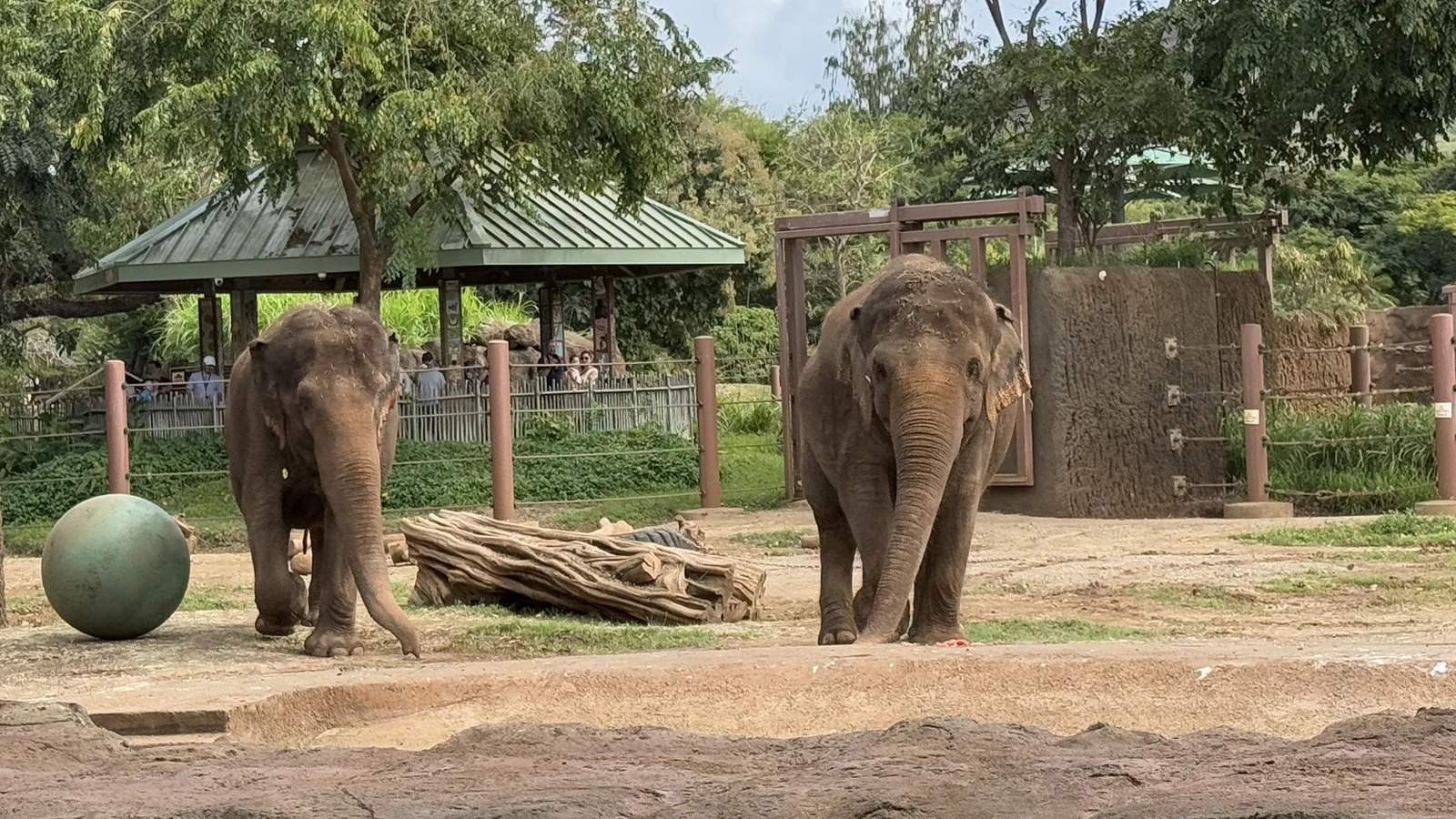
A lawsuit over whether elephants are entitled to human rights will go before the Hawai‘i Supreme Court next week.
A 2023 petition that argued that two elephants at the Honolulu Zoo, Mari and Vaigai, have a common-law right to live free from imprisonment, goes before Hawai‘i’s highest court on Monday, Nov. 9.
The petition was filed by Florida-based nonprofit Nonhuman Rights Project, which argued in Honolulu’s First Circuit Court that Mari and Vaigai have a right to bodily liberty, and requested that the elephants be released to an elephant sanctuary. When the First Circuit and Intermediate Court of Appeals ruled against the NhRP — with Judge Keith Hiraoka writing for the appellate court that common law considers a “person” and an “animal” distinct legal concepts — the Supreme Court agreed in June to hear the case.
Since then, the elephants have gathered supporters from across the nation. Several groups have submitted amicus curiae briefs — opinions from parties interested but unaffiliated in an ongoing case — in support of Mari, Vaigai and the NhRP.
One such brief was submitted by four experts on elephant cognition, who argued that the enrichment provided by zoos “cannot supply the scale, ecological diversity, social complexity, sensory stimulation, foraging opportunities and meaningful choice that elephants have evolved to require.”
Another brief was submitted by Edwin Cameron, a retired justice of the Constitutional Court of South Africa, that country’s highest court. Cameron wrote that South Africa follows national standards for the care of elephants that “recognize their sentient nature, highly organized social structure and ability to communicate.”
Cameron wrote that South Africa proves a legal system “can respond incrementally to what is known about elephants without resolving every question concerning the legal status of nonhuman animals.” Consequently, he wrote that a ruling in favor of Mari and Vaigai wouldn’t inherently call into question the rights of every animal in captivity.
Other briefs were submitted by members of the Los Angeles County Bar Association with expertise in animal law, as well as 20 law professors throughout the U.S. who specialize in the same field. Another was sent by a group of UK legal scholars, and yet another by a retired New York appeals judge.
The defendants in the case — the City and County of Honolulu, the Honolulu Department of Enterprise Services, DES Director Dita Holifield, and Honolulu Zoo Director John Berry — submitted rebuttals to each brief. Regarding Cameron’s arguments, the defendants countered that South African law has a different lineage than Hawai‘i law, which would be undermined by extending legal personhood to animals.
Meanwhile, the Association of Zoos and Aquariums, which accredited the Honolulu Zoo, submitted its own amicus in opposition to the Nonhuman Rights Project. The AZA argued that the critically endangered ‘alalā, or Hawaiian crow, is another cognitively complex and sophisticated animal that only exists today because of captive populations.
Granting Mari and Vaigai the right to not be imprisoned would turn the confinement of ‘alalā populations into a legal wrong, the AZA argued. The crows would therefore need to be released, and would likely face extinction.
The Supreme Court will consider these various arguments at a hearing on Nov. 9 at Punahou School’s Dillingham Hall.
For the latest news of Hawai‘i, sign up here for our free Daily Edition newsletter.


