
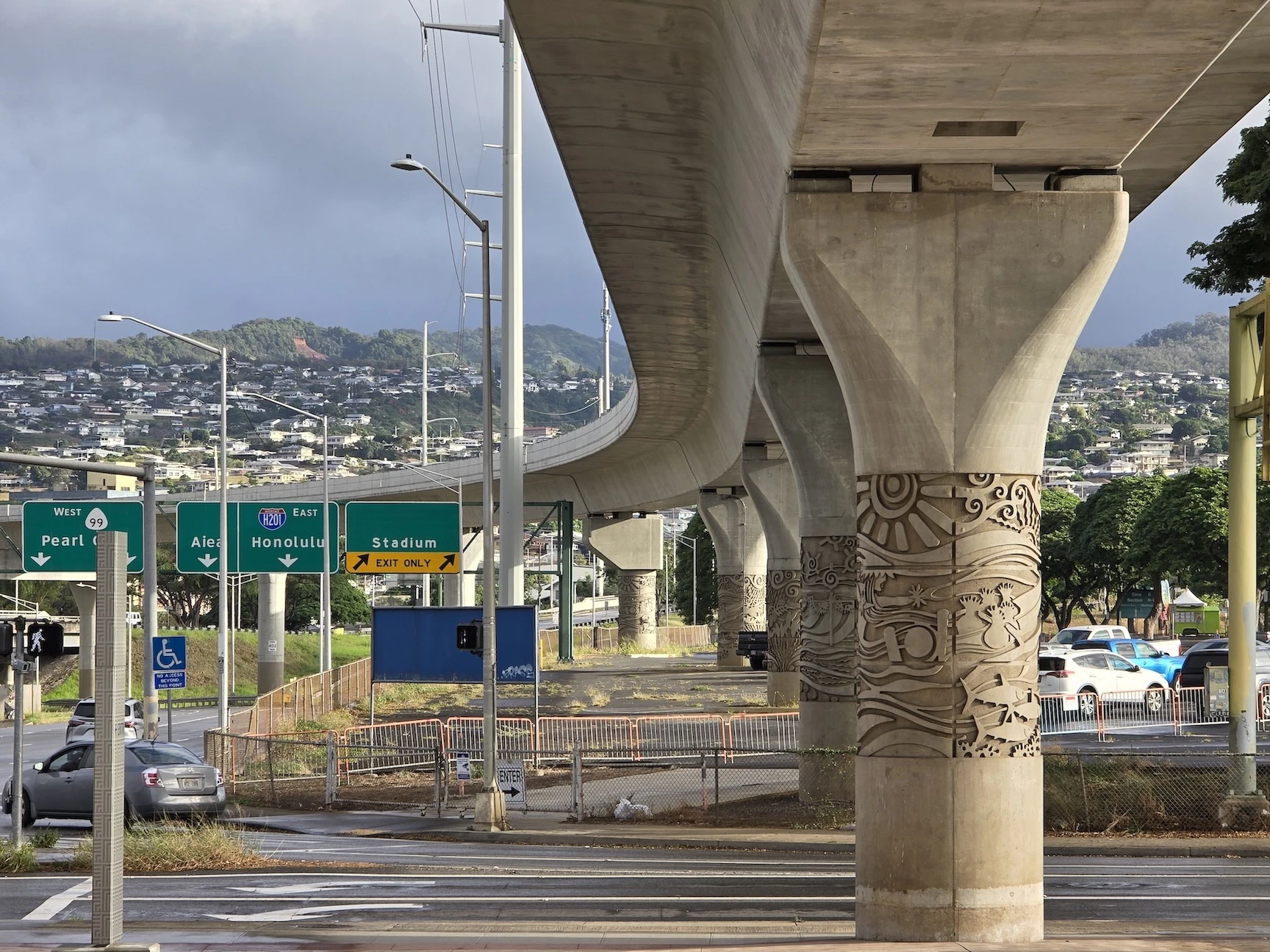
Honolulu Skyline is one of several transportation projects labeled a “boondoggle” by an Iowa senator seeking to cut federal funds.
Republican Sen. Joni Ernst has been crusading against “boondoggles” for some time, and at the start of August published a report on her website about a series of projects around the nation that have gone over-budget and behind schedule.
While Ernst’s main bête noire is the California High-Speed Rail project — which has seen its projected completion date slide from 2017 to 2029 and its budget balloon from $5 billion to $18 billion, according to a U.S. Department of Transportation report — she wrote in her report that the federal government can save further taxpayer money by cutting funds for other, similarly long-delayed projects.
Ernst’s report was predicated on the release of a brief U.S. DOT paper that disclosed all public projects either $1 billion or more over budget or five years or more behind schedule. While the California project was among the most late and expensive projects on that list, Honolulu Rail Transit was not far behind.
That U.S. DOT report stated that Honolulu Skyline is currently 11 years behind schedule, with its project completion date now set back to 2031, and nearly $5 billion over budget, with current cost estimates now at $9.9 billion.
The DOT report also states that the project’s struggles have been caused by “multiple unsuccessful attempts to award a construction contract” for a segment of the Skyline at the city center.
Ernst lambasted the project for wasteful practices: “More than $200 million has been paid to contractors for sitting idle due to numerous delays resulting from prematurely awarding the contract, incomplete designs and lawsuits,” read her report.
Meanwhile, Ernst called the Honolulu Authority for Rapid Transportation, the project’s overseeing agency, “a bloated, mismanaged bureaucracy that lavishes excessive perks on its own executives and consultants.”
She adds that the first phase of Skyline only sees fewer than 3,000 passengers daily. HART's ridership report for July bears that out, with daily rates ranging from 1,815 to 4,123.
While her report urges that Skyline and other projects should be canceled in order to save taxpayer money, a bill she introduced this year to address the issue doesn’t go that far. The “Billion-Dollar Boondoggle Act” instead calls for greater transparency about public infrastructure projects that have gone over-budget and behind schedule.
Under that bill, agencies responsible for projects included in the U.S. DOT report — those five years or more behind schedule, or more than $1 billion over budget — must submit annual reports to the U.S. Office of Management and Budget explaining what changes have been made to the project, its current cost estimate and an explanation for the project’s delay and cost overruns.
That bill passed the Senate Committee on Homeland Security and Governmental Affairs on July 30, but no other action has been taken on the measure. A corresponding measure in the House has gone nowhere since February.
Aloha State Daily reached out to HART for comment.
UPDATE Aug. 11: HART Executive Director and CEO Lori Kahikina provided the following statement Friday evening:
"We are aware of the Act, which essentially requires federal agencies affiliated with projects that are five or more years behind schedule and $1 billion over budget to submit annual project status reports to the Office of Management and Budget. The Act does not appear to mandate or require withholding funds from any project, including the Honolulu Rail Project.
"For context, following years of cost overruns and delays, HART’s new leadership team submitted a Recovery Plan to the Federal Transit Administration (FTA) in 2022 that detailed numerous corrective actions HART had undertaken and that continues today. The FTA accepted the Recovery Plan within four months. The corrective actions, along with additional performance milestones, were then incorporated into a revised Full Funding Grant Agreement (FFGA) between HART and the FTA, which governs the release of federal funds for the project. HART has consistently met all corrective actions and milestones in the FFGA and continues to do so. As a result, HART does not anticipate any changes to the remaining federal funding for the rail project. HART also continues to maintain strong relationships with both the Hawai‘i congressional delegation and the FTA, and will continue to work closely with them on matters pertaining to the rail project."


