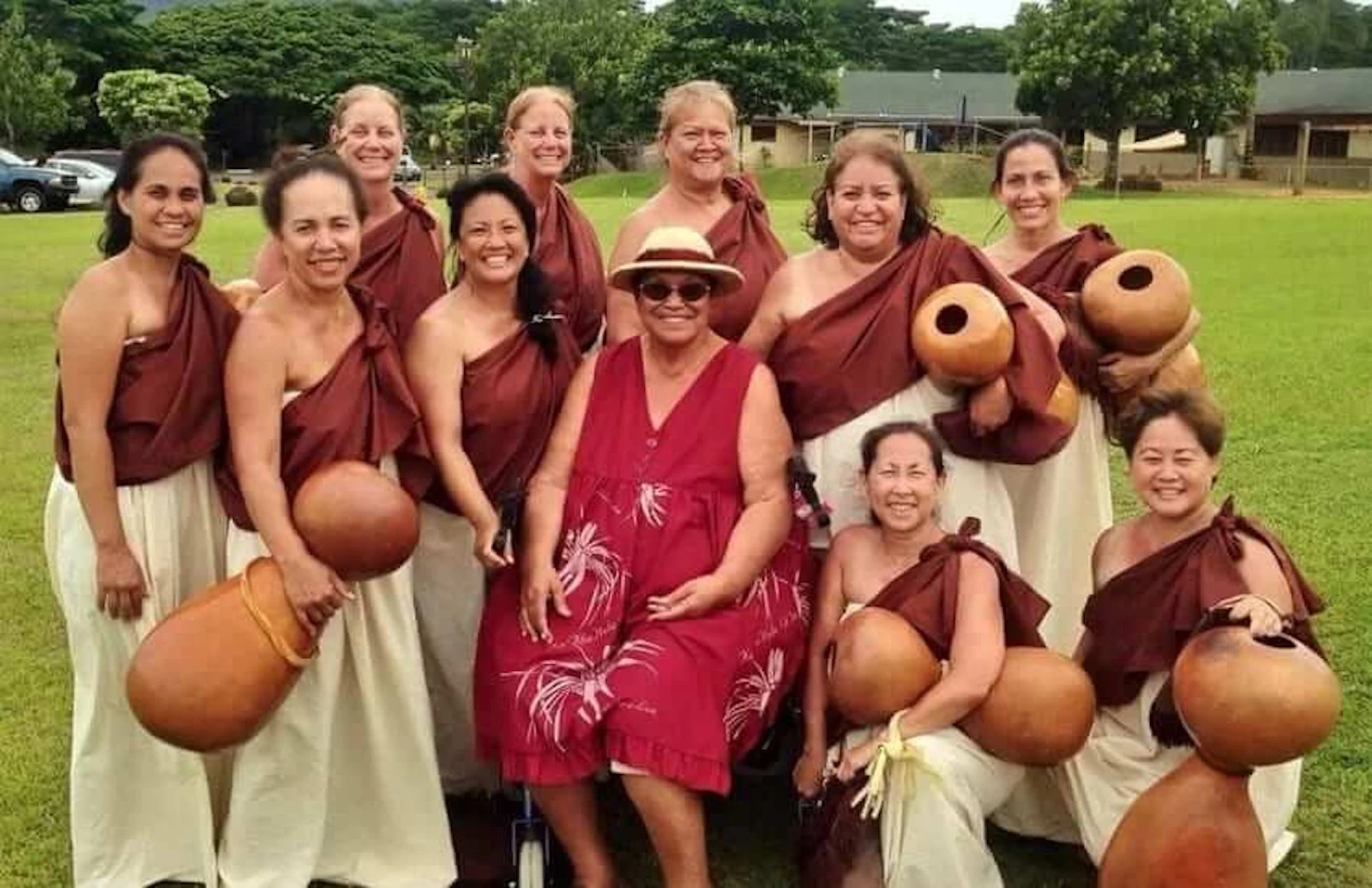
Leināʻala Kalama Heine, beloved kumu hula and founder of Nā Pualei o Likolehua, left behind an indelible hula legacy that continues to thrive under the leadership of her oldest daughter, Kumu Hula Niuliʻi Heine.
Established in 1976 amid the Hawaiian Renaissance, Nā Pualei o Likolehua is celebrating its 50th anniversary this year, which will include competing at the Merrie Monarch Festival this [week].
The story of Nā Pualei, as shared by Niuliʻi, is more than a story about perpetuating hula; it is a story about enduring love.
Trained as a dancer by noted kumu hula like Joseph “Uncle Joe” Kahaulelio and sisters Leilani and Puanani Alama, as a young woman in the 1960s Kalama Heine danced professionally at various “lūʻau shows” for popular musicians including Vickie Iʻi Rodrigues. When Kumu Hula Maʻiki Aiu Lake advertised in 1972 that she was starting a kumu hula class, both Kahaulelio and Rodrigues urged Kalama Heine to sign up.
“My mom really wasn't ready,” recalled Heine who was about 8-years-old at the time. “She just liked dancing and traveling. [But] my grandmother, Rebecca Kalama, told her that she needed to become a teacher of hula.”
Kalama Heine ultimately listened to her mother and her mentors, becoming part of Aiu Lake’s first, and largest, master class: Papa Lehua. The class included her close friend, Robert Cazimero. Both Cazimero and Kalama Heine completed their ʻūniki (graduation) ceremonies in 1973. Another friend, Wayne Keahi Chang, was in Papa ʻIlima, Aiu Lake’s second master class.
At the time, both Cazimero and Chang were working at Kamehameha Schools (KS), training haumāna in the schools’ Concert Glee program to dance hula. Because of her close friendship with them, Kalama Heine agreed to train the female students while they concentrated their efforts on the boys.
Heine says that her mother initially envisioned establishing a hālau together with Cazimero and Chang, but in 1975 they formed Nā Kamalei o Lililehua – an all-male hālau comprised of their KS students. Instead, Cazimero urged Kalama Heine to form her own hālau and Nā Pualei o Likolehua was born on February 24, 1976.
The handful of young women she was training from KS Concert Glee, formed the core Kalama Heine’s original group of dancers, along with some of the other women from Aiu Lake’s Papa Lehua and Papa ʻIlima classes. “Lahela Kaʻaihue, Aunty Vicky (Holt-Takamine), Jade Hind and Tootsie Cazimero, Uncle Robert’s sister. They had ʻūniki from Aunty Maʻiki but hadn’t yet formed their own hālau(s) so they gravitated to my mom because they all hung out together,” Heine said.
“From that point on it was like a brother-sister hālau because Uncle Wayne and Uncle Robert and my mother were so close,” she added. “That’s how it always was through the years.”
Under Kalama Heine’s guiding hand, the hālau blossomed. In 1977, Kalama Heine took her new hālau to the Merrie Monarch Festival. The caliber of Nā Pualei’s debut performance at the festival was such that they took first place in Hula Kahiko, receiving a perfect score, and winning first place overall in the Wāhine Division.
For Heine, who was there and witnessed the performance, the experience was life changing. She had quit dancing hula several years earlier when she was about 10 years old. “I didn’t want to dance hula. I told my mom, ʻI’m over it. I’m going to play sports,’” Heine admitted.
“But then, after the performance, I told her, ʻMom, I want to dance hula, and I want to dance for you.’ It was because I had seen excellence on that floor and it shocked me into doing something better.”
One of the things that set the hālau’s kahiko performance apart were their kaʻi (entrance dance) and hoʻi (exit dance). Instead of a traditional kaʻi, Kalama Heine composed an original kaʻi, Panaewa.
Their hoʻi was also special. It was a portion of a 9th century Tahitian migration chant, Nuʻumea Lani, gifted to Kalama Heine by Kumu Hula John Kaʻimikaua. “This chant has a thousand lines, but he gave us a section and said, ʻthis is what you use to take your women offstage,’” Heine remembered. Nā Pualei has been using it as their hoʻi for 50 years now.
From the beginning, Nā Pualei and Nā Kamalei were regular collaborators who were making an impact in the hula community. “Their thinking was so progressive that they kind of pushed the envelope,” said Heine. “It kind of forced all the other young, up-and-coming hālau to think outside the box, yet stay within the [required] boundaries and parameters. They were always learning, improving and just sharing.”
Decades passed, and while some haumāna came and went, the core group of women who had been with Nā Pualei from the beginning remained intact through graduations, marriages, careers, parenthood and loss; more than a hālau, they were ʻohana. Pilina built on aloha and a shared passion for hula, enduring through all seasons of life.
In the mid-2000s, Kalama Heine was determined to form an ʻūniki class for 13 of her students – one of whom was her daughter. Like her mother before her, Heine initially hesitated, reluctant to take on the kuleana. “I knew that, eventually, hālau would come to me,” she said.
Some of her hula sisters were also reluctant to ʻūniki, but for a different reason. They did not want to leave the hālau that was also ʻohana. “But my mom allowed everyone to stay until they were ready to leave.”
In 2009, Heine and 12 of her hula sisters completed ʻūniki ceremonies and Nā Pualei continued to evolve. Then in 2012, the hālau that had been exclusively for women for 30 years opened a class for keikikāne – in part because so many of the haumāna had young sons. And as those boys grew up, a kāne class was added as well.
When Kalama Heine passed in 2015, she was in the process of training a second ʻūniki class. Heine assumed leadership of Nā Pualei, and completed their training in 2018 – a class that included her sister, ʻAuliʻi Heine Hirahara, who has since started her own hālau. Heine is now training her youngest sister, Healiʻi Heine, to become a kumu hula as well.
In all, Nā Pualei has graduated 16 kumu hula and birthed eight new hālau. However, some remain at Nā Pualei, content to kākoʻo Heine with running the hālau, teaching its classes, and helping to build a vision for the next 50 years.
Beyond training young people to preserve and perpetuate hula as a living art, Kalama Heine wanted to instill in her haumāna a love for all that is Hawaiian and determination to uphold their kuleana to our people – whatever that might be.
“One of my mom’s goals for Nā Pualei was to train young people to be future leaders and to move our lāhui forward,” Heine reminisced. “She was a mana wahine. Even today people speak highly of her. It’s like she never left; a name that is not forgotten. She touched a lot of people.”
This article is reprinted with permission from OHA's Ka Wai Ola newspaper: "Nā Pualei o Likolehua – “ʻO ke Aloha hoʻi e Hoʻomau ʻia ana" by Puanani Fernandez-Akamine, in its April 2026 issue, Vol. 43 No. 4. Read more at kawaiola.news.
For the latest news of Hawai‘i, sign up here for our free Daily Edition newsletter.