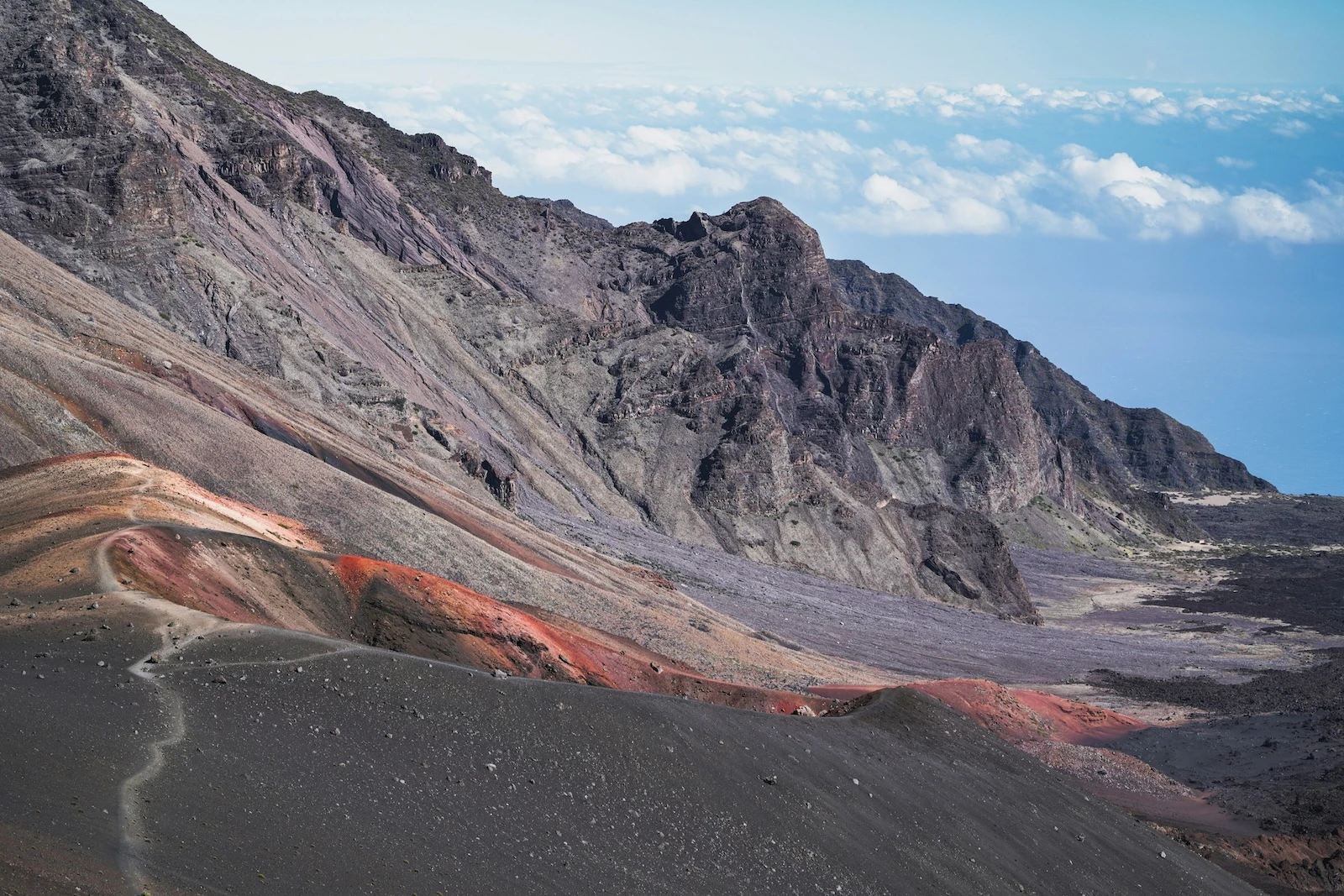
From sea to summit, Haleakalā is a living, breathing, ancestral system whose most sacred part is its piko, or highest point. To understand its sacredness, we must begin at the origin of our islands and the life that fills them.
Our most extensive genealogical chant of creation is the Kumulipo. Long before Charles Darwin came up with his theory of evolution, Hawaiians were chanting their universe, from the walewale hoʻokumu honua — much like the western idea of a “primordial soup” — to the plants and animals, and eventually to themselves.
In this genealogy, the coral polyp was the first true organism. Then plants were born in the ocean and paired with others born on land. This land/sea connection is a foundational and enduring concept in our worldview, epitomized by the Kāne/Kanaloa water cycle.
After land and sea plants came the fish, birds, insects, and mammals. Collectively, these organisms filled the ʻāina and created the foundation for human life, which was the last to emerge.
As the muli loa, or last born, in this long line of life forms, we honor them all as kūpuna, or ancestors, and we show our gratitude to them through respect and protection.
I want to be clear here that we don’t choose to stand up for the ʻuaʻu and the ʻāhinahina, for example. Rather, as Kumu Kīʻope Raymond has put it, we have a familial obligation to do so. This is also why the first rule is to take only what you need and no more. Hoarding is abhorrent and forbidden, as it’s unsustainable and breaks the contract with our family of life.
Our akua, our deities, also come from the Pō. Other genealogies tell us of the unions of various akua and the birth of our islands. Wākea and Papa came together and the first islands Papa birthed were Hawaiʻi, Maui, and Kahoʻolawe. This is part of the reason that Kahoʻolawe is considered a kalana (land area) belonging to the Honuaʻula district of Maui.
Among the many gifts of the god Kāne are sunlight and freshwater. In concert with Kanaloa, whose realm is the ocean, they are the water cycle. The abundant wai of East Maui activates the fertility of Papa (in her many Haumea forms), driving primary productivity on land and enabling the symphony of life that came to be on Haleakalā.
These kūpuna plants and animals arrived and evolved there for nearly 2 million years after Papa gave birth. This created what biologist Art Medeiros refers to as a lei, or garland of forest, that once went all the way around Haleakalā, comprising roughly 450 native species in habitats from rainforest to dryforest. Many of these species are endemic — found nowhere else in the world.
The koʻolau, or northeast part of that lei of forest is a 100,000-acre watershed that produces 60 billion gallons of water annually, on which we, the people, survive. It does this because we have protected it and limited the amount of human activity there.
This is one of several reasons that the land from where the forest begins all the way to the summit is called the wao akua, or the realm of the gods.
This brings us to the summit itself, which is called the piko, or navel. This is where Haleakalā was connected to its mother, Papa. While the physical piko was severed at birth, an energetic connection remains to Papa in her forms as Haumea.
Haleakalā, through its piko, draws nourishment from Haumea and our celestial ʻohana and that mauli, that life force, feeds the entire living, breathing, mountain system. The symphony of life we talked about earlier, which includes us as Kānaka, is nourished through this critical point of connection.
In fact, when we go to the summit for special occasions or ceremonies and our piko align with that piko, we experience an especially profound connection to life force that is unique to that place. This is at the heart of why obstructions and developments at the summit are highly detrimental.
So, the piko draws down this nourishment and feeds the ʻāhinahina, the ʻuaʻu, the koa, the ʻōhiʻa, and all the forms of life on the mountain. Amazingly, Haumea is found both high above in the heat of the stars and deep below in the earth’s molten core; as above, so below. Haumea’s daughter, Pele, is embodied in the most recent flows on our mountain, where molten rock once again broke the surface and formed new land.
Some folks tend to think of Pele’s activity as confined to the lua, or crater portion of the national park, but we must break out of this fragmented mindset that is not in line with our cultural history.
Pele’s activity spreads across the whole kualono (ridgeline) of Haleakalā. Entire hula traditions are devoted to the dances that honor this akua and her wondrous work across the mountain. Much of the extent of her influence is within Honuaʻula and the ahupuaʻa of Pāpaʻanui.
Pele eventually went on to Hawaiʻi Island, but the goddesses Lilinoe and Poliʻahu continued to shape the summit and the crater with their clouds, mist, rain, snow and ice. Lilinoe is still with us today, casting her kīhei of clouds around the mountain, feeding many areas with her gentle rain and fog drip, and helping to regulate temperatures.
This is just a fraction of the knowledge that exists about Haleakalā, the kuahiwi that is our malu (sanctuary), our life source, and the only home many of us will ever know. Its sacred summit is second to none and telescopes do not belong there. We will forever stand in protection of this piko of nourishment and connection.
Adapted from a presentation at the Hanohano ʻo Haleakalā forum. For the full version of this presentation, go to protecthaleakala.com, hit the “watch livestream” button, and advance to 35 minutes.
This article is reprinted with permission from OHA's Ka Wai Ola newspaper: "Why is Haleakalā a sacred place?" by Hina Kneubuhl in its May 2026 issue, Vol. 43 No. 5. Read more at kawaiola.news.
For the latest news of Hawai‘i, sign up here for our free Daily Edition newsletter.