
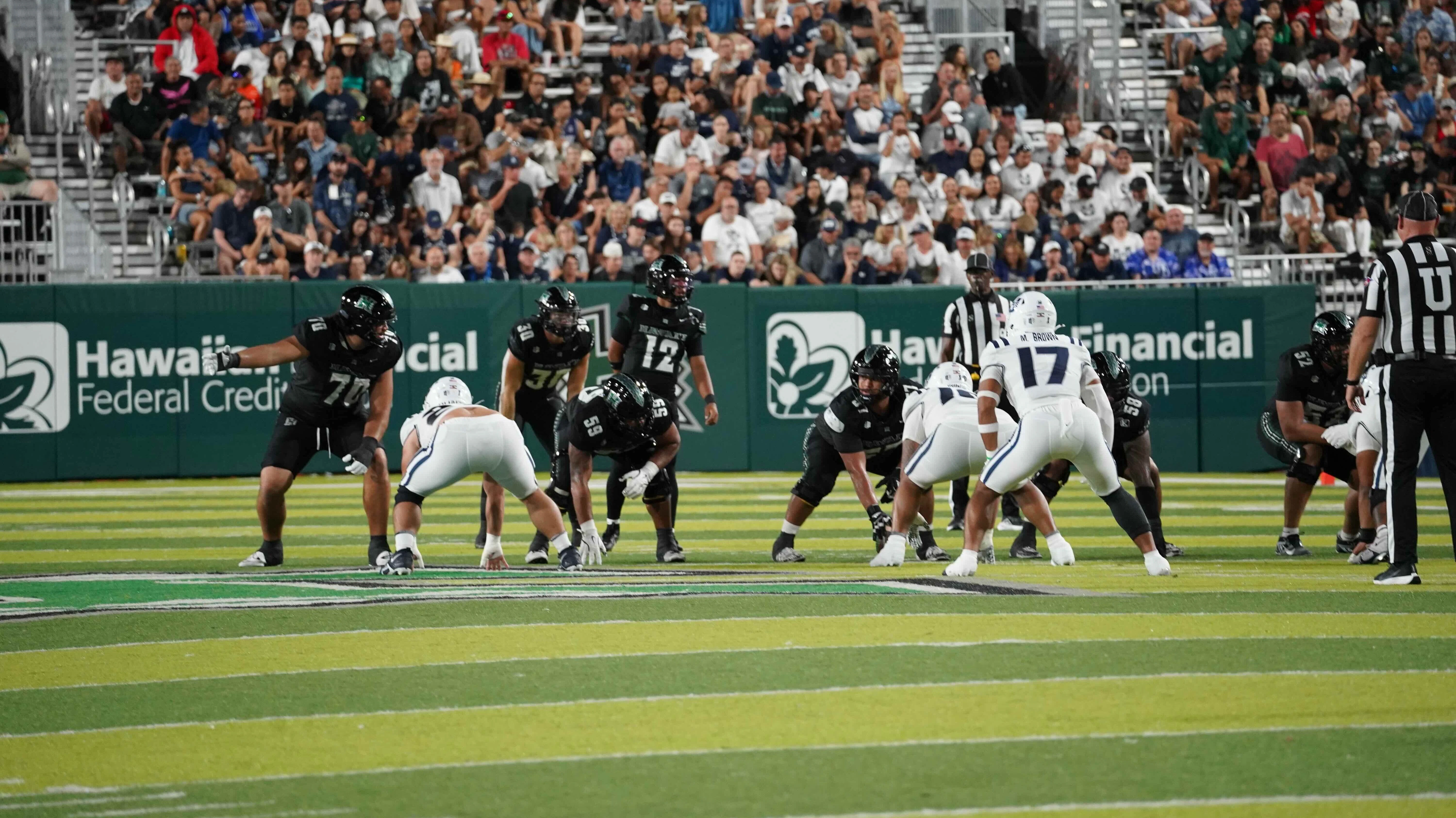
Five donors are collectively making a $5 million commitment to the student-athletes at the University of Hawai‘i at Mānoa.
UH on Wednesday announced that Bank of Hawai‘i, First Hawaiian Bank and Matson, along with longtime UH supporters Jack Tsui, chair of the Clarence T.C. Ching Foundation and former First Hawaiian Bank president, and Walter Dods, former CEO of First Hawaiian Bank, will each commit $200,000 annually for the next five years via the UH Foundation to support name, image and likeness, or NIL, opportunities for student athletes.
All told, the donations will provide $1 million per year for NIL support, “helping UH Mānoa retain homegrown talent, recruit high-level student-athletes and provide equitable, Title IX-compliant opportunities across sports in an increasingly competitive Division I athletics environment," UH says. "It will also strengthen a program that generates statewide pride, visibility and meaningful economic impact for Hawaiʻi."
“This extraordinary commitment reflects something that has always made Hawaiʻi special: people who deeply believe in UH and understand the important role athletics plays in bringing our community together,” UH Mānoa Director of Athletics Matt Elliott said in the announcement. “College athletics has changed, and our objective is to adapt in a way that reflects the values of this university and our state. Our goal is to build a stable, student-centered foundation that supports academic success, competitive excellence and responsible NIL opportunities while ensuring UH Mānoa remains ‘Our Team, Hawaiʻi’s Team.’”
According to ESPN, it wasn't until 2021 that the NCAA, or the National Collegiate Athletic Association, changed rules to allow students to profit from their name, image and likeness.
NIL "refers to a person's legal right to control how their image is used, including commercially," ESPN reported in March. "In college, student-athletes have long been prohibited from making deals to profit from their fame, so they forfeited their NIL rights by signing on with college sports teams. A combination of NCAA rule changes and state laws restored NIL rights to college athletes, and they've been making sponsorship deals ever since."
In 2020, Arizona State swimmer Grant House sued the NCAA in a landmark class action case alleging that the NCAA’s rules forbidding compensation for college athletes were illegal under antitrust laws, Hawai‘i Tax Foundation President Tom Yamachika recently wrote, noting, "The settlement of that lawsuit in 2025 cleared the way for college athletes to be compensated for their name, image, and likeness (referred to as NIL)." You can read more about that settlement here.
According to UH, as NIL compensation becomes a "standard component of Division I athletics nationwide," universities across the U.S. have committed "significant resources to support student-athletes." That includes every member of the Mountain West Conference, which UH Mānoa will join as a full member on July 1, the university notes.
"University leaders estimate UH Mānoa needs approximately $5 million annually in NIL support to remain competitive in the Mountain West and on the national stage," UH says.
In Hawai‘i, Senate Bill 3263, which aimed to affirm the right of student-athletes to engage in NIL activities and establish an endowment to support the compensation of student-athletes, died near the end of this year's Legislative session, failing to pass final reading of the state Senate in an 11-12 vote, with two senators excused.
UH President Wendy Hensel said in the announcement that the new $5 million commitment provides an "important foundation" for Mānoa athletics, but noted that broader support will still be needed for long-term success.
Dods says that the changing landscape of college athletics requires action.
“People can certainly have different opinions about whether college athletes should be compensated, but the reality is already here,” he said in the announcement. “Every school we compete against is investing in NIL, and if we want Hawaiʻi teams to remain competitive and our student-athletes to stay home, then we — the state, the private sector and the broader community — need to step up in some way. We understand the pressures on the Legislature and that everyone is asking for support. That is part of why the five of us decided to act now and help create a foundation others can build on.”
The university underscored the economic impact athletics bring to the Islands, citing a 2015 study by the UH Mānoa Shidler College of Business. That study found that, based on a $35 million athletics budget at the time, UH Athletics generated $66 million in direct spending, produced $128 million in statewide business sales, generated about $7 million in tax revenue and supported more than 860 jobs across the state. An updated economic impact study is almost finished and expected this summer.
“I genuinely believe we are only scratching the surface of what UH Athletics can become,” Elliott said in Wednesday's announcement. “If we build this foundation the right way — with support from philanthropy, corporate partners and ultimately the state — we can retain local student-athletes, compete at a high level and continue creating opportunities for student-athletes who want to stay home, earn their degrees and represent Hawaiʻi the right way.”
According to Elliott, UH Mānoa Athletics intends to launch a new giving society later this year "to honor the individuals and organizations helping strengthen opportunities for student-athletes and support the department’s long-term future."
(ICYMI: You can read Aloha State Daily Editor-in-Chief A. Kam Napier's recent take on the UH athletics here).
Stephanie Salmons can be reached at stephanie@alohastatedaily.com.
For the latest news of Hawai‘i, sign up here for our free Daily Edition newsletter.


