

Honolulu residents for years have known Kaka‘ako as a site of constant construction, as it transitions from light industrial use to a forest of 400-foot condo towers. This is the first article of a series on Kaka‘ako’s evolution from the 20th century to today.
To start with, let’s decide how to define the boundaries of Kaka‘ako. For these articles, we’ll say that the area being described is between Kapi‘olani Boulevard, Pi‘ikoi Street, Ala Moana Boulevard and South Street.
As was said in the first paragraph, today Kaka‘ako is increasingly being filled with tall condominiums which all rise to the maximum height allowed by City & County of Honolulu zoning, 400 feet – which, in a side note, is the reason that our city’s skyline is so uniform and, truthfully, boring. But aside from that, what was the first such big building to be constructed in this neighborhood? What unknowingly set the trend for the Kaka‘ako to come?

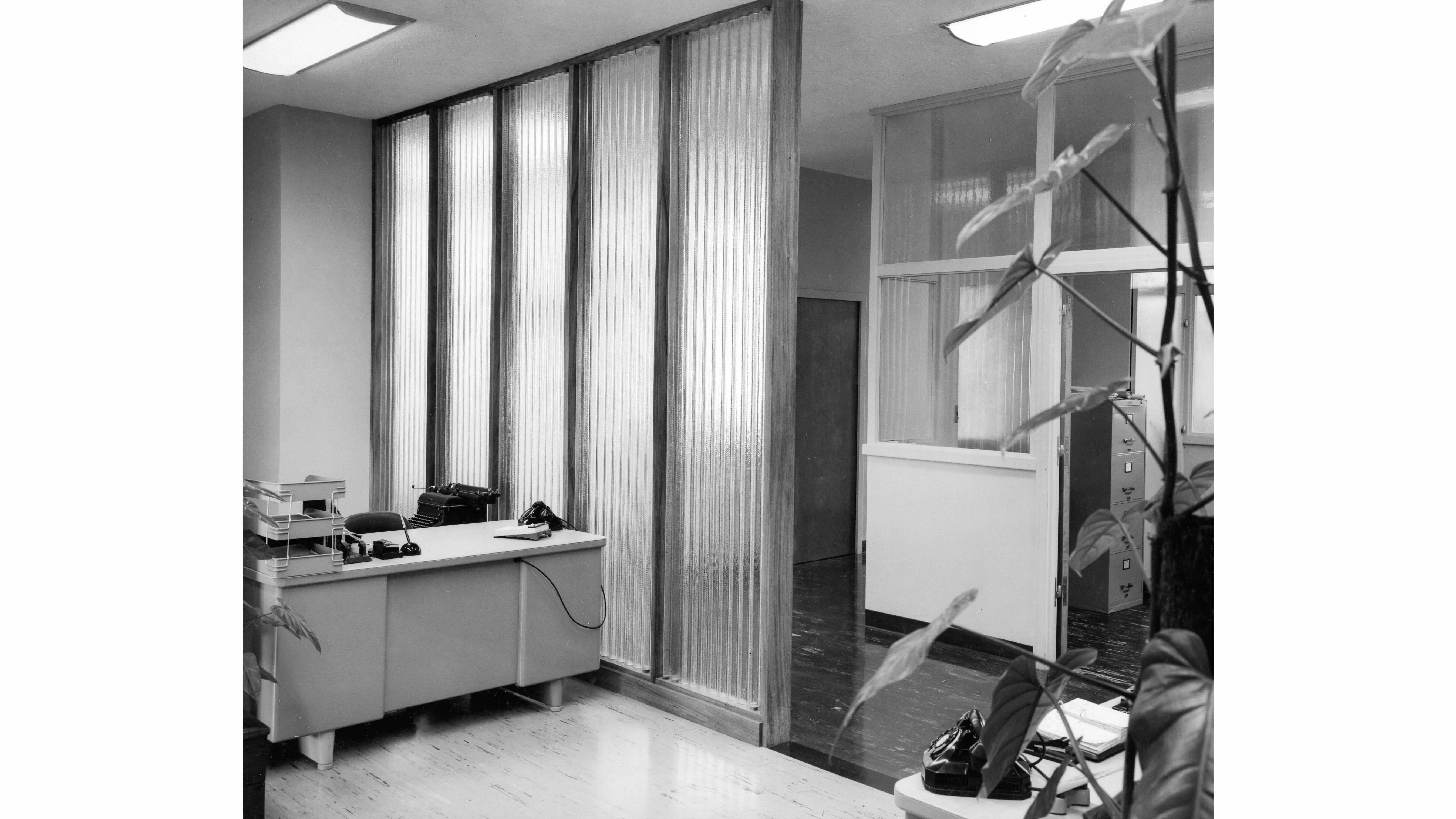
We’ll go back first to 1950. That was when the Hawaiian Dredging Company, part of the larger Dillingham Corporation, moved into a new headquarters building on the corner of Pi‘ikoi Street and Ala Moana Boulevard. The property was part of what Dillingham had purchased back in 1912 from the Bishop Estate (the former name of the real estate portion of the Kamehameha Schools) which also included the site of today’s Ala Moana Center. This tract then was mostly wetlands which Dillingham filled with dredged material from offshore to create dry land, as we well know today.
The new Hawaiian Dredging building, which had been started in March 1950 and was occupied in October, stood only a modest two stories tall with a rooftop penthouse which held the employee lunch room which could also be used for social events. Several other Dillingham subsidiaries were also housed here, along with executive offices. The interior overall reflected the current trends of the time in construction as well as interior decoration.
This small structure was surrounded by open grassy space and some parking on the rest of its lot. In the vicinity of its property was more open space along with commercial structures, the most important being the Lewers & Cooke building supply company immediately mauka. This was a sprawling warehouse and retail complex on a 14-acre lot that was similar to the familiar Home Depot and Lowe’s that we patronize today. But towards Waikīkī, across Pi‘ikoi Street, the future site of Ala Moana Center was a completely unoccupied expanse.
The Hawaiian Dredging building became obsolete a mere 11 years later as construction in Hawai‘i boomed and the company’s workload increased. The business moved its offices to the new Ala Moana Building, then the tallest in the state, in 1961.
Now would come the big change, which typically for Honolulu saw something small be replaced by something pretty huge. In September 1966, the former Hawaiian Dredging site was filled with equipment to begin the process of pile-driving hundred of cement columns deep in the ground to support the new 1350 Ala Moana condominium. Newspaper articles of the time variously described this structure as having 32, 33, 34 and 35 stories, but all agreed that it would contain 350 individual units. These averaged a price of $44,600 and were advertised as coming equipped with appliances, carpets and drapes. (Advertisements and articles in 1966 did not specify if the units were fee simple.) Sales had started in July 1966, even before construction began, and after only seven months the project was 80% sold out.
The building was designed by architect Minoru Yamasaki, then internationally renowned for such designs as the World Trade Center in New York. Its 1966 average sales price is equal to nearly $460,000 in 2026 dollars. Units currently on the market list from $875,000 to $1.38 million fee simple.

On August 1, 1968, the $10 million building was complete and the first tenants began moving in. And for the next 20 or so years, 1350 Ala Moana would stand by itself as the sole substantial high-rise in all of Kaka‘ako.

Today, of course, what was once a landmark is pretty much overwhelmed by the numerous other towers in its vicinity, and the insignificant building it replaced is long forgotten. This is a process well established in Kaka‘ako, and it continues even now.
(Watch for future articles which will continue to tell Kaka‘ako’s historical stories.)
For the latest news of Hawai‘i, sign up here for our free Daily Edition newsletter.


