
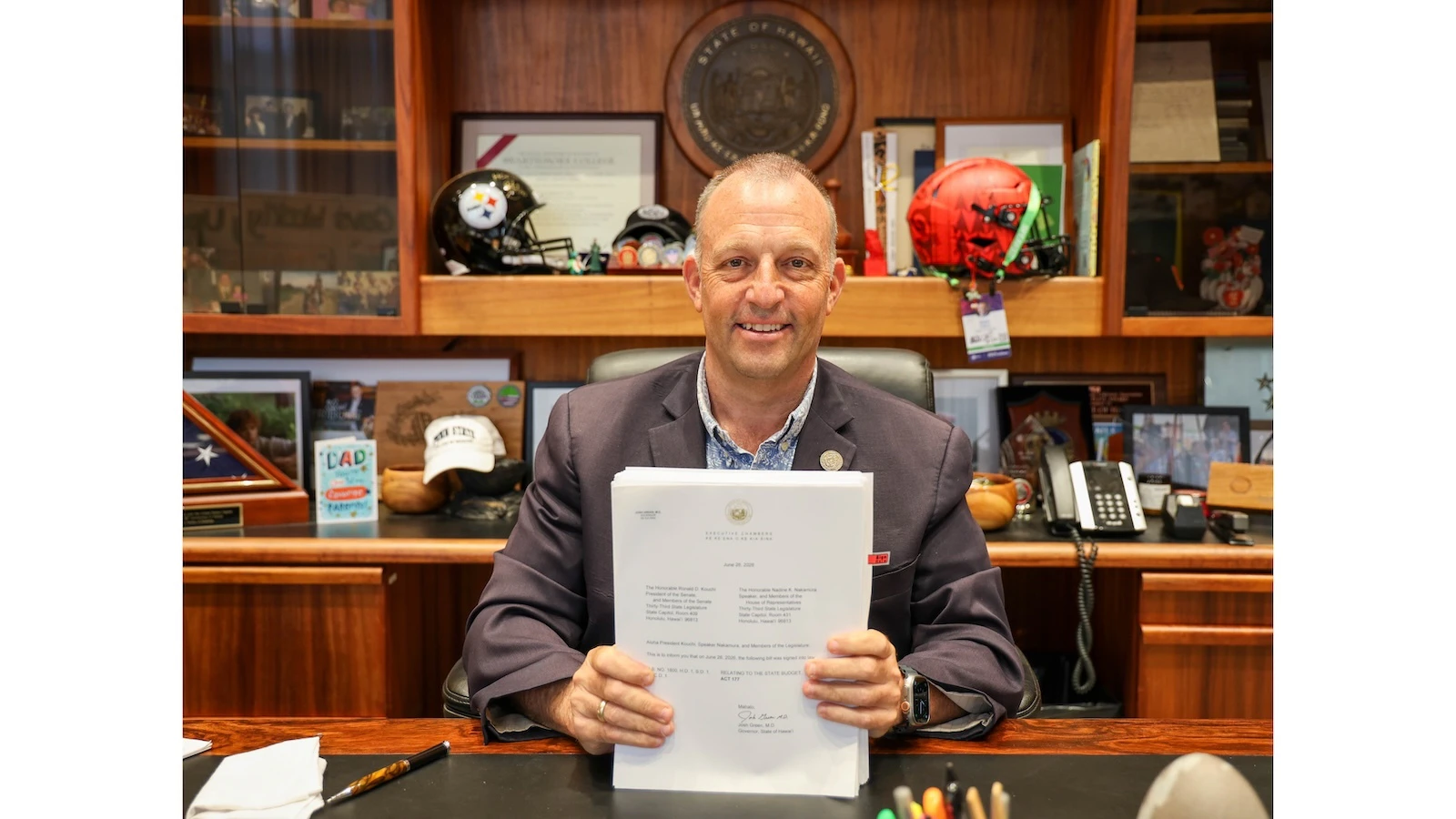
Gov. Josh Green signed a $20 billion budget bill and the death warrants for four other bills Friday.
House Bill 1800, the state's supplemental budget bill, appropriated funds for the executive branch's operating budget and capital improvement projects for the 2026 and 2027 fiscal years.
The measure includes $10.4 billion and $10.6 billion to the operating budget for the 2026 and 2027 fiscal years, respectively, along with another $1.5 billion for capital improvement projects.
Green announced Friday that the bill "balances the financial plan and maintains state reserves ... continues to invest in Hawai‘i's priorities, including affordable housing, support for local families, public health initiatives and economic development opportunities."
Among the capital improvement projects funded by the bill are $100 million for the Hawai‘i Housing Finance and Development Corp. "to finance additional affordable rental housing statewide," $58.5 million for improvements to the Wahiawā Dam, $7 million for a Waikīkī beach restoration project, and much more.
Green also unveiled his intent-veto-list, which included only four measures this year.
The four measures Green plans to veto are:
An independent commission to close schools
House Bill 2344 would have established a temporary “Public School Realignment and Closure Commission,” independent of any state agency, to develop recommendations for consolidating and closing public schools.
In the preamble to the bill, lawmakers wrote that current school enrollment declines have left school facilities underutilized, diverting resources away from areas where they could be better spent.
Lawmakers added that a federal process for making military realignment decisions — the Base Realignment and Closure Process, which includes the establishment of an independent commission — ensures that those decisions are guided by objective data.
Green explained in his announcement that decisions for closing or consolidating schools are already within the authority of the state Department of Education, and that HB 2344 would be redundant.
A $50 million infusion to the Rainy Day Fund
Senate Bill 2600 is a brief measure making a large contribution to the state’s emergency and budget reserve fund, commonly referred to as the Rainy Day Fund.
The bill noted that the state Legislature is constitutionally required to dispose of excess tax revenues whenever the state general fund balance exceeds 5% of general fund revenues for the previous two fiscal years, and would therefore transfer $50 million from the state general fund to the Rainy Day Fund.
Earlier versions of the measure also allowed for an income tax credit for all taxpayers in the state, but that was removed from the final version that reached Green’s desk.
Green explained in his Friday announcement that such a use of funds is not prudent “given disaster recovery efforts and other state priorities such as affordable housing and reducing the cost-of-living for our residents.” He added that the current balance of the Rainy Day Fund is more than $1.5 billion, “the largest it has ever been.”
More oversight for the Teacher Standards Board
Senate Bill 3262 would require the Board of Education to select an executive director for the Hawai‘i Teacher Standards Board — the body that sets teacher credentialing standards — from three candidates selected by the HTSB. Currently, the HTSB is only required to forward a single nominee to the BOE.
Furthermore, SB 3262 also requires the state Senate to confirm the final nominee.
Green explained that the measure needs to be reviewed further for possible entanglements of the responsibilities and duties of both boards. The changes in the bill, he explained, may “create ambiguity regarding governance and accountability.”
A shakeup at state housing offices
Senate Bill 2338 made several administrative changes throughout the Hawai‘i Housing Finance and Development Corp. and the Hawai‘i Community Development Authority, a pair of agencies attached to the state Department of Business, Economic Development and Tourism.
Among other things, the bill removed a requirement that DBEDT’s director must approve the job descriptions of employees of the two agencies, and set salary guidelines for the top positions of HHFDC and HCDA — the executive directors of both agencies could be paid no more than 99% of the governor’s salary, which will be nearly $227,000 beginning July.
Green explained that the intended effects of the bill can probably be achieved through current administrative rules, and that legislation is superfluous to the goal.
Green must issue final vetoes by July 15, after which all bills not vetoed will become law. He is not required to veto all bills on his intent-to-veto list, but he cannot veto any bill not on the list.
Outside the four bills on Green’s list, 263 other measures made it to his desk and seem likely to become law.
For the latest news of Hawai‘i, sign up here for our free Daily Edition newsletter.


