
Inspired by the famed words of the late Mary Kawena Pukui, a Hawaiian scholar who developed and taught cultural curriculum at Punahou School from 1936 to 1941, the school’s mission and values are rooted in being “children of Ka Punahou, the new spring.”
Pukui recognized then the school’s future as a “spring of wisdom. As the hala tree stands firm through wind or storm, so shall the children of this school stand strong and brave through joy and sorrow. And just as the hala tree has many uses, so shall these children be useful to Hawai‘i.”
Fluent in ʻŌlelo Hawaiʻi, she went on to grow Punahou’s Hawaiian Studies program alongside Jane Lathrop Winne and later worked at Kamehameha Schools and Bishop Museum, in addition to publishing more than 50 works, including the “Hawaiian Dictionary” and “ʻŌlelo Noʻeau: Hawaiian Proverbs and Poetical Sayings.” Pukui devoted her life to preserving and perpetuating Hawaiian language, oral hisory, mele, hula, cultural traditions and practices, and more.
Fittingly, the first day of the 2026-27 school year at Punahou on Tuesday marked the official opening of the Mary Kawena Pukui Learning Commons, which is named in her honor and breathes new life into the school’s former Cooke Library, which was originally built in 1908 and last reconstructed in 1964. According to the school, the historic library’s terrazzo wall, among other architectural features, “have been restored or incorporated into the new design.”
The structure itself has multiple entryways, with one entrance facing Ka Punahou, its namesake natural spring.
“When I was a student, I studied in this building and spent time learning here,” Punahou President Mike Latham, a 1986 graduate of the school, told Aloha State Daily. “As you can imagine, the purpose and function of libraries have changed quite a bit in the past 60 years — the way we store information and knowledge, the way that we teach, the way that we help students learn how to do research.
“We wanted to develop a facility, which would allow us to engage in a lot more collaborative and project based learning, where students are able to draw knowledge from different fields, and they can apply it to authentic real-world challenges and problems. That was really at the heart of the work that we're doing.”

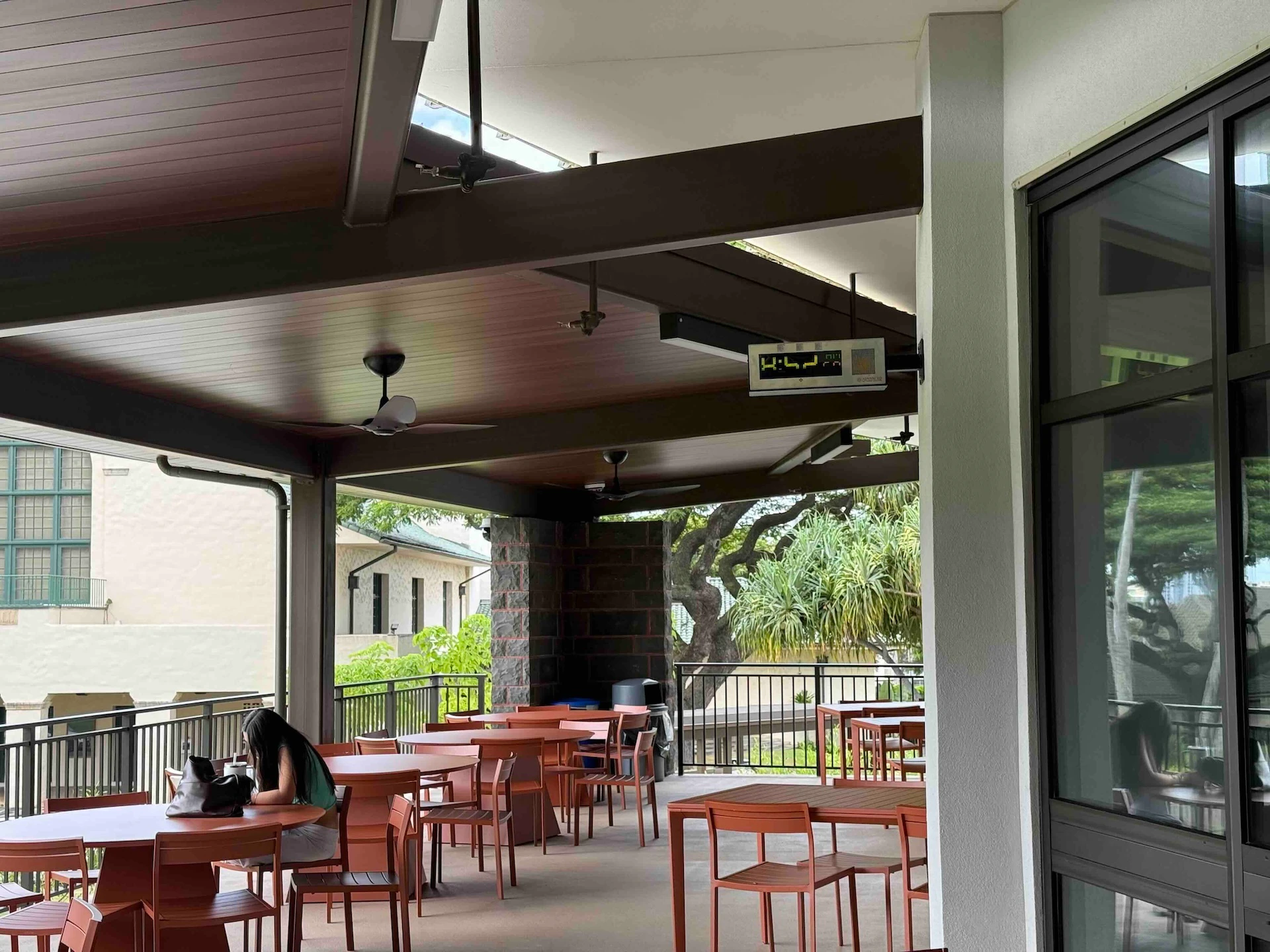
The new, two-level center spans more than 53,000 square feet, and was designed by Honolulu-based WhiteSpace Architects, which was founded by Punahou alum, Pip White, and is currently overseen by a parent of the school, Laura Ayers. Albert C. Kobayashi Inc. was the general contractor for the project, which began construction permitting in 2023. Photo by Kelsey Kukaua Medeiros (Aloha State Daily Staff) 
Latham told ASD: “Every kid at Punahou, kindergarten through sixth grade, now studies Hawaiian language, which we're really proud of. Every student at Punaohou takes a Hawaiian history course as a graduation requirement. Hawaiian is one of the major languages that we offer to all of our high school-level students. And I think we have in a far more intentional way come to recognize and embrace that part of our history, which also goes hand in hand with naming this signature academic building after such a prominent native Hawaiian scholar — it's a recognition of who she was, what she did for Punahou, but what she did more broadly for the entire state.” Photo by Kelsey Kukaua Medeiros (Aloha State Daily Staff) 
The facility features a nearly 27,000 library book collection and expanded archives with a climate-controlled vault; a “History Wall,” or photo timeline connecting past and present; and an extended reality design lab with technological capabilities for Artificial Intelligence, Virtual Reality and Augmented Reality. Photo by Kelsey Kukaua Medeiros (Aloha State Daily Staff) 
The new learning commons has a teaching kitchen headed by local chef Mark Noguchi and outdoor garden space to grow ʻulu, kalo, ʻuala (sweet potato) and hōʻiʻo (fern). Photo by Kelsey Kukaua Medeiros (Aloha State Daily Staff) 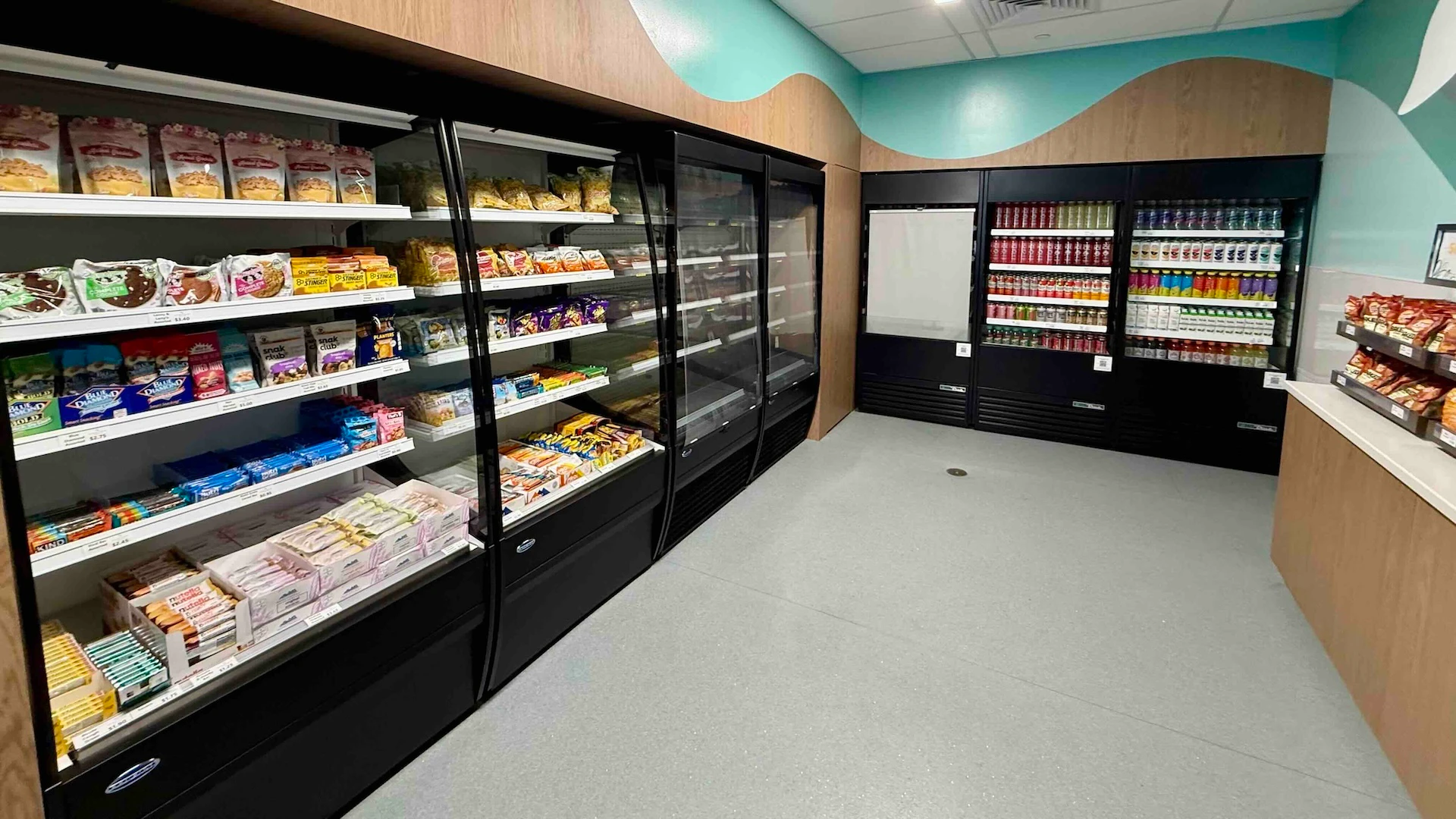
Punahou President Mike Latham said that the building's snack-and-go center is anticipated to be a big hit with students. Photo by Kelsey Kukaua Medeiros (Aloha State Daily Staff)
The new, two-level center spans more than 53,000 square feet, and was designed by Honolulu-based WhiteSpace Architects, which was founded by Punahou alum, Pip White, and is currently led by the firm's partner, Laura Ayers, who is a parent at the school. Albert C. Kobayashi Inc. was the general contractor for the project, which began construction permitting in 2023.
Latham said the Mary Kawena Pukui Learning Commons is intended for students to engage with each other, teachers and staff, as well as community partners on research and innovation.
“In our professional lives, we are constantly doing collaborative work. Very rarely do we work entirely alone. And we wanted a building that really supported that kind of collaborative engagement by students and that created problem solving,” Latham told ASD. “It's really fundamental to the kind of education that we want to deliver. It's fundamental to the kind of work that Mary Kawena Pukui herself did, especially at Bishop Museum. I mean, she was constantly in collaboration with historians, anthropologists, linguists, archaeologists. ... She's a hallmark for what we're seeking to accomplish.
“This is a building that both looks into the past and draws inspiration from that past. But it's very much about preparing students for a world that's rapidly changing. And the forces of technology, AI, global interconnection, they really require that we think carefully about what students need to be able to do and learn to get ready for higher education, but also for this future workplace.”
The facility features a nearly 27,000 library book collection and expanded archives with a climate-controlled vault; a “History Wall,” or photo timeline connecting past and present; an extended reality design lab with technological capabilities for artificial intelligence, virtual reality and augmented reality; a teaching kitchen headed by local chef Mark Noguchi and outdoor garden space growing ʻulu, kalo, ʻuala (sweet potato) and hōʻiʻo (fern); an art gallery; and indoor and outdoor learning spaces.
Latham mentioned the significance of the two-story “History Wall” that “goes back to [Punahou’s] earlier days,” as a tool to "reflect on almost 200 years of history.”
“This building is the home of our archival collections ... and this intersection of two gifts; a Hawaiian commitment to knowledge, to reciprocity, to cultural exchange; and a missionary commitment to education,” he said, “Out of that shared heritage of [blending] Hawaiian and Christian heritage together, what complements that is the fact that Punahou becomes a home for people from all over the world, who come here, find a home, and ultimately, become part of the shared work that they do together.”
Latham added: “Every kid at Punahou, kindergarten through sixth grade, now studies Hawaiian language, which we're really proud of. Every student at Punahou takes a Hawaiian history course as a graduation requirement. Hawaiian is one of the major languages that we offer to all of our high school-level students. And I think we have in a far more intentional way come to recognize and embrace that part of our history, which also goes hand in hand with naming this signature academic building after such a prominent native Hawaiian scholar — it's a recognition of who she was and what she did for Punahou, but what she did more broadly for the entire state.”
He said last week that a number of Pukui's descendants, including her grandson, Laʻakea Suganuma, attended the building’s blessing ceremony and groundbreaking and was expected to be present at its opening celebration on Friday, Aug. 7.
The Mary Kawena Pukui Learning Commons also meets LEED (Leadership in Energy and Environmental Design) Gold certification standard, with a rooftop photovoltaic system, rain gardens, water-efficient landscaping that uses native plants, and more.
Looking ahead, Latham said that he hopes that the new building will be used for not only student and teacher development, but also the broader community to continue to build relationships with donors and the state Department of Education, for example, among other partners.
“It's a project that further integrates the scope of our campus itself,” he said. “We're fortunate to have this very beautiful 76-acre campus here in Mānoa, and this building brings the campus together in a way that's really, really exciting.”
Fundraising for the project is still ongoing. Learn more here.
Punahou School is the largest private K-12 school on a single campus in the country, with more than 3,755 students currently enrolled. The school’s tuition for the 2026-27 school year is $34,230, though, it has a $11.1 million budget annually for financial aid, which is dispersed to about a quarter of the student population, per its website. Latham confirmed that the average award per student is around $12,000.
When asked what he’s been learning lately as a leader, Latham told ASD that having a clear sense of mission and purpose is “essential.”
That’s what first got his attention when conducting more research about Mary Kawena Pukui for the naming of this building.
“[Pukui said] that ‘Knowledge to me is life.’ ... If we can't do everything possible to preserve Hawaiian culture, what will happen to Hawaiʻi? What would Hawaiʻi be like without Hawaiian culture? What then? And so, I think her her sense of commitment and dedication, you know, we often talk about this idea of kuleana, or responsibility or duty. For her, there was a clear North Star. She knew what she was trying to accomplish. And it became her life's work,” he said. “Your mission should matter. And having a clear and compelling mission, which you're proud of, which is resonant, comes back to that idea of a North Star.”
Kelsey Kukaua Medeiros can be reached at kelsey@alohastatedaily.com.
For the latest news of Hawai‘i, sign up here for our free Daily Edition newsletter.


