
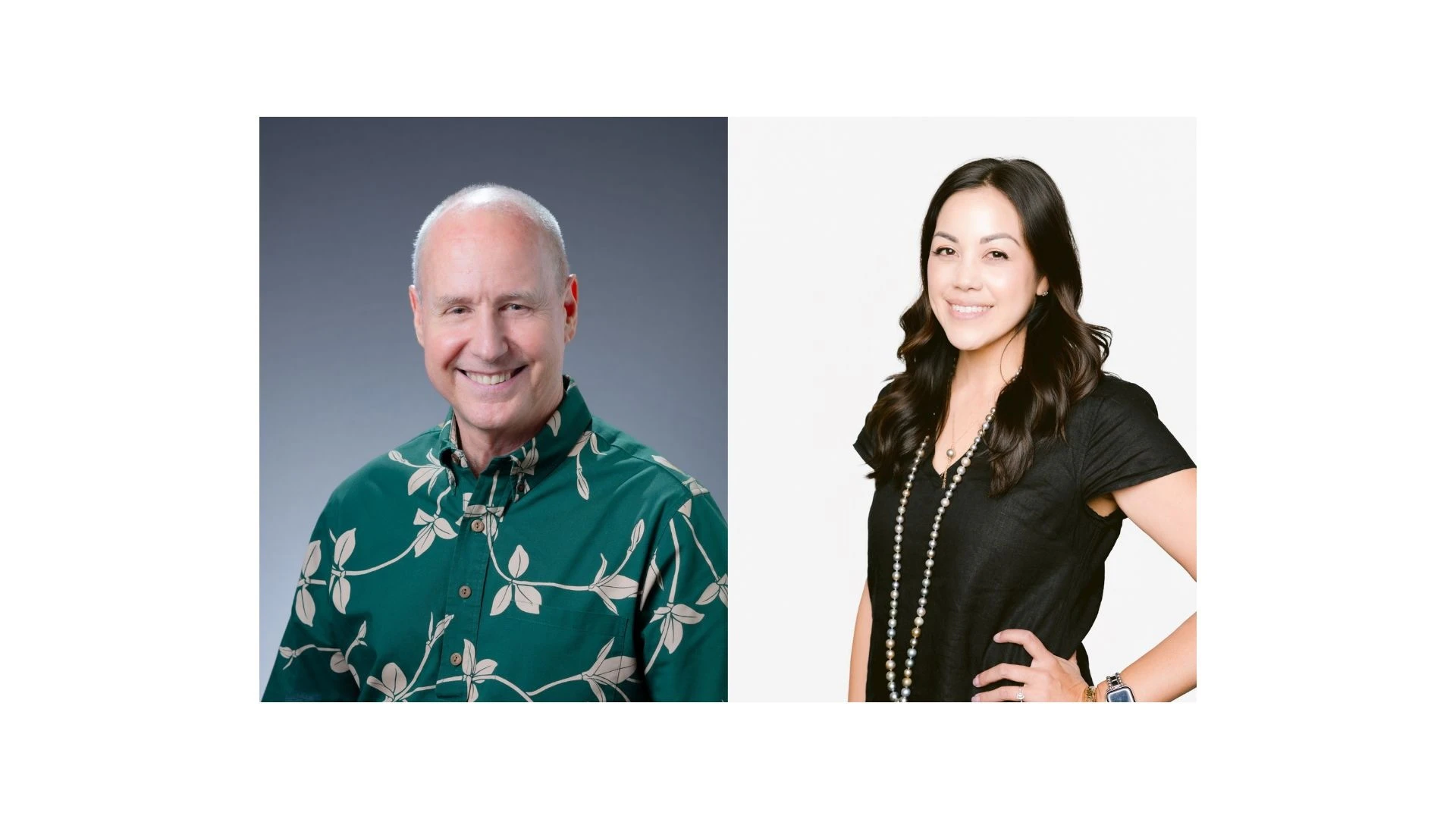
The executive leadership team at Hawai'i Community Foundation has seen some transition over the last year.
HCF’s board of directors appointed Terry George, who previously led the Harold K.L. Castle Foundation for 22 years, as its president and CEO, effective Aug. 1, 2025.
He succeeded Micah Kāne, who went on to become CEO of Parker Ranch Inc., which is based in Waimea on Hawai’i Island. HCF’s Michelle Kaʻuhane was also promoted to chief operating officer and executive vice president last summer.
Shortly after, Keanu Lau Hee, who had served as senior director of HCF's Maui Recovery Effort, was promoted to her current role as vice president of community resilience and strategic implementation.
“We spotted leadership from the minute I met her, and on my first day, I turned to Michelle and said, ‘We gotta give Keanu some more stretch opportunities.’ [She’s] done a marvelous job in [her] new VP level, overseeing not just Maui or Maui recovery, not just our new Stronger Hawaiʻi statewide approach,” George told Aloha State Daily earlier this month. “But also, essentially, helping to pull us together to make sure that we're implementing on our strategic priorities the way we need to across the organization.”
“We hired 13 new people in the year that I’ve been here,” he added.
Launched in March, HCF’s Stronger Hawaiʻi Fund supports “statewide disaster and emergency related preparedness, response, recovery, mitigation and resilience … across all islands, deploying resources to where the need is greatest at the moment it arises.”
In response to this past weekend’s Hurricane Lala — which so far has claimed a life, damaged more than 100 homes, and left thousands without power — the fund has deployed grants totaling $320,000 to nonprofits Vibrant Hawai’i, The Salvation Army Hilo Corps and Hope Services Hawai’i, to be used for financial assistance, food and supplies, water and communication, among other services, the organization announced Monday. Click here to learn more and here to donate.
Since the Maui wildfires three years ago, work toward recovery and rebuilding continue. HCF’s Maui Strong Fund has raised more than $212 million in donations from around the globe and offers grants to local nonprofits addressing housing, health and workforce development, and more. According to Lau Hee, the remaining amount left to deploy is $30 million.
“We don't see it as just a $30 million investment next year but [aim to] understand what some of those longer-term systems are that we need to build to help recovery,” she said.
“Reflecting on three years of what Hawaiʻi Community Foundation has done and [what] the Maui Strong Fund has done, they've really moved with the speed of recovery and the community,” Lau Hee continued. “So, when resources were needed in the aftermath of the wildfire, the foundation deployed funds quickly to trusted organizations to get resources to the community when they needed it most. Whether that was supporting resilience hubs, which you saw stood up all over, or lodging, or rental assistance, or just even direct financial assistance, the organization moved quickly to do that. I think what enabled them to do so was because prior to the disaster, the foundation has been doing work in the Maui community for decades. That allowed the team and the staff to develop the partnerships on the ground, prior to the disaster, in which they could lean on.”
She acknowledged that while some families have rebuilt in Lahaina, others are “struggling” with their next step.
“Where we’re positioned is to continue to listen to what the needs are, to understand what our partners (including government and other philanthropic organizations funding recovery) are doing, and to lean on community leaders to invest in better solutions,” she said.
Lau Hee and George shared more about their current and long-term priorities, both for the organization and Maui recovery efforts, in a recent conversation with ASD.
How is HCF going about funding housing needs on Maui?
Lau Hee: Prior to the disaster, the Hawaiʻi Community Foundation founded the House Maui Initiative, because housing was the biggest challenge. And when the disaster hit, it exacerbated the housing crisis on Maui and continues to be the No. 1 challenge for recovery. The Hawaiʻi Community Foundation to date has invested just over $102 million into both housing programs, as well as [new] builds. … We helped the County of Maui pool together $50 million in road projects for Waiʻale Road Extension in Wailuku and the North-South Collector Road in Kīhei, which will open up more housing opportunities. But because of the mapping and infrastructure work done prior to the disaster, County of Maui used that to apply for the CDBG-DR (Community Development Block Grant Disaster Recovery) funds.
… Last year, we engaged stakeholders, leveraged the data we invested in with (The Maui Wildfire Exposure Study) MauiWES/UHERO (University of Hawai‘i Economic Research Organization) studies to understand where the recovery needs are for community. We did a very large investment into ʻUlu O Lele, a marketplace by Hawaiian Council, to reenergize the historic and commercial district of Lahaina and to build a gathering place for community. [HCF also supported the Lahaina Homecoming event from July 17 to 19.] … Attendees and organizers have described to us that Lahaina feels different now — it feels hopeful, that people are ready to come back to Front Street, their home.
George: This past year has been the time to really lean in on economic recovery, as we've also still focused on housing and mental health issues, supporting those committee organizations that stepped up to do what we call clinical case management, which means meeting people where they are and helping them get to where they need to be.
What are you most proud of delivering to Maui in the last year?
George: I’m proud of the fact that against some people’s wishes, the Hawaiʻi Community Foundation deliberately and intentionally held back a significant amount of the Maui Strong funds. There were some people who would have hoped that all those dollars would have been pushed out in the first weeks and months.
… Disasters reveal inequities; they reveal vulnerabilities; they reveal an incredible amount of community resilience and grit. They also take a long time to recover from. We are not a disaster recovery organization that jumps in when a disaster happens and only works there for the first few months. We are a perpetual resource to make sure that all communities thrive. So, I'm actually proud that because of, first, the outpouring generosity that was unprecedented in our state, to create the Maui Strong Fund with the size that it had, we had the ability, under Keanu, and rest of our team's leadership and our board’s leadership, to hold back dollars for when we knew most of those disaster relief organizations would be gone.
Lau Hee: Because we exercised some of that discipline, we are able to invest in solutions for permanent recovery, like a kauhale project that was a deeply affordable rental facility, as well as an emergency shelter. So, making those investments with the generosity that was entrusted to us allows us to build real lasting recovery for that community.
Why did you start the Stronger Hawaiʻi Fund when you did?
Lau Hee: The objective there is that we need to build a more comprehensive approach to resilience. We’ve often been a funder in the response and recovery phase, but we’ve struggled to be a funder in the blue skies/preparedness phase. Stronger Hawaiʻi really lets us span the spectrum of disaster … and helps us deploy those dollars accordingly. That is in alignment with our four-phase strategy to disaster that we adopted in 2019. This fund allows us greater flexibility to meet the needs of where this disaster is occurring.
George: It was conceived last summer, blessed by the board in the fall, and then we decided to deploy the fund on March 19, right before the worst of the Kona Lows was going to hit. We set a goal of $10 million for that fund; we’re a third of the way there, and we’ve already deployed $1.5 million out the door. … We think it’s not if the next disaster hits, but when. We think we’re going to be able to make a bigger difference.
What are your strategies to sustain funding?
George: We’re much more effective when we work together. For example, we just created a pool fund to support grassroots organizations supporting immigrant communities.
… We’ve proposed longer-term partnerships with several prominent, community-minded corporations within the state, and we’ve seen some creative partnerships begin to develop out of that. We’re working more thoughtfully along the lines of our CHANGE framework to bring those donors into direct conversation with some of our grantees. [With a focus on access to health care, HCF is anticipating conversations with The Queen’s Health System and Waiʻanae Coast Comprehensive Health Center.] Grantees also have opportunities to learn from each other and support one another.
… We restarted The Hawaiʻi Resilience Fund about nine months ago, and it is explicitly aimed at building nonprofit stability to weather all the uncertainties at the federal funding level. It’s also aimed at strengthening the nonprofit infrastructure through HANO, or the Hawaiʻi Alliance of Nonprofit Organizations.
Lau Hee: The Maui Recovery Funders Collaborative has shifted from being funded by HCF to FunderHui. It set up a common application for nonprofits, which made for easier access. For funders, it also allows them to see where funding is needed and who’s funding in which spaces.
How is HCF investing in local workforce?
Lau Hee: Oftentimes, teachers are the stable force and they’re a constant in your child’s life, so HCF is investing in the educator pipeline through the University of Hawaiʻi Maui College. Some of our other work at the college include building the pipeline of construction and health care workers. … The Ho'omau Fire Academy provides exposure to what public safety careers look like but also builds leadership skills.
What is next for HCF?
George: Our vision is an equitable future for Hawaʻi where all communities thrive. … We are going to double down on the CHANGE framework that aligns our work to six key areas that are necessary for communities to thrive.
… I would say another theme is, really, the building of the Hawaiʻi Community Foundation. We truly believe that the genius does lie in communities, and when they are able to lead and able to partner effectively with government and with philanthropy, and where businesses within those communities are also able to thrive and grow jobs, we're gonna be OK. And building those partnerships and working through challenges is difficult because the civic muscle to stop something or blame somebody for something is in abundant supply around not just Hawaiʻi, but the world. But the civic muscle, as all our grantees are showing, in Maui and elsewhere, to roll up your sleeves, innovate, build consensus, and make a deep and lasting difference for a community. That's what we most want to invest in. That takes partnerships, it takes trust, it takes focus on big goals and sticking with it. And it takes all of us to do that together.
… We’ve been good stewards of the endowed dollars we manage, with returns above our benchmark of about 17% over that one-year period. We overhauled our scholarship program; paid out over $5.3 million in scholarships, and are working toward building [other] scholarship products. We made grants totaling $100.8 million over the last 12 months, and we’ve raised $96.2 million (that’s actually higher because we don’t have final numbers yet). We doubled our social impact investment cap to $20 million, which is a way we can use tools other than grants. These are 0 to super low interest loans, and occasionally equity investments for charitable purposes.
What have you been learning lately as leaders?
Lau Hee: Patience. Discipline. Investing intentionally to my time, energy, my capacity to support the relationships we’ve built over the years. … Listening more, continuing to grow from these lessons, and sharing [them].
George: You thrive when you know what your purpose is. And we’ve been having some deep, wonderful conversations about our purpose and the reason we exist. The second thing is that leadership is very much a team sport, so creating safe spaces for everyone to observe their leadership and step out of their comfort zones, that’s when you can wait for the magic to happen.
More information about HCF can be found online at hawaiicommunityfoundation.org or on its social media: Facebook, Instagram, LinkedIn and YouTube.
Kelsey Kukaua Medeiros can be reached at kelsey@alohastatedaily.com.
For the latest news of Hawai‘i, sign up here for our free Daily Edition newsletter.


