
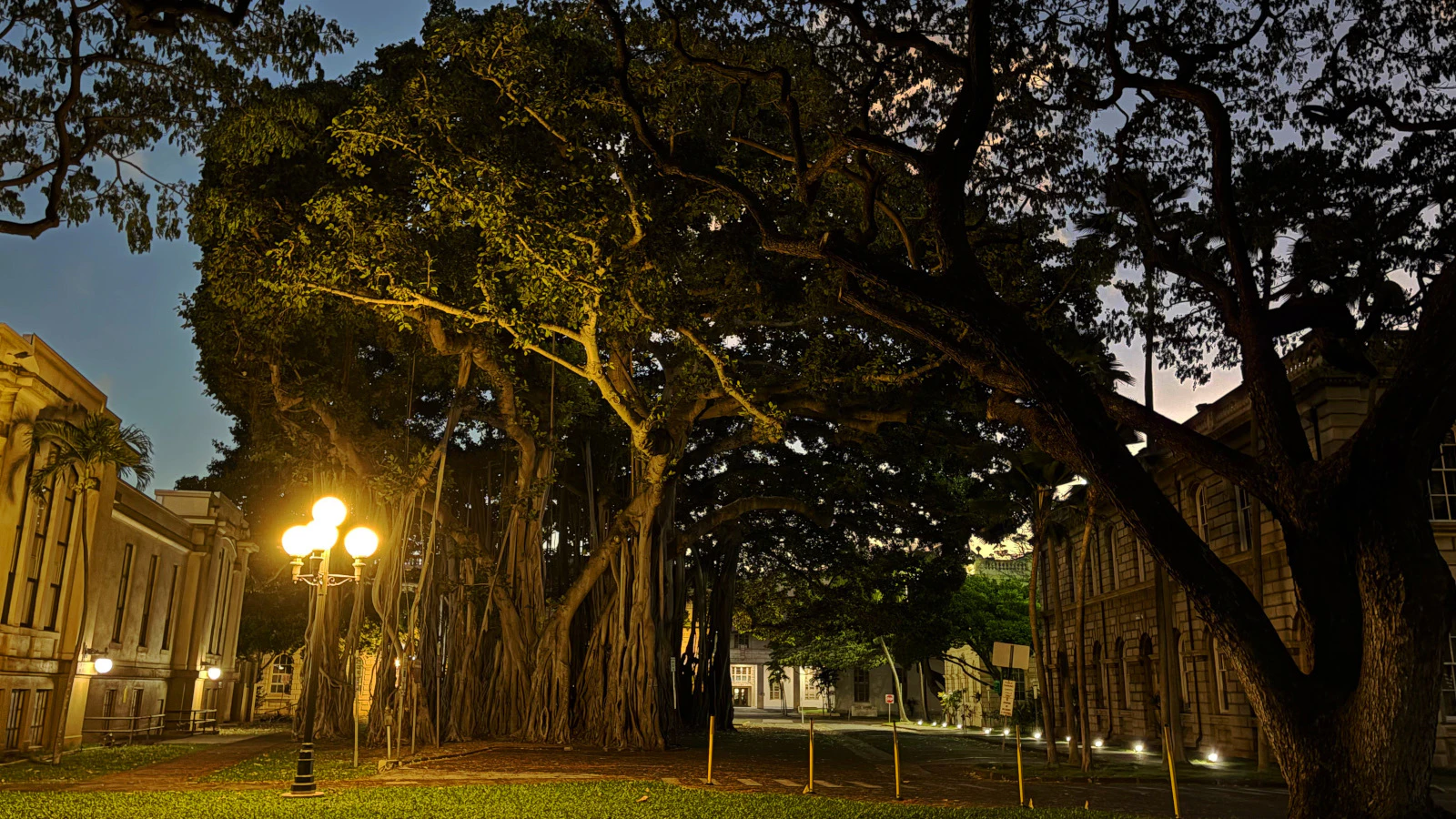
Banyan trees are a wonder of nature, where myths, legends, and ancient knowledge intertwine like the roots that hang from their branches.
In Buddhism, the banyan tree symbolizes enlightenment. In Hinduism, it is associated with the gods. And Asian folklore connects the banyan to spirits and magic. If the main trunk of a banyan is damaged or destroyed, it can continue to grow through its numerous roots, making it a symbol of eternal life and rebirth.
The Indian banyan (Ficus benghalensis) is the national tree of India, and represents longevity, strength, resilience, and the enduring bonds of community. A 700-year-old tree in Munger, Bihar, India is considered the oldest banyan in the world, with radiocarbon dating of its wood samples confirming it has been standing since the 1300s.
In Chinese culture, banyan trees are notable for their excellent feng shui and symbolize longevity and perseverance. They are also home to earth gods that protect their villages. In Hainan, China’s smallest and southernmost province, the banyan tree is regarded as a spirit tree that can ward off evil spirits and communicate with God. Shrines are often built at the base of these trees, and in many cases, people worship the trees themselves.
Throughout the Philippines, banyan trees are often believed to be home to engkantos, environmental spirits, as well as frightening beings like the Tikbalang and Kapre. Stories of encounters with these spirits have led many people to show respect when passing them and to leave the trees untouched, never cutting them down. Offerings were once made to appease the spirits they thought dwelled within the trees.
Across Asia, many people believe that spirits, ghosts, and deities inhabit banyan trees. The folklore in many of these cultures warns against sleeping or lingering beneath them, especially after dark, for fear of disturbing restless spirits or malicious entities.
While it’s quite common to see massive banyans in Hawai‘i, many don’t realize that these trees are not native to these islands. Archibald Cleghorn, Princess Ka‘iulani’s father, planted the first banyan tree in Hawai‘i around 1870, at ‘Ainahau, their family estate in Waikīkī. In April 1873, missionaries from India gifted a banyan to Maui Sheriff William Owen Smith, who planted it in Lāhainā to commemorate the 50th anniversary of the first Protestant mission to Lāhainā.
The original banyan at ‘Ainahau is no longer there, which makes the one in Lāhainā one of the oldest banyans in the U.S. Although it was significantly damaged during the great fire in 2023, the Lāhainā banyan stands today as a cultural and historical landmark and represents the enduring spirit of Lāhainā and the people of Maui.
For more than 150 years, banyans have been planted all across our islands. The giant trees provide comforting shade beneath their sprawling canopies, while aerial prop roots that grow down from their branches offer endless fun for children.
The two banyan trees adjacent to Ali‘iolani Hale in Downtown Honolulu are estimated to have been planted between 1882 and 1887. There is no record as to who planted them, but they are listed in Honolulu’s Register of Exceptional Trees and are protected under that status.
The trees are home to birds, including the indigenous manu o kū (white tern or fairy tern), the occasional four-legged pest, and perhaps something more.
Rumors of hauntings and lingering spirits within the confines of the banyans have been around for years. One night, I came across a sheriff rushing past the trees on his way to his car. I offered a greeting, and he stopped to look at me.
“You’re that ghost guy, yeah?” He pointed.
When I confirmed I was who he thought I was, he decided to share his story.
The sheriff said that the night before, he parked his car under the banyans because he had to visit the Kekuanaoa Building next door to check on some electricians working in the basement. When he was finished, he got back in his car, buckled his seatbelt, and then turned on his a/c. He paused to type a note into his phone and said he felt two hands come up from behind, grab his duty belt, and readjust it as he sat there. Barely a second later, he felt fingertips run through his hair, and he heard a voice call him by his name.
The man jumped out of his car, hand on his sidearm, ready to confront whoever was hiding in his vehicle. But no one was there.
Looking around, heart pounding and completely puzzled, something in the canopy above him caught his attention. The sheriff looked up and saw a thin, black figure walking from branch to branch. It stopped just above him and leaned down, as if to get a better look.
He said that while he knew the banyans near the Supreme Court Building are from India, the feeling he got from them was similar to what he encountered in the Philippines, where deceased relatives were presented to the banyan, or balete, as offerings for the ancestors, the spirits, and the gods.
“I park in the main lot now,” the sheriff said. “If those guys need something, they can text.”
The authors can be reached at hawaii.mysteries@gmail.com
For the latest news of Hawai‘i, sign up here for our free Daily Edition newsletter.


