Is Honolulu Councilman Tommy Waters eligible for re-election? We'll know by the end of the week.
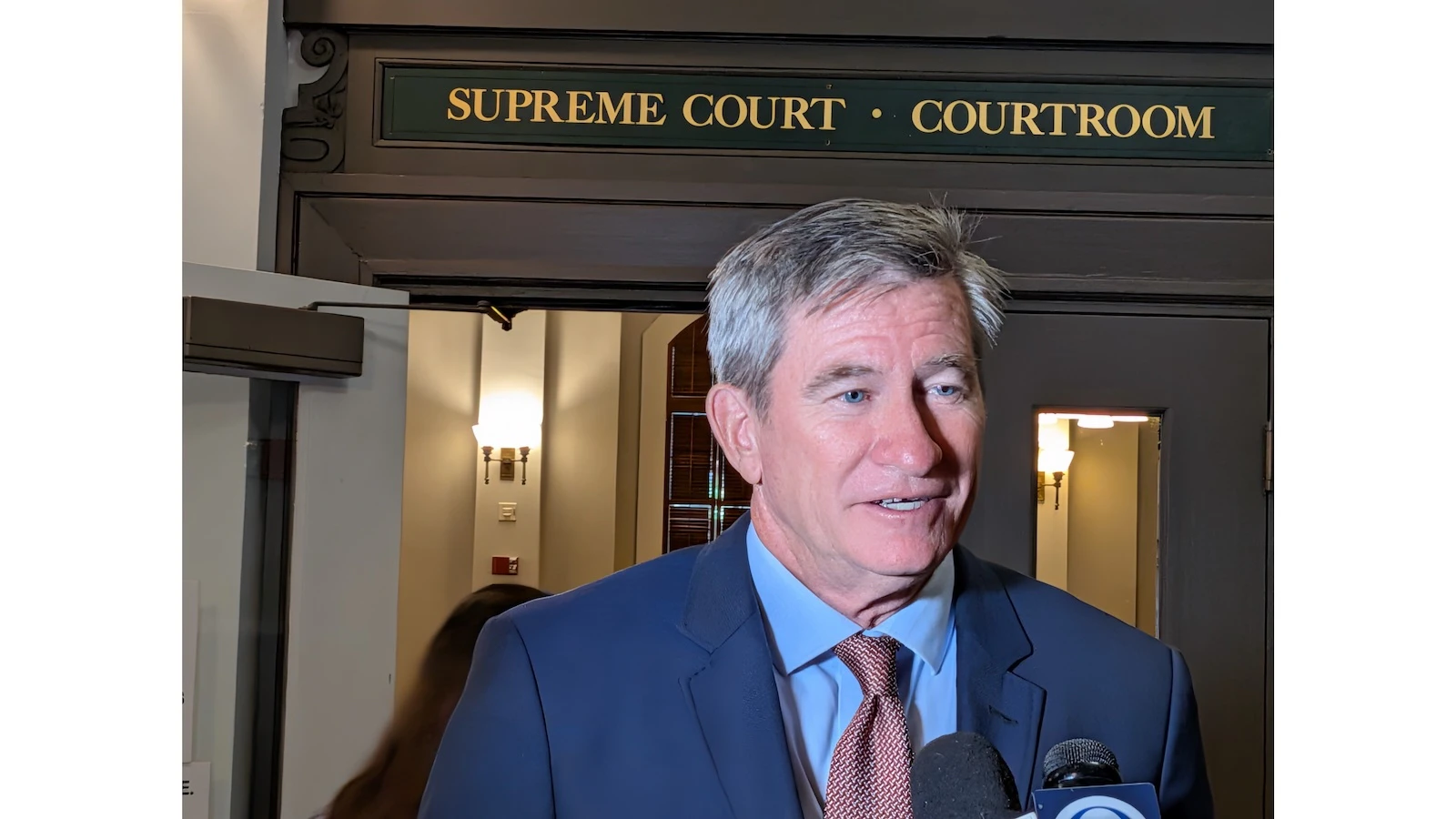
Waters and competing candidate Trevor Ozawa appeared before the Hawai‘i Supreme Court Tuesday to argue whether Waters is eligible to be elected for another term this year.
Waters and Ozawa both ran to represent Council District 4, including Hawai‘i Kai, Kaimukī and Waikīkī, for a term extending from 2027 to 2031.
But Waters has already served on the council for nearly eight consecutive years — he joined the council in 2019, and was elected again in 2022 — and the Honolulu City Charter limits council members to serve for only two consecutive four-year terms. Ozawa filed a lawsuit against Waters in June, requesting that the First Circuit Court declare the incumbent Waters ineligible to run.
That case, after appeals, reached the state’s highest court Tuesday, where attorneys for Waters and Ozawa attempted to answer: what actually is a council term?
Waters: It’s only a full council term if you serve all four years
As the City Charter requires that “no person shall be elected to the office of councilmember for more than two consecutive four-year terms,” the arguments of Waters’ legal team revolved around the special circumstances of Waters’ first election in 2019.
Waters ran for the District 4 seat in 2018, against then-incumbent Ozawa. But that election was extremely close: Ozawa seemed to defeat Waters by only 22 votes and, because of confusion involving late-counted absentee ballots, the Hawai‘i Supreme Court invalidated the results of that election, leading to a special remedial election in 2019, which Waters won.
But because Waters was not sworn in on Jan. 2, 2019 — the start of the term — his attorneys contended that he did not serve a “four-year term” as defined by the charter. Therefore, he has only served a single full term, and can run for another consecutive one.
“The basic point to make is that a four-year term means just that: it’s four years. You can’t start midway into a term of four years,” said Joseph Stewart, one of Waters’ attorneys. “In this case, the election issue occurred in April of 2019, when the four-year term was supposed to start on Jan. 2 of 2019. That’s not a four-year term. That’s something less than a four-year term.”
Associate Justice Lisa Ginoza countered that the charter does not determine eligibility by the length of a council member’s service, but simply by whether they were elected to a four-year term.
Nonetheless, Stewart said, the 2018 election was invalidated by the Supreme Court, which technically created a vacancy on the council — which was temporarily filled by former county Managing Director Mike Formby — and triggered a new, separate election.
“The fact that there’s a regular term that starts on Jan. 2 … contemplates that there is also an irregular term, something that doesn’t start on Jan. 2,” Stewart said.
Ozawa: A term is a term, regardless of whether you're in the seat
On the other side of the argument, Ozawa’s attorney Deirdre Marie-Iha argued that the charter establishes a “bright line rule,” which she said is unambiguous.
“If you are elected to a four-year term, then the whole term counts against you,” Marie-Iha said. “A term is a set period of time. And standing here today, I can tell you the exact start dates of every city council election for the next 100 years. If they don’t change the law, those terms do not move.”
Marie-Iha opined that it would be “unsound” to allow the results of an election — in this case, the 2019 special election — to determine the term that the election was called to fulfill. She added that the 2019 election existed to “finish the job” that the 2018 election failed to do; had the votes been tallied properly in 2018, there would be no question that the winner would serve from 2019 to 2023.
“The term doesn’t move, and the term started without him,” Marie-Iha said.
Associate Justice Lisa Ginoza challenged Marie-Iha, noting that other state supreme courts have ruled that, in cases where a candidate’s eligibility is ambiguous, then it is better to allow the candidate to run in order to preserve the rights of voters and candidates alike.
In particular, Waters’ attorney Thomas Otake noted that some 8,600 voters who cast ballots for Waters would have their votes invalidated if the court ruled Waters ineligible.
But Marie-Iha said the matter is not ambiguous, and that one way or another, the court can definitively state who is eligible to run, and can do so very soon.
What’s next
The Supreme Court’s verdict will ultimately determine which two candidates will appear on the ballot in the general election; as none of the four candidates in the primary election received more than 50% of the votes, those with the two highest vote counts will duel in the general.
If the court rules in Waters’ favor, the general election will be between Ozawa — who received 12,279 votes in the primary, according to the state’s final voter numbers — and Waters, who received 8,678 votes.
If the court rules in Ozawa’s favor, the election will be between Ozawa and the third-place candidate Tara Malia Gregory, who received 4,225 votes.
Ginoza said the court will deliver a verdict in the case by Friday, before general election ballots are mailed.
For the latest news of Hawai‘i, sign up here for our free Daily Edition newsletter.