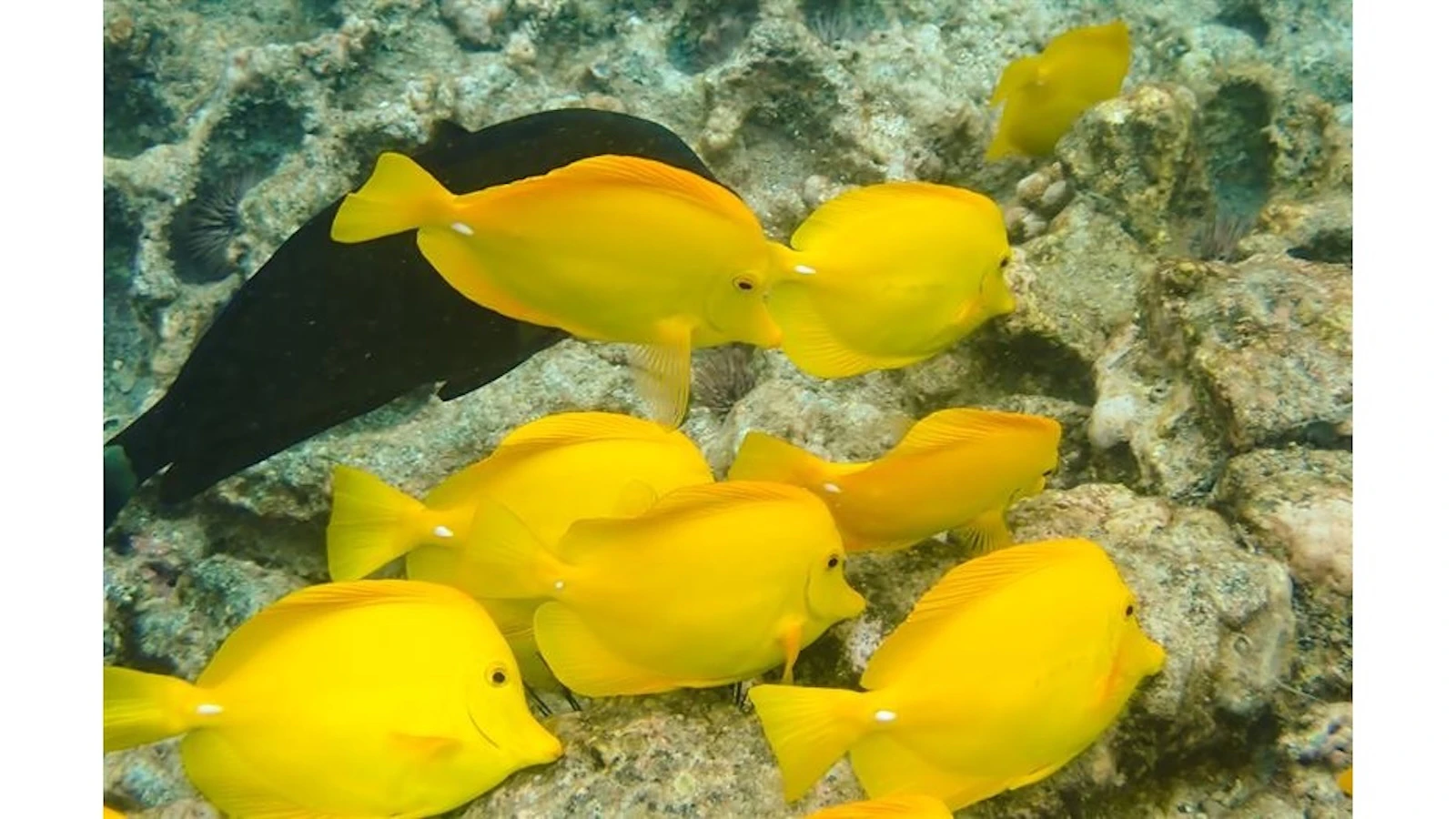
Commercial aquarium fishing in Hawai‘i is dead again, perhaps forever, after a heated Board of Land and Natural Resources meeting Friday.
The board on Friday discussed a series of proposed new rules for aquarium fishing in West Hawai‘i — an industry that has been effectively banned statewide since 2021 — and contemplated a choice. The board could have adopted the new rules, reinstating the industry alongside new regulations, or it could have rejected them and ordered the Department of Land and Natural Resources to draft different rules that could instead formalize the statewide ban.
After impassioned public testimony extended the meeting to more than 10 hours long, the board chose the latter.
The final motion — for which four of five board members voted, with the fifth, Kaiwi Yoon, abstaining — was for DLNR’s Division of Aquatic Resources to further review and revise the rules, and to “consider the alternatives under the public trust and cultural landscape analysis” before returning to the board.
While that motion does not explicitly direct DAR to formalize a ban on commercial aquarium fishing, it does align with a previous 2023 decision by the BLNR, when the board voted unanimously to begin a rulemaking process to establish a statewide ban on the industry.
That decision became stalled by legal disputes that only were resolved earlier this year; in the interim, DAR began developing the proposed rules to reopen the industry, which the board rejected on Friday.
Dozens of environmental advocates and Hawai‘i residents urged the board on Friday to reject those rules.
“These fish are a public resource and a cultural one,” said one testifier, Robert Phares. “While they remain on our reefs, they support the ecosystem, recreation, cultural uses, snorkeling and diving, and a visitor economy in which experiencing Hawai‘i's ocean life is a major attraction. Once a fish is commercially removed, that continuing public value becomes a one-time private transaction. The trade-off should require an extremely compelling public benefit, and I don’t see one here.”
While some testified in favor of DAR’s proposed rules — one fisherman, Jay Lovell, noted that “90% of those fish [that we catch]” would otherwise be killed through natural predation — they were few and far between, and one drew an admonition from Yoon.
Ron Tubbs, an advocate for commercial fishing, called the opposition “a bunch of anti-ecology BS,” arguing that marine fish are “the most renewable source on the planet.” But Yoon responded to Tubbs’ testimony, asking him to clarify if he believes the state’s cultural and environmental assessments are “BS.”
“The science that opposes you is ‘BS,’ is that correct?” Yoon responded, before Tubbs and Yoon began a back-and-forth over whether certain groups were being paid to publicly oppose commercial fishing.
Ultimately, Yoon said he abstained “out of good faith” for the pro-fishing contingent, “even though the numbers are overwhelmingly against you.”
Environmental group Earthjustice — which was involved in the legal debates surrounding the BLNR’s 2023 decision — declared the board’s decision a “victory,” with Earthjustice attorney Mahesh Cleveland saying the decision “recognizes the will of the people.”
“Again and again, communities have turned out at public meetings to oppose this trade,” Cleveland said. “We hope the Department will return with rules that protect Hawai‘i’s reefs and marine life from the harms of an extractive, profit-driven industry.”
For the latest news of Hawai‘i, sign up here for our free Daily Edition newsletter.